Senate adopts committee amendment but declines to advance College Promise bill amid budget concerns
January 23, 2026 | 2026 Legislature NE, Nebraska
This article was created by AI summarizing key points discussed. AI makes mistakes, so for full details and context, please refer to the video of the full meeting. Please report any errors so we can fix them. Report an error »
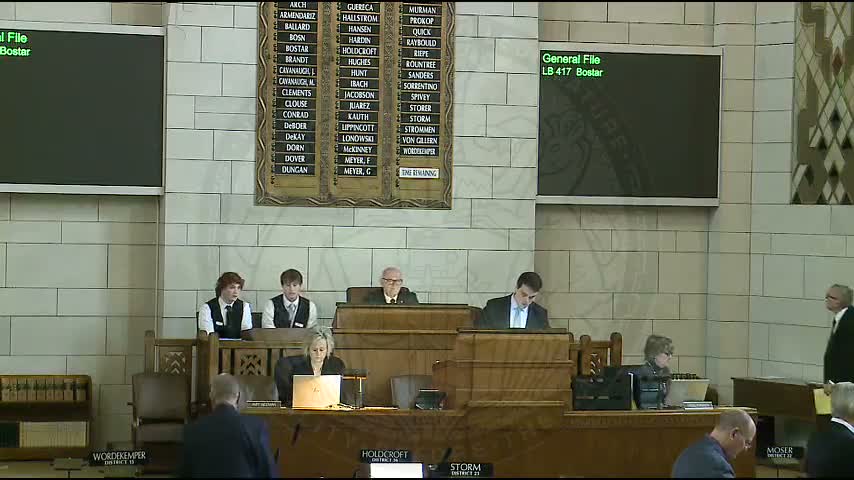
Lincoln, Neb. — The Nebraska Legislature on Wednesday adopted a committee amendment to LB417 but rejected the bill’s advancement after a floor debate over funding and state priorities.
LB417, introduced by Sen. Bostar, would codify the University of Nebraska’s Nebraska Promise program and create a College Promise Act to extend tuition remission to eligible residents at the University, state colleges and community colleges. Under the bill as presented, students from families with annual incomes under $65,000 could receive tuition waivers for up to four years at state colleges and two years at community colleges, once federal and state aid is applied. The bill sets a 2.5 GPA minimum and requires the Coordinating Commission for Postsecondary Education to certify waived tuition totals so the State Treasurer can reimburse institutions from a College Promise Fund.
“LB417 codifies Nebraska promise program established by the Board of Regents, which provides tuition remission for eligible Nebraska residents students attending the University of Nebraska,” Sen. Bostar said in opening remarks. He urged colleagues to advance the bill to select so the Legislature could identify a funding source.
Supporters argued the program would expand affordable pathways beyond four‑year campuses and boost workforce development. “This credential signals to employers that a student possesses essential workforce skills and enhances employability in high demand industries,” Bostar said.
Opponents focused on the bill’s fiscal note and on the risk of creating a new, statutorily required spending program during a budget deficit. "Codifying it into statute would remove NU oversight and flexibility, transferring control to the legislature without a dedicated funding mechanism," Sen. Ihbaw said, citing a January 13 fiscal note and an estimated $21 million exposure to the University system.
The Senate first voted to adopt the committee amendment AM07:48, which adds a contingency allowing the Board of Regents to pause Nebraska Promise in an academic year if federal Pell grants were unavailable; the amendment passed, Clerk recorded 25 ayes and 19 nays. After further debate, the body voted on advancement of the bill to select file; the Clerk recorded 18 ayes and 25 nays, and LB417 did not advance.
Clerks also placed the house under call during the advancement vote to secure attendance. The record shows several named no votes during the roll call but does not provide a full roll‑call list in the transcript.
Next steps: Sponsors said they intend to revisit funding options and possibly return the bill to the floor if a viable appropriation or offset can be identified. The committee amendment remains adopted on the bill’s text should it reappear.
— Reporting from the floor of the Nebraska Legislature.
LB417, introduced by Sen. Bostar, would codify the University of Nebraska’s Nebraska Promise program and create a College Promise Act to extend tuition remission to eligible residents at the University, state colleges and community colleges. Under the bill as presented, students from families with annual incomes under $65,000 could receive tuition waivers for up to four years at state colleges and two years at community colleges, once federal and state aid is applied. The bill sets a 2.5 GPA minimum and requires the Coordinating Commission for Postsecondary Education to certify waived tuition totals so the State Treasurer can reimburse institutions from a College Promise Fund.
“LB417 codifies Nebraska promise program established by the Board of Regents, which provides tuition remission for eligible Nebraska residents students attending the University of Nebraska,” Sen. Bostar said in opening remarks. He urged colleagues to advance the bill to select so the Legislature could identify a funding source.
Supporters argued the program would expand affordable pathways beyond four‑year campuses and boost workforce development. “This credential signals to employers that a student possesses essential workforce skills and enhances employability in high demand industries,” Bostar said.
Opponents focused on the bill’s fiscal note and on the risk of creating a new, statutorily required spending program during a budget deficit. "Codifying it into statute would remove NU oversight and flexibility, transferring control to the legislature without a dedicated funding mechanism," Sen. Ihbaw said, citing a January 13 fiscal note and an estimated $21 million exposure to the University system.
The Senate first voted to adopt the committee amendment AM07:48, which adds a contingency allowing the Board of Regents to pause Nebraska Promise in an academic year if federal Pell grants were unavailable; the amendment passed, Clerk recorded 25 ayes and 19 nays. After further debate, the body voted on advancement of the bill to select file; the Clerk recorded 18 ayes and 25 nays, and LB417 did not advance.
Clerks also placed the house under call during the advancement vote to secure attendance. The record shows several named no votes during the roll call but does not provide a full roll‑call list in the transcript.
Next steps: Sponsors said they intend to revisit funding options and possibly return the bill to the floor if a viable appropriation or offset can be identified. The committee amendment remains adopted on the bill’s text should it reappear.
— Reporting from the floor of the Nebraska Legislature.
View the Full Meeting & All Its Details
This article offers just a summary. Unlock complete video, transcripts, and insights as a Founder Member.
✓
Watch full, unedited meeting videos
✓
Search every word spoken in unlimited transcripts
✓
AI summaries & real-time alerts (all government levels)
✓
Permanent access to expanding government content
30-day money-back guarantee
