Vigo County Schools told state policy shifts, lost textbook grant and tax changes will squeeze district budgets
January 30, 2026 | Vigo County, Indiana
This article was created by AI summarizing key points discussed. AI makes mistakes, so for full details and context, please refer to the video of the full meeting. Please report any errors so we can fix them. Report an error »
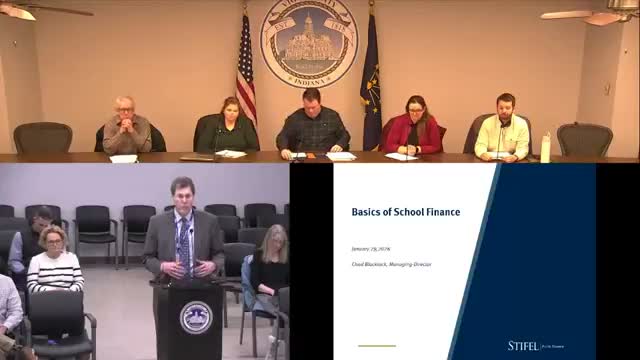
Vigo County Schools officials were briefed on a suite of state policy changes and financial pressures that presenters said will shrink local school revenue and increase pressure on operating budgets.
Chad Blacklock, a public‑finance banker with Stifel, told the board the district’s two main revenue streams — state tuition support and property tax — face growing constraints from enrollment declines and recent legislation. “Every kid in the state of Indiana that attended a public school, they were worth $5,995” in FY22, Blacklock said, summarizing how per‑pupil foundation funding has changed over recent years and the mechanics of the state Tuition Support Formula.
Blacklock and Superintendent Dr. Himsell identified several changes that together reduce district flexibility. A temporary textbook grant that provided about $155 per student in 2023–24 was removed in 2025, leaving districts to pay those costs from education‑fund dollars, a shift Blacklock said “was gone” in the new budget. The presenters showed projected per‑pupil amounts of roughly $6,967 in fiscal 2026 and $7,071 in fiscal 2027, and warned district enrollment declines can offset those percentage increases.
On the property‑tax side, Blacklock described the operations fund, the debt fund and the operating‑referendum fund and explained statutory caps on how much property‑tax revenue districts may collect. He said legislators capped the Max Levy Growth Quotient at 4% for 2024–26, limiting how much districts could raise the operations levy and costing some districts “millions” compared with the uncapped calculation.
Blacklock summarized Senate Enrolled Act 1 and its key mechanics: he said the law lowers the debt‑service tax‑rate threshold that triggers a required public referendum on new debt from $0.80 to $0.70 (per the transcript discussion), phases in larger deductions over six years that will lower net assessed values (taxable values) for homeowners and other property types, and creates a homestead credit equal to the lesser of 10% of a homeowner’s final tax liability or $300 beginning in 2026. “That credit is a dollar‑for‑dollar minus off of the net liability,” he said, noting the change will reduce revenue for all taxing units, including the school district.
District staff described local practices used to manage reduced property‑tax receipts, including using short‑term rolling general‑obligation bonds for capital needs such as roofing, paving and HVAC work. Dr. Himsell emphasized transparency in the district’s rainy‑day fund: when money would be spent from reserves, “we want to have a special line item in the board meeting so that the community can see that we’re doing it and the board take action on it,” he said.
Board members asked whether the 15% cap on transfers from the education fund to the operations fund covers costs shifted by the 2019 fund structure changes; Blacklock said transfers rarely cover all those costs now and that many districts are retaining more state tuition support in the education fund to protect instructional budgets. On whether the state will replace the revenue lost to SEA 1, Blacklock said he did not see any new statewide revenue source and predicted districts will either reduce services or run more referendums.
What happens next: presenters said they will prepare a follow‑up presentation for the board with additional analysis and options. The meeting record shows the staff will return Monday with more detail on the six options previously discussed.
Reporting note: direct quotes and attributions are drawn from the meeting transcript; numeric figures (per‑student amounts, grant values, levy caps, credit amounts) were stated by presenters during the briefing. The district did not adopt any formal policy or vote during this presentation; the session was informational and followed by questions and answers.
Chad Blacklock, a public‑finance banker with Stifel, told the board the district’s two main revenue streams — state tuition support and property tax — face growing constraints from enrollment declines and recent legislation. “Every kid in the state of Indiana that attended a public school, they were worth $5,995” in FY22, Blacklock said, summarizing how per‑pupil foundation funding has changed over recent years and the mechanics of the state Tuition Support Formula.
Blacklock and Superintendent Dr. Himsell identified several changes that together reduce district flexibility. A temporary textbook grant that provided about $155 per student in 2023–24 was removed in 2025, leaving districts to pay those costs from education‑fund dollars, a shift Blacklock said “was gone” in the new budget. The presenters showed projected per‑pupil amounts of roughly $6,967 in fiscal 2026 and $7,071 in fiscal 2027, and warned district enrollment declines can offset those percentage increases.
On the property‑tax side, Blacklock described the operations fund, the debt fund and the operating‑referendum fund and explained statutory caps on how much property‑tax revenue districts may collect. He said legislators capped the Max Levy Growth Quotient at 4% for 2024–26, limiting how much districts could raise the operations levy and costing some districts “millions” compared with the uncapped calculation.
Blacklock summarized Senate Enrolled Act 1 and its key mechanics: he said the law lowers the debt‑service tax‑rate threshold that triggers a required public referendum on new debt from $0.80 to $0.70 (per the transcript discussion), phases in larger deductions over six years that will lower net assessed values (taxable values) for homeowners and other property types, and creates a homestead credit equal to the lesser of 10% of a homeowner’s final tax liability or $300 beginning in 2026. “That credit is a dollar‑for‑dollar minus off of the net liability,” he said, noting the change will reduce revenue for all taxing units, including the school district.
District staff described local practices used to manage reduced property‑tax receipts, including using short‑term rolling general‑obligation bonds for capital needs such as roofing, paving and HVAC work. Dr. Himsell emphasized transparency in the district’s rainy‑day fund: when money would be spent from reserves, “we want to have a special line item in the board meeting so that the community can see that we’re doing it and the board take action on it,” he said.
Board members asked whether the 15% cap on transfers from the education fund to the operations fund covers costs shifted by the 2019 fund structure changes; Blacklock said transfers rarely cover all those costs now and that many districts are retaining more state tuition support in the education fund to protect instructional budgets. On whether the state will replace the revenue lost to SEA 1, Blacklock said he did not see any new statewide revenue source and predicted districts will either reduce services or run more referendums.
What happens next: presenters said they will prepare a follow‑up presentation for the board with additional analysis and options. The meeting record shows the staff will return Monday with more detail on the six options previously discussed.
Reporting note: direct quotes and attributions are drawn from the meeting transcript; numeric figures (per‑student amounts, grant values, levy caps, credit amounts) were stated by presenters during the briefing. The district did not adopt any formal policy or vote during this presentation; the session was informational and followed by questions and answers.
Don't Miss a Word: See the Full Meeting!
Go beyond summaries. Unlock every video, transcript, and key insight with a Founder Membership.
✓
Get instant access to full meeting videos
✓
Search and clip any phrase from complete transcripts
✓
Receive AI-powered summaries & custom alerts
✓
Enjoy lifetime, unrestricted access to government data
30-day money-back guarantee
