NIST releases DART MS Data Interpretation Tool and updated Dragonfly spectra library
January 30, 2026 | Office of Justice Programs, Department of Justice (DOJ), Executive, Federal
This article was created by AI summarizing key points discussed. AI makes mistakes, so for full details and context, please refer to the video of the full meeting. Please report any errors so we can fix them. Report an error »
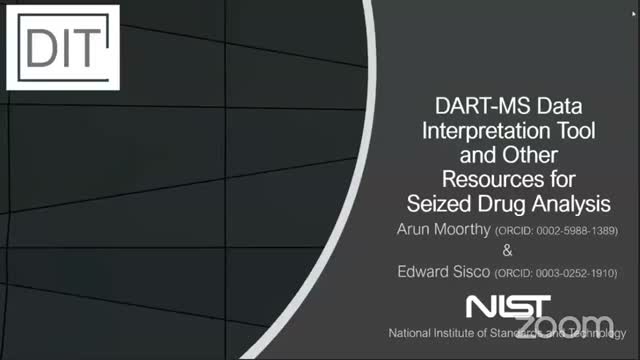
The National Institute of Standards and Technology (NIST) on a recent webinar demonstrated a new DART mass spectrometry Data Interpretation Tool (DIT) for pre‑screening seized-drug mixtures and announced an updated DART mass spectra library now at roughly 895 compounds.
Ed Sisco, a research chemist at NIST, said the DIT packages the team’s Inverted Library Search Algorithm (ILSA) into a user-facing application that runs in a web browser and can be installed for standalone (offline) use. "A portion of this work was funded by an NIJ award," Sisco said during the presentation, describing the project’s funding and collaborative approach.
The tool is designed for ambient ionization mass spectrometry—particularly DART (Direct Analysis in Real Time)—which produces spectra of mixtures without chromatographic separation. Arun Murthy, a NIST scientist involved in library and algorithm development, described ILSA as a three‑step method that first identifies candidate targets from a low‑fragmentation spectrum, matches those masses to library entries within a tolerance, and then scores potential matches using metrics that include the fraction of peak intensity explained and a reverse match factor. "We’ve been able to release an updated DART mass spec database of forensic compounds currently at 895 compounds, and it’s growing pretty regularly," Murthy said.
DIT’s interface allows users to upload low-, mid- and high‑fragmentation spectra, adjust an identification‑threshold slider and set m/z tolerance, and run searches against selectable reference libraries (the webinar highlighted the Dragonfly update). Search results show candidate identifications with scoring metrics; the application produces printable/PDF reports that include metadata fields such as instrument ID, case number and operator comments.
NIST described curation and contribution procedures for the library: external laboratories may submit spectra but NIST will evaluate submissions for collection parameter consistency and quality before inclusion; contributors may be credited or remain anonymous. Sisco identified current contributors in the library as including the Virginia Department of Forensic Science, U.S. Customs and Border Protection labs and the Maryland State Police.
Presenters emphasized that DIT is vendor‑agnostic and supports multiple file formats, with converters for specific vendor exports (for example, Waters QDA exports) to parse fragmentation spectra for searching. NIST also released a validation and implementation package—containing standard operating procedures, validation plans and maintenance plans—developed in collaboration with the Maryland State Police to help laboratories adopt DART‑based workflows.
Planned features include building a negative‑mode library to capture compounds more responsive in negative ionization, a database‑builder tool to let users create and evaluate their own libraries, batch processing and data‑mining capabilities, and hybrid‑search or similarity‑mapping functions adapted from electron‑ionization mass spectrometry to help identify compounds not yet in the library.
On legal admissibility, presenters said DART mass spectrometry has been defended in court in multiple states but did not claim a universal status of 'general acceptance.' The team also discussed plans for inter‑laboratory studies and round‑robin testing to evaluate reproducibility across instruments and laboratories.
The webinar concluded with contact information and links to the DIT landing page; presenters invited laboratories and researchers to contribute spectra, participate in beta testing and training, and to use provided validation materials to accelerate implementation.
Ed Sisco, a research chemist at NIST, said the DIT packages the team’s Inverted Library Search Algorithm (ILSA) into a user-facing application that runs in a web browser and can be installed for standalone (offline) use. "A portion of this work was funded by an NIJ award," Sisco said during the presentation, describing the project’s funding and collaborative approach.
The tool is designed for ambient ionization mass spectrometry—particularly DART (Direct Analysis in Real Time)—which produces spectra of mixtures without chromatographic separation. Arun Murthy, a NIST scientist involved in library and algorithm development, described ILSA as a three‑step method that first identifies candidate targets from a low‑fragmentation spectrum, matches those masses to library entries within a tolerance, and then scores potential matches using metrics that include the fraction of peak intensity explained and a reverse match factor. "We’ve been able to release an updated DART mass spec database of forensic compounds currently at 895 compounds, and it’s growing pretty regularly," Murthy said.
DIT’s interface allows users to upload low-, mid- and high‑fragmentation spectra, adjust an identification‑threshold slider and set m/z tolerance, and run searches against selectable reference libraries (the webinar highlighted the Dragonfly update). Search results show candidate identifications with scoring metrics; the application produces printable/PDF reports that include metadata fields such as instrument ID, case number and operator comments.
NIST described curation and contribution procedures for the library: external laboratories may submit spectra but NIST will evaluate submissions for collection parameter consistency and quality before inclusion; contributors may be credited or remain anonymous. Sisco identified current contributors in the library as including the Virginia Department of Forensic Science, U.S. Customs and Border Protection labs and the Maryland State Police.
Presenters emphasized that DIT is vendor‑agnostic and supports multiple file formats, with converters for specific vendor exports (for example, Waters QDA exports) to parse fragmentation spectra for searching. NIST also released a validation and implementation package—containing standard operating procedures, validation plans and maintenance plans—developed in collaboration with the Maryland State Police to help laboratories adopt DART‑based workflows.
Planned features include building a negative‑mode library to capture compounds more responsive in negative ionization, a database‑builder tool to let users create and evaluate their own libraries, batch processing and data‑mining capabilities, and hybrid‑search or similarity‑mapping functions adapted from electron‑ionization mass spectrometry to help identify compounds not yet in the library.
On legal admissibility, presenters said DART mass spectrometry has been defended in court in multiple states but did not claim a universal status of 'general acceptance.' The team also discussed plans for inter‑laboratory studies and round‑robin testing to evaluate reproducibility across instruments and laboratories.
The webinar concluded with contact information and links to the DIT landing page; presenters invited laboratories and researchers to contribute spectra, participate in beta testing and training, and to use provided validation materials to accelerate implementation.
View the Full Meeting & All Its Details
This article offers just a summary. Unlock complete video, transcripts, and insights as a Founder Member.
✓
Watch full, unedited meeting videos
✓
Search every word spoken in unlimited transcripts
✓
AI summaries & real-time alerts (all government levels)
✓
Permanent access to expanding government content
30-day money-back guarantee
