Vermont building at Eastern States Exposition advancing to interior design; BGS seeks continued capital funding
January 30, 2026 | Corrections & Institutions, HOUSE OF REPRESENTATIVES, Committees, Legislative , Vermont
This article was created by AI summarizing key points discussed. AI makes mistakes, so for full details and context, please refer to the video of the full meeting. Please report any errors so we can fix them. Report an error »
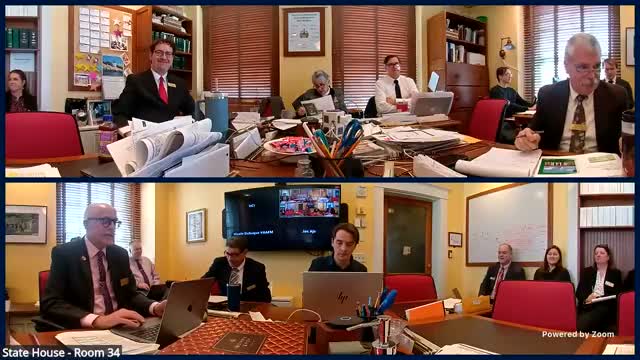
State officials updated the House Corrections and Institutions Committee on renovation progress for the Vermont building at the Eastern States Exposition (the "Big E") and outlined near-term design and budget needs for interior systems.
Gregory Lowell, assistant director in the Agency of Agriculture’s development division, described the building as a unique, nearly 100‑year‑old state-owned exhibit that draws heavy foot traffic during the 17‑day fair and serves as a marketing platform for Vermont businesses and youth agriculture programs. He said the fair historically draws large crowds—“the attendance record, I think, was set in 2019 overall at 1,700,000 people who came through the gates of the fair over those 17 days.”
Project status: Jessica Tine, project manager and architect for Building & General Services, said exterior restoration is about 75% complete — slate roof replacement, cupola and masonry work among the tasks finished or ongoing — and reported the appropriation to date (including the FY27 bond amount) is $6,000,000 with roughly $3,000,000 expended and approximately $2.9 million remaining. Tine said the FY27 request shown in the original appropriation remains $1,500,000 and that phase‑2 design (mechanical/electrical/interior) is starting now.
Key technical needs: Presenters said the building’s electrical service is undersized (a 300‑amp service in current configuration), which limits vendor equipment, food-service capability and interior improvements. Tine said planned upgrades would bring the service to 600 amps and address code and accessibility issues, including adding ADA‑accessible restrooms on the first floor where practicable.
Why it matters: The building’s deferred maintenance — roof leaks, limited electrical capacity, aging doors and limited restroom accessibility — affects the vendor experience and the state’s ability to present a consistent tourism and business-development presence at the fair. Lowell stressed that commission revenue from vendors (currently collected at a 15% rate) funds staffing and maintenance and that the program seeks to keep vendor access and commission rates sustainable for small businesses.
Schedule and next steps: Tine said phase‑2 design and procurement for long‑lead items (notably 600‑amp electrical equipment) will overlap with subsequent phases; depending on procurement timelines, substantial construction work for phase 3 will be in FY28–FY29. She asked for continuity in design teams and a construction manager across phases to reduce rework and improve schedule certainty. Committee members were offered site visits during construction or the fair to inspect the work.
Ending: The committee paused for a short break after the presentation; no formal votes on the project funding were recorded in the transcript.
Gregory Lowell, assistant director in the Agency of Agriculture’s development division, described the building as a unique, nearly 100‑year‑old state-owned exhibit that draws heavy foot traffic during the 17‑day fair and serves as a marketing platform for Vermont businesses and youth agriculture programs. He said the fair historically draws large crowds—“the attendance record, I think, was set in 2019 overall at 1,700,000 people who came through the gates of the fair over those 17 days.”
Project status: Jessica Tine, project manager and architect for Building & General Services, said exterior restoration is about 75% complete — slate roof replacement, cupola and masonry work among the tasks finished or ongoing — and reported the appropriation to date (including the FY27 bond amount) is $6,000,000 with roughly $3,000,000 expended and approximately $2.9 million remaining. Tine said the FY27 request shown in the original appropriation remains $1,500,000 and that phase‑2 design (mechanical/electrical/interior) is starting now.
Key technical needs: Presenters said the building’s electrical service is undersized (a 300‑amp service in current configuration), which limits vendor equipment, food-service capability and interior improvements. Tine said planned upgrades would bring the service to 600 amps and address code and accessibility issues, including adding ADA‑accessible restrooms on the first floor where practicable.
Why it matters: The building’s deferred maintenance — roof leaks, limited electrical capacity, aging doors and limited restroom accessibility — affects the vendor experience and the state’s ability to present a consistent tourism and business-development presence at the fair. Lowell stressed that commission revenue from vendors (currently collected at a 15% rate) funds staffing and maintenance and that the program seeks to keep vendor access and commission rates sustainable for small businesses.
Schedule and next steps: Tine said phase‑2 design and procurement for long‑lead items (notably 600‑amp electrical equipment) will overlap with subsequent phases; depending on procurement timelines, substantial construction work for phase 3 will be in FY28–FY29. She asked for continuity in design teams and a construction manager across phases to reduce rework and improve schedule certainty. Committee members were offered site visits during construction or the fair to inspect the work.
Ending: The committee paused for a short break after the presentation; no formal votes on the project funding were recorded in the transcript.
Don't Miss a Word: See the Full Meeting!
Go beyond summaries. Unlock every video, transcript, and key insight with a Founder Membership.
✓
Get instant access to full meeting videos
✓
Search and clip any phrase from complete transcripts
✓
Receive AI-powered summaries & custom alerts
✓
Enjoy lifetime, unrestricted access to government data
30-day money-back guarantee
