Vermont Care Partners urges sustained investment to shore up community mental-health services
January 30, 2026 | Health Care, HOUSE OF REPRESENTATIVES, Committees, Legislative , Vermont
This article was created by AI summarizing key points discussed. AI makes mistakes, so for full details and context, please refer to the video of the full meeting. Please report any errors so we can fix them. Report an error »
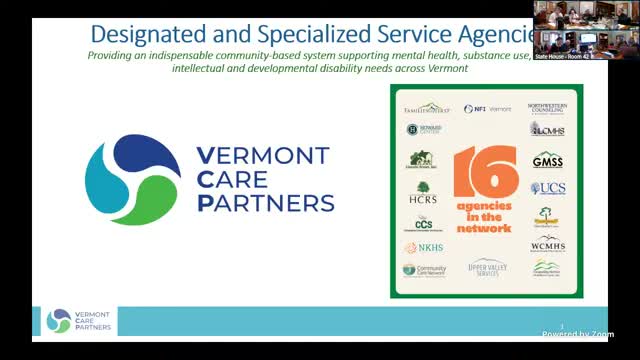
Vermont Care Partners told a legislative committee that the state's designated and specialized service agencies (DAs and SSAs) provide the coordinated, community-based safety net Vermonters rely on for mental-health, substance‑use and developmental‑disability services.
Simone Rishmeier, executive director of Vermont Care Partners, said the system is "under extraordinary pressure and strain" because of workforce shortages, rising acuity and housing instability, but stressed that much of the system still works and must be preserved. "Vermont's designated specialized service agencies are backbone of our publicly funded system," she said.
Why it matters: Presenters argued that Vermont's decades‑long policy choice to favor community care over institutional placements makes statewide reforms—payment modernization, crisis continuum expansion and service integration—possible, but only if implementation and financing are carefully aligned. "Multiple interrelated changes are happening at the same time across policy, across payment, and service delivery," Rishmeier said, warning that concurrent reforms can either enable the system to thrive or destabilize it.
Key points and evidence: Speakers described a 16‑agency network of designated and specialized agencies that are state‑contracted nonprofits, locally governed and accountable through designation. Amy Johnson, director of legislative affairs and policy for Vermont Care Partners, highlighted the crisis continuum (including 988 expansion, mobile crisis teams and community urgent cares) and the Certified Community Behavioral Health Clinic (CCBHC) model as opportunities to increase access and parity with federally qualified health centers, while noting the need for adequate payment levels and implementation supports.
Kelsey Staffstep, identifying herself as executive director for Northeast Indiana Human Services and co-president of the Client Care Partners Board, described operational pieces: DAs run the 988 lifeline split between agencies, each DA operates mobile crisis teams, and the network has embedded partnerships with Vermont State Police for jointly responding to community incidents.
Presenters stressed the array of services DAs/SSAs provide beyond therapy, from psychiatric care and case management to perinatal supports, school‑based programs and transportation. They emphasized prevention and the role of primary care and hospitals as major referral sources.
Data presented: The presenters said the network reaches thousands (slides cited 3,800 students in Success Beyond 6) and that an average‑day caseload across the network is about 5,260 people; they also cited 3,725 mobile crisis responses during a recent period. Presenters acknowledged they have more detailed fiscal and vacancy data and offered to provide it to the committee when presenting budget requests.
Points of caution: Presenters repeatedly warned that reforms such as conflict‑of‑interest‑free case management and developmental‑services payment changes are sensitive to staffing and service acuity. They said CCBHCs could expand access under a cost‑reimbursed model but implementation details (including workforce capacity and payment rates) will determine success.
Next steps: Vermont Care Partners said they will share budgetary and stability data with the committee and include vacancy/turnover figures in a subsequent slide deck. The meeting then recessed for a short break.
Ending: The briefing closed with an offer to provide one‑page materials and follow‑up data to inform the committee's upcoming budget deliberations.
Simone Rishmeier, executive director of Vermont Care Partners, said the system is "under extraordinary pressure and strain" because of workforce shortages, rising acuity and housing instability, but stressed that much of the system still works and must be preserved. "Vermont's designated specialized service agencies are backbone of our publicly funded system," she said.
Why it matters: Presenters argued that Vermont's decades‑long policy choice to favor community care over institutional placements makes statewide reforms—payment modernization, crisis continuum expansion and service integration—possible, but only if implementation and financing are carefully aligned. "Multiple interrelated changes are happening at the same time across policy, across payment, and service delivery," Rishmeier said, warning that concurrent reforms can either enable the system to thrive or destabilize it.
Key points and evidence: Speakers described a 16‑agency network of designated and specialized agencies that are state‑contracted nonprofits, locally governed and accountable through designation. Amy Johnson, director of legislative affairs and policy for Vermont Care Partners, highlighted the crisis continuum (including 988 expansion, mobile crisis teams and community urgent cares) and the Certified Community Behavioral Health Clinic (CCBHC) model as opportunities to increase access and parity with federally qualified health centers, while noting the need for adequate payment levels and implementation supports.
Kelsey Staffstep, identifying herself as executive director for Northeast Indiana Human Services and co-president of the Client Care Partners Board, described operational pieces: DAs run the 988 lifeline split between agencies, each DA operates mobile crisis teams, and the network has embedded partnerships with Vermont State Police for jointly responding to community incidents.
Presenters stressed the array of services DAs/SSAs provide beyond therapy, from psychiatric care and case management to perinatal supports, school‑based programs and transportation. They emphasized prevention and the role of primary care and hospitals as major referral sources.
Data presented: The presenters said the network reaches thousands (slides cited 3,800 students in Success Beyond 6) and that an average‑day caseload across the network is about 5,260 people; they also cited 3,725 mobile crisis responses during a recent period. Presenters acknowledged they have more detailed fiscal and vacancy data and offered to provide it to the committee when presenting budget requests.
Points of caution: Presenters repeatedly warned that reforms such as conflict‑of‑interest‑free case management and developmental‑services payment changes are sensitive to staffing and service acuity. They said CCBHCs could expand access under a cost‑reimbursed model but implementation details (including workforce capacity and payment rates) will determine success.
Next steps: Vermont Care Partners said they will share budgetary and stability data with the committee and include vacancy/turnover figures in a subsequent slide deck. The meeting then recessed for a short break.
Ending: The briefing closed with an offer to provide one‑page materials and follow‑up data to inform the committee's upcoming budget deliberations.
Don't Miss a Word: See the Full Meeting!
Go beyond summaries. Unlock every video, transcript, and key insight with a Founder Membership.
✓
Get instant access to full meeting videos
✓
Search and clip any phrase from complete transcripts
✓
Receive AI-powered summaries & custom alerts
✓
Enjoy lifetime, unrestricted access to government data
30-day money-back guarantee
