Clark County outlines ADA transition plan, seeks public input on sidewalks and curb ramps
January 26, 2026 | Clark County, Washington
This article was created by AI summarizing key points discussed. AI makes mistakes, so for full details and context, please refer to the video of the full meeting. Please report any errors so we can fix them. Report an error »
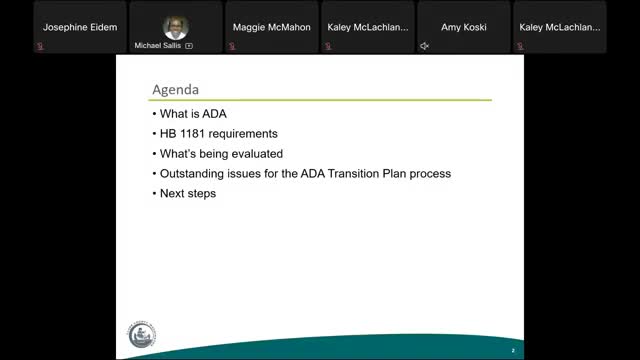
Michael Salas, a planner with the Clark County Department of Community Planning, told attendees the county has completed a self-evaluation and is updating its Americans with Disabilities Act (ADA) transition plan to identify barriers and prioritize fixes.
"The document is being used as a tool we can use to update the ADA plan," Salas said, adding the plan will identify physical obstacles, describe methods to correct them, provide a schedule and name officials responsible for implementation. He said the update is required under House Bill 1181 as part of the county's comprehensive-plan climate initiative.
Why it matters: Salas said the updated plan will allow the county to classify some work as capital projects rather than routine maintenance, which makes projects eligible for state funding and reduces the chance accessibility fixes are delayed by competing pavement priorities.
What the county found: The self-evaluation mapped curb ramps, sidewalks and traffic-control signals across the urban growth area and identified multiple deficiency types. Salas said many curb ramps are out of date, missing sidewalks are common, and tree roots and uplifted panels create hazardous conditions for people with disabilities. He gave a neighborhood example where developer-installed mailbox placement reduced sidewalk width to about 3 feet, blocking wheelchair access.
On accessible pedestrian signals, Salas noted some push-button systems are properly located and updated while others remain in difficult-to-access positions. He said the inventory and GIS mapping use a mix of 2019 and current data and include priority mapping.
Funding and next steps: Salas said the county will post a draft of the transition plan in February, begin public comment in March and hopes to complete the plan by April so it does not delay the broader comprehensive-plan update. He said projects would be proposed for the Transportation Improvement Program (TIP) and reported to the State Department of Commerce, which administers a revolving fund. Salas identified the Federal Highway Administration and the U.S. Department of Transportation as common funding sources for such work.
How priorities will be set: Salas said the county will use a public survey to collect resident reports of deficiencies; responses will help rank the top-10 projects by the number of people served and by proximity to public facilities such as schools, transit stops and medical services. He said some repairs caused by property owners may remain the landowner's responsibility, but Public Works can perform fixes when funded through maintenance or capital projects.
Coordination: The effort covers the unincorporated area of Clark County but will be coordinated with cities inside the urban growth area and with C-Tran, which Salas said generally ensures new construction complies with ADA standards. The county will also evaluate access within roughly a quarter-mile of bus stops and look for connections through open space.
Public action requested: "The first step is filling out the survey," Salas said, noting survey responses will be included in the draft plan's appendix and used to select initial projects for the state submittal.
The next procedural steps are a February draft, public hearings to be scheduled for the planning commission and the council, and a target completion date of April.
"The document is being used as a tool we can use to update the ADA plan," Salas said, adding the plan will identify physical obstacles, describe methods to correct them, provide a schedule and name officials responsible for implementation. He said the update is required under House Bill 1181 as part of the county's comprehensive-plan climate initiative.
Why it matters: Salas said the updated plan will allow the county to classify some work as capital projects rather than routine maintenance, which makes projects eligible for state funding and reduces the chance accessibility fixes are delayed by competing pavement priorities.
What the county found: The self-evaluation mapped curb ramps, sidewalks and traffic-control signals across the urban growth area and identified multiple deficiency types. Salas said many curb ramps are out of date, missing sidewalks are common, and tree roots and uplifted panels create hazardous conditions for people with disabilities. He gave a neighborhood example where developer-installed mailbox placement reduced sidewalk width to about 3 feet, blocking wheelchair access.
On accessible pedestrian signals, Salas noted some push-button systems are properly located and updated while others remain in difficult-to-access positions. He said the inventory and GIS mapping use a mix of 2019 and current data and include priority mapping.
Funding and next steps: Salas said the county will post a draft of the transition plan in February, begin public comment in March and hopes to complete the plan by April so it does not delay the broader comprehensive-plan update. He said projects would be proposed for the Transportation Improvement Program (TIP) and reported to the State Department of Commerce, which administers a revolving fund. Salas identified the Federal Highway Administration and the U.S. Department of Transportation as common funding sources for such work.
How priorities will be set: Salas said the county will use a public survey to collect resident reports of deficiencies; responses will help rank the top-10 projects by the number of people served and by proximity to public facilities such as schools, transit stops and medical services. He said some repairs caused by property owners may remain the landowner's responsibility, but Public Works can perform fixes when funded through maintenance or capital projects.
Coordination: The effort covers the unincorporated area of Clark County but will be coordinated with cities inside the urban growth area and with C-Tran, which Salas said generally ensures new construction complies with ADA standards. The county will also evaluate access within roughly a quarter-mile of bus stops and look for connections through open space.
Public action requested: "The first step is filling out the survey," Salas said, noting survey responses will be included in the draft plan's appendix and used to select initial projects for the state submittal.
The next procedural steps are a February draft, public hearings to be scheduled for the planning commission and the council, and a target completion date of April.
View the Full Meeting & All Its Details
This article offers just a summary. Unlock complete video, transcripts, and insights as a Founder Member.
✓
Watch full, unedited meeting videos
✓
Search every word spoken in unlimited transcripts
✓
AI summaries & real-time alerts (all government levels)
✓
Permanent access to expanding government content
30-day money-back guarantee
