Utilities warn of PJM-region supply squeeze, urge ‘all-of-the-above’ response including transmission, storage and targeted generation
January 23, 2026 | Environment and Transportation Committee, HOUSE OF REPRESENTATIVES, Committees, Legislative, Maryland
This article was created by AI summarizing key points discussed. AI makes mistakes, so for full details and context, please refer to the video of the full meeting. Please report any errors so we can fix them. Report an error »
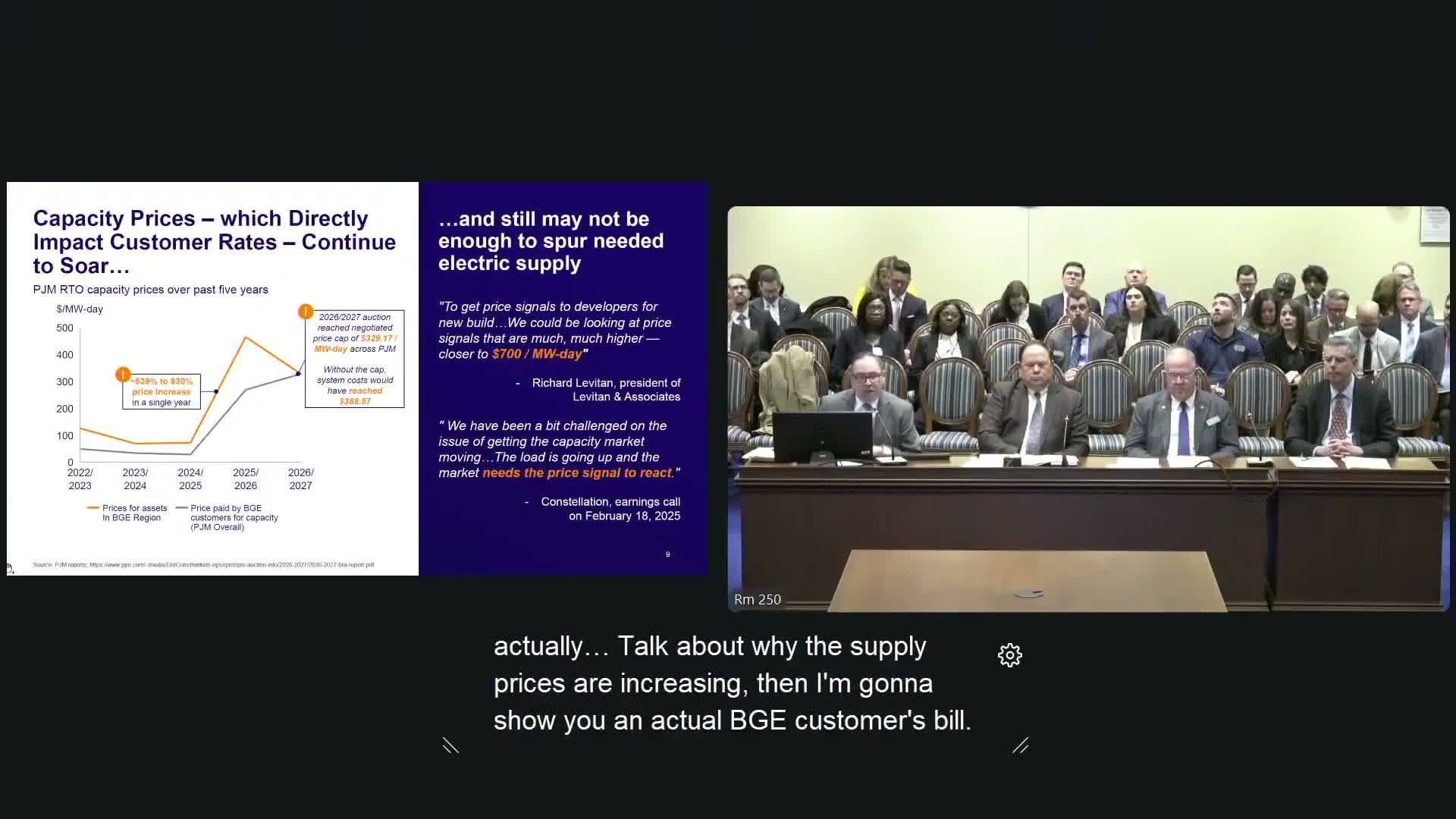
Baltimore Gas & Electric and other presenters told the House Environment and Transportation Committee on Wednesday that Maryland faces a regional supply shortfall that has driven wholesale and retail price volatility, and that solving it will require multiple tools.
"We do not have enough supply," said John Frey, vice president of regulatory policy and strategy for Baltimore Gas and Electric, describing capacity-price moves that rose from roughly $30 per megawatt-day to an emergency-capped $329 per megawatt-day. Frey said those capacity and generation-price increases — not delivery-rate regulation — account for much of the recent upward pressure on customers’ bills.
Frey and other panelists pointed to a mix of older generators retiring and rising peak demand, a dynamic they said has tightened the PJM regional market. Mason Emnet of Constellation Energy, a competitive generator, said competitive markets previously drove retirements when prices were low; Constellation reported 15,000 megawatts left PJM in the last five years and about 50,000 megawatts over the last two decades.
Why it matters: Higher capacity and supply prices flow through to customers quickly and can overwhelm the regulated distribution portion of bills. Frey showed a representative BGE bill in which the distribution portion is about 4.5¢ per kilowatt-hour while the supply component has reached roughly 16¢ per kilowatt-hour.
What the panel recommended: utilities and generators offered overlapping proposals. They urged prompt completion of a transmission expansion tied to the planned retirement of near‑term local plants (Brandon Shores and Wagner) to allow more imports; faster deployment of battery storage and demand‑response programs; and keeping “all options on the table,” including the possibility of regulated utilities building supply if statutory clarity and protections ensure market revenues are credited to customers.
Emnet said storage projects could reach operation in roughly two to three years, subject to interconnection queue timing at PJM, while gas-fired projects’ timelines depend on turbine availability and gas-delivery infrastructure. He described potential near-term submissions for about 700 megawatts of new natural‑gas capacity and storage proposals that would participate in state solicitations.
On costs and trade-offs: panelists warned of hard trade-offs. Emnet and Frey both noted the Brandon Shores-related transmission upgrade was initially estimated at about $800 million and later increased in design to ~$1.5 billion, raising questions about affordability and timing. Emnet said building generation in Maryland tends to be roughly 25% more expensive than in neighboring states that are closer to gas infrastructure, which factors into siting and procurement decisions.
Next steps: Panelists urged the committee and the General Assembly to refine load forecasting (especially for data center demand), accelerate storage procurements already authorized by statute, consider targeted transmission acceleration, and provide statutory clarity if the state seeks regulated utilities to build supply while guaranteeing market revenues return to customers.
"We do not have enough supply," said John Frey, vice president of regulatory policy and strategy for Baltimore Gas and Electric, describing capacity-price moves that rose from roughly $30 per megawatt-day to an emergency-capped $329 per megawatt-day. Frey said those capacity and generation-price increases — not delivery-rate regulation — account for much of the recent upward pressure on customers’ bills.
Frey and other panelists pointed to a mix of older generators retiring and rising peak demand, a dynamic they said has tightened the PJM regional market. Mason Emnet of Constellation Energy, a competitive generator, said competitive markets previously drove retirements when prices were low; Constellation reported 15,000 megawatts left PJM in the last five years and about 50,000 megawatts over the last two decades.
Why it matters: Higher capacity and supply prices flow through to customers quickly and can overwhelm the regulated distribution portion of bills. Frey showed a representative BGE bill in which the distribution portion is about 4.5¢ per kilowatt-hour while the supply component has reached roughly 16¢ per kilowatt-hour.
What the panel recommended: utilities and generators offered overlapping proposals. They urged prompt completion of a transmission expansion tied to the planned retirement of near‑term local plants (Brandon Shores and Wagner) to allow more imports; faster deployment of battery storage and demand‑response programs; and keeping “all options on the table,” including the possibility of regulated utilities building supply if statutory clarity and protections ensure market revenues are credited to customers.
Emnet said storage projects could reach operation in roughly two to three years, subject to interconnection queue timing at PJM, while gas-fired projects’ timelines depend on turbine availability and gas-delivery infrastructure. He described potential near-term submissions for about 700 megawatts of new natural‑gas capacity and storage proposals that would participate in state solicitations.
On costs and trade-offs: panelists warned of hard trade-offs. Emnet and Frey both noted the Brandon Shores-related transmission upgrade was initially estimated at about $800 million and later increased in design to ~$1.5 billion, raising questions about affordability and timing. Emnet said building generation in Maryland tends to be roughly 25% more expensive than in neighboring states that are closer to gas infrastructure, which factors into siting and procurement decisions.
Next steps: Panelists urged the committee and the General Assembly to refine load forecasting (especially for data center demand), accelerate storage procurements already authorized by statute, consider targeted transmission acceleration, and provide statutory clarity if the state seeks regulated utilities to build supply while guaranteeing market revenues return to customers.
Don't Miss a Word: See the Full Meeting!
Go beyond summaries. Unlock every video, transcript, and key insight with a Founder Membership.
✓
Get instant access to full meeting videos
✓
Search and clip any phrase from complete transcripts
✓
Receive AI-powered summaries & custom alerts
✓
Enjoy lifetime, unrestricted access to government data
30-day money-back guarantee
