Maryland planning secretary briefs House panel on permitting council, prototype dashboard
January 23, 2026 | Environment and Transportation Committee, HOUSE OF REPRESENTATIVES, Committees, Legislative, Maryland
This article was created by AI summarizing key points discussed. AI makes mistakes, so for full details and context, please refer to the video of the full meeting. Please report any errors so we can fix them. Report an error »
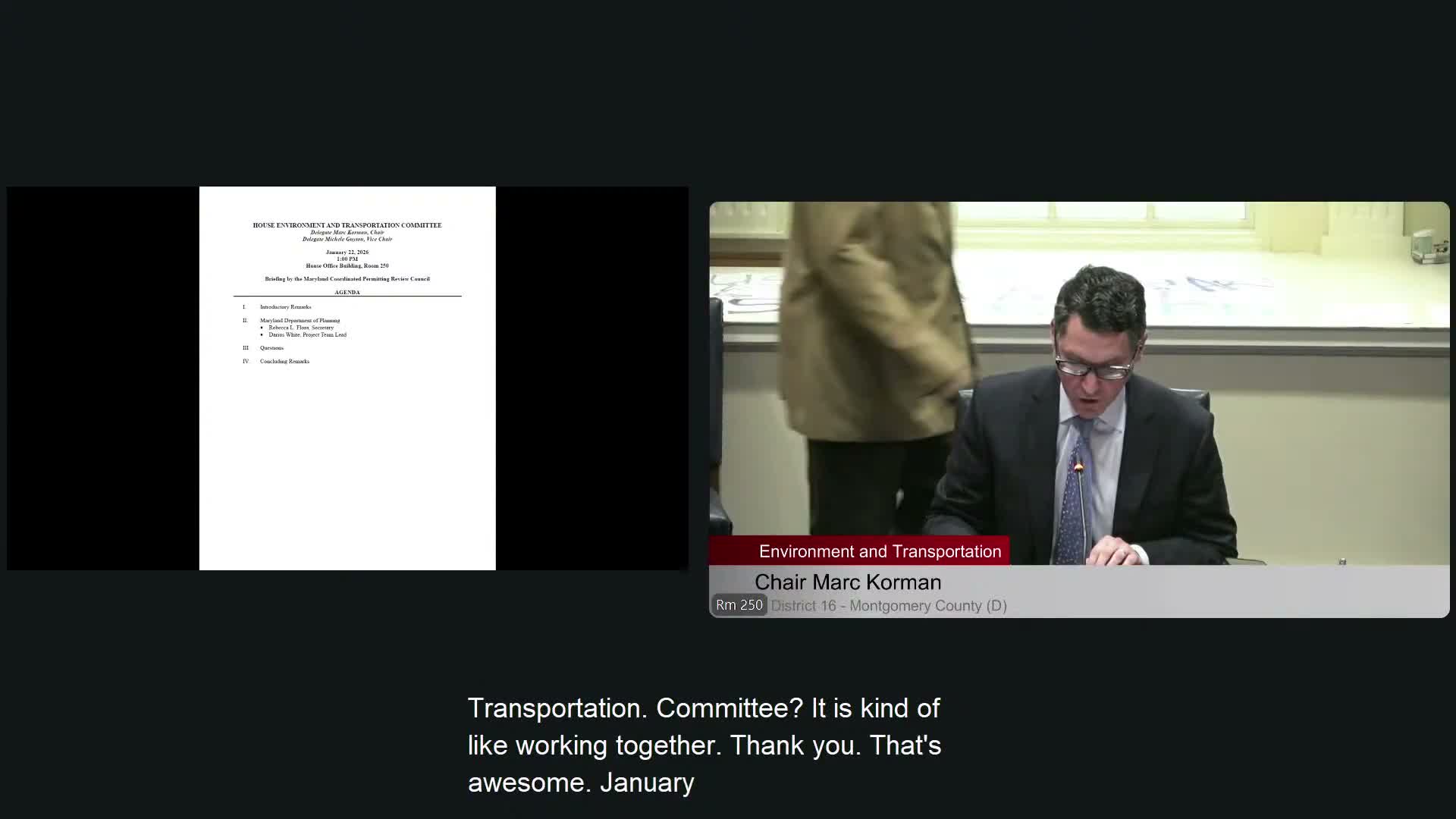
An Annapolis briefing on Jan. 22 drew lawmakers’ questions about permitting delays, local‑state coordination and a newly launched prototype permitting dashboard.
Rebecca Flora, secretary of the Maryland Department of Planning, told the House Environment and Transportation Committee that the governor’s executive order created a Permitting Review Council focused on state permitting for infrastructure and place‑based development. "We just hit a milestone yesterday, and the prototype dashboard was launched yesterday," Flora said, describing a public prototype that lists five active projects, associated permits and a map view to help users "dig in" on permit status.
The council is built as a cabinet‑level body (deputy‑secretary equivalents across permitting, review and funding agencies) supported by a staff working group chaired by Darius White, the department’s community design and development lead. Flora said the council was stood up in April 2025 after an executive order in December 2024 and was given roughly a year to produce deliverables, including pilot project tracking, an internal intake system and a final report with policy and technology recommendations.
Why it matters: permitting delays for public‑interest projects and housing have been cited across Maryland as an impediment to construction and economic competitiveness. Lawmakers in the hearing pressed for clearer data and local coordination as they sought fixes that do not simply shift burdens to counties.
Flora described six pilot projects the council is tracking to learn where approvals and reviews can be coordinated to reduce serial delays. She highlighted two project case studies — Quantum Frederick, an ongoing project, and Burnt Hill Farm, a completed value‑add agricultural project the council retained as a case study for lessons learned — and said the working groups bring together state and local reviewers to identify where approvals can overlap.
On data: Flora cited local reporting required by the General Assembly, referring to the local permitting reporting bill and a residential permit data bill assigned to the Department of Planning. She reported the first full-year data for nine jurisdictions of 150,000-plus population for calendar year 2024 showed "10,157 developer projects" and "over 11,000 building permits" issued; she cautioned that metrics need standardization to show how long projects actually take because agency systems differ.
Lawmakers raised three recurring concerns: (1) local zoning and delegation limits the state’s ability to speed approvals; (2) differing agency interpretations of regulations and turnover among reviewers cause inconsistent outcomes; and (3) smaller and mid‑sized projects lack the in‑house expertise that large developers use to navigate fragmented systems. "We are not directly involved," Flora said of local zoning, "zoning is local," but she added the council will examine delegation, guidance and where statutory or policy changes could help.
Flora also described technology options the final report will weigh, from agency‑by‑agency fixes to unified or hybrid systems, and said the work is being coordinated with the state’s Department of Information Technology. She said the council’s research includes conversations with Delaware, Pennsylvania and Virginia, and that Virginia’s agency‑by‑agency approach had the biggest jump‑start. "Virginia had the biggest jump start," she said, noting the state hired consultants and pursued multi‑year investment.
The committee sought the council’s data and webinars; Flora agreed to provide datasets and said the department will host outreach including developer roundtables and focus groups. She told the panel the team is "pushing to get this final report done by the June."
The hearing included factual details and requests for follow‑up rather than formal votes or committee actions. The committee paused after the briefing to take up the next item on the agenda.
Rebecca Flora, secretary of the Maryland Department of Planning, told the House Environment and Transportation Committee that the governor’s executive order created a Permitting Review Council focused on state permitting for infrastructure and place‑based development. "We just hit a milestone yesterday, and the prototype dashboard was launched yesterday," Flora said, describing a public prototype that lists five active projects, associated permits and a map view to help users "dig in" on permit status.
The council is built as a cabinet‑level body (deputy‑secretary equivalents across permitting, review and funding agencies) supported by a staff working group chaired by Darius White, the department’s community design and development lead. Flora said the council was stood up in April 2025 after an executive order in December 2024 and was given roughly a year to produce deliverables, including pilot project tracking, an internal intake system and a final report with policy and technology recommendations.
Why it matters: permitting delays for public‑interest projects and housing have been cited across Maryland as an impediment to construction and economic competitiveness. Lawmakers in the hearing pressed for clearer data and local coordination as they sought fixes that do not simply shift burdens to counties.
Flora described six pilot projects the council is tracking to learn where approvals and reviews can be coordinated to reduce serial delays. She highlighted two project case studies — Quantum Frederick, an ongoing project, and Burnt Hill Farm, a completed value‑add agricultural project the council retained as a case study for lessons learned — and said the working groups bring together state and local reviewers to identify where approvals can overlap.
On data: Flora cited local reporting required by the General Assembly, referring to the local permitting reporting bill and a residential permit data bill assigned to the Department of Planning. She reported the first full-year data for nine jurisdictions of 150,000-plus population for calendar year 2024 showed "10,157 developer projects" and "over 11,000 building permits" issued; she cautioned that metrics need standardization to show how long projects actually take because agency systems differ.
Lawmakers raised three recurring concerns: (1) local zoning and delegation limits the state’s ability to speed approvals; (2) differing agency interpretations of regulations and turnover among reviewers cause inconsistent outcomes; and (3) smaller and mid‑sized projects lack the in‑house expertise that large developers use to navigate fragmented systems. "We are not directly involved," Flora said of local zoning, "zoning is local," but she added the council will examine delegation, guidance and where statutory or policy changes could help.
Flora also described technology options the final report will weigh, from agency‑by‑agency fixes to unified or hybrid systems, and said the work is being coordinated with the state’s Department of Information Technology. She said the council’s research includes conversations with Delaware, Pennsylvania and Virginia, and that Virginia’s agency‑by‑agency approach had the biggest jump‑start. "Virginia had the biggest jump start," she said, noting the state hired consultants and pursued multi‑year investment.
The committee sought the council’s data and webinars; Flora agreed to provide datasets and said the department will host outreach including developer roundtables and focus groups. She told the panel the team is "pushing to get this final report done by the June."
The hearing included factual details and requests for follow‑up rather than formal votes or committee actions. The committee paused after the briefing to take up the next item on the agenda.
View the Full Meeting & All Its Details
This article offers just a summary. Unlock complete video, transcripts, and insights as a Founder Member.
✓
Watch full, unedited meeting videos
✓
Search every word spoken in unlimited transcripts
✓
AI summaries & real-time alerts (all government levels)
✓
Permanent access to expanding government content
30-day money-back guarantee
