Easton Utilities urges Legislature to reinvest ACP funds in local renewables, cites a $14M solar-plus-storage feasibility project
January 23, 2026 | Environment and Transportation Committee, HOUSE OF REPRESENTATIVES, Committees, Legislative, Maryland
This article was created by AI summarizing key points discussed. AI makes mistakes, so for full details and context, please refer to the video of the full meeting. Please report any errors so we can fix them. Report an error »
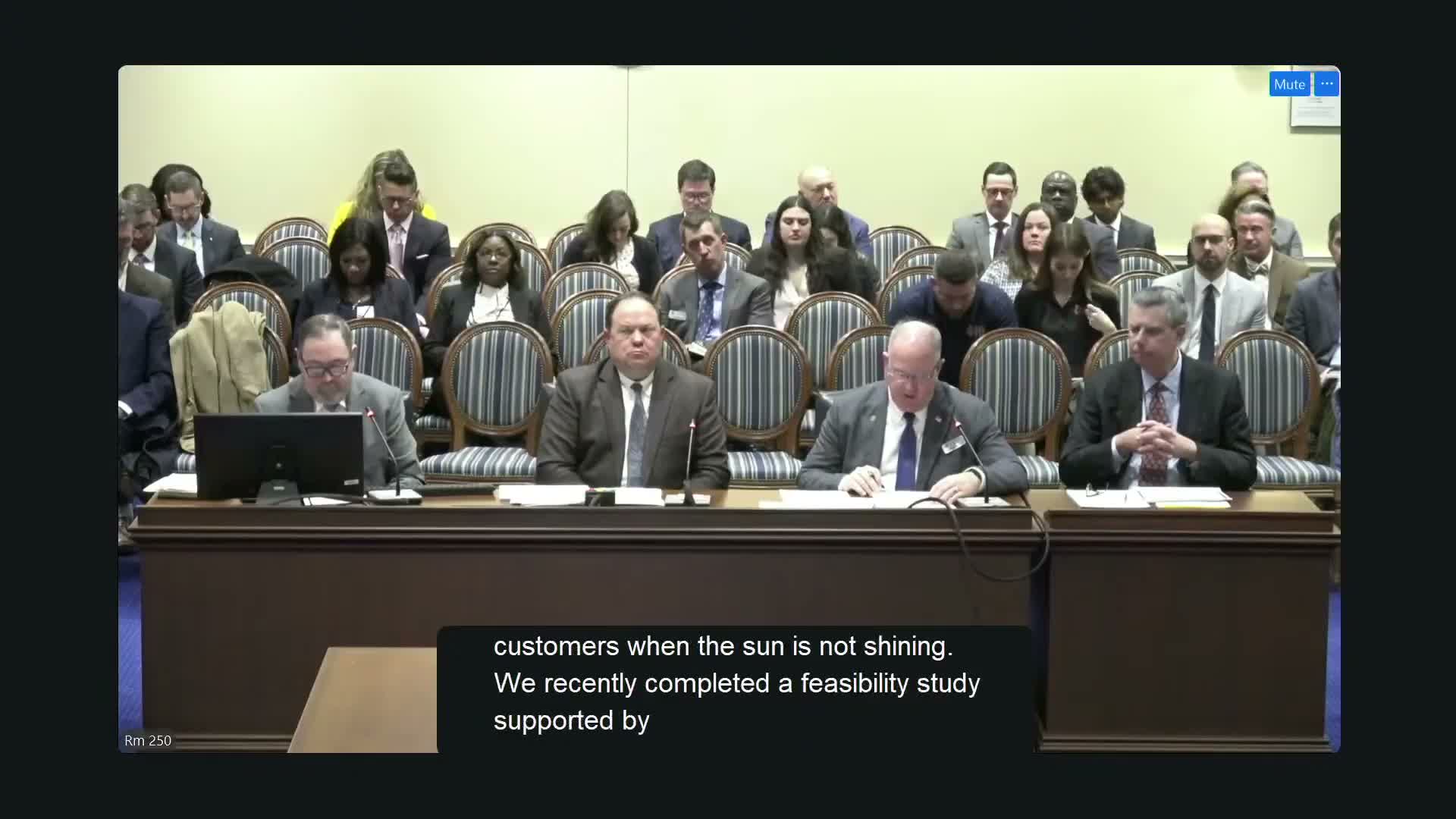
John Horner, president and CEO of the Easton Utilities Commission, told the House Environment and Transportation Committee that Easton — a small municipal utility serving roughly 11,000 electric and 5,000 gas customers — has prioritized local renewables but needs state funding partnerships to keep rates stable.
Horner described a feasibility study for an additional 2 MW solar array paired with 10 MWh of battery storage. "The total project cost is $14,000,000 with a potential 2 and a half million dollar grant," Horner said. He emphasized customer survey results showing 75% of respondents were unsure they would pay more to support renewable energy because of affordability concerns.
Why it matters: Horner argued that municipal and small utilities lack the scale of investor-owned utilities and therefore must rely on grants and state funds to avoid shifting large costs to ratepayers. He asked the committee to consider expanding the use of existing Alternative Compliance Payment (ACP) funds through the Maryland Energy Administration to finance local, shovel‑ready projects that advance state renewable goals while limiting customer rate pressure.
Context and constraints: Horner noted Easton already operates 17 generation units totaling about 66 MW and a 2 MW behind‑the‑meter solar array (19% average capacity factor) and that many of its smaller generation units have exceeded expected service life. Without additional funding partnerships, Horner said projects of the proposed scale would create significant rate pressure.
Horner described a feasibility study for an additional 2 MW solar array paired with 10 MWh of battery storage. "The total project cost is $14,000,000 with a potential 2 and a half million dollar grant," Horner said. He emphasized customer survey results showing 75% of respondents were unsure they would pay more to support renewable energy because of affordability concerns.
Why it matters: Horner argued that municipal and small utilities lack the scale of investor-owned utilities and therefore must rely on grants and state funds to avoid shifting large costs to ratepayers. He asked the committee to consider expanding the use of existing Alternative Compliance Payment (ACP) funds through the Maryland Energy Administration to finance local, shovel‑ready projects that advance state renewable goals while limiting customer rate pressure.
Context and constraints: Horner noted Easton already operates 17 generation units totaling about 66 MW and a 2 MW behind‑the‑meter solar array (19% average capacity factor) and that many of its smaller generation units have exceeded expected service life. Without additional funding partnerships, Horner said projects of the proposed scale would create significant rate pressure.
Don't Miss a Word: See the Full Meeting!
Go beyond summaries. Unlock every video, transcript, and key insight with a Founder Membership.
✓
Get instant access to full meeting videos
✓
Search and clip any phrase from complete transcripts
✓
Receive AI-powered summaries & custom alerts
✓
Enjoy lifetime, unrestricted access to government data
30-day money-back guarantee
