Commission adopts Opportunity Public Charter School framework on final read, adds postsecondary readiness measures
January 26, 2026 | Tennessee Public Charter School Commission, Deparments in Office of the Governor, Organizations, Executive, Tennessee
This article was created by AI summarizing key points discussed. AI makes mistakes, so for full details and context, please refer to the video of the full meeting. Please report any errors so we can fix them. Report an error »
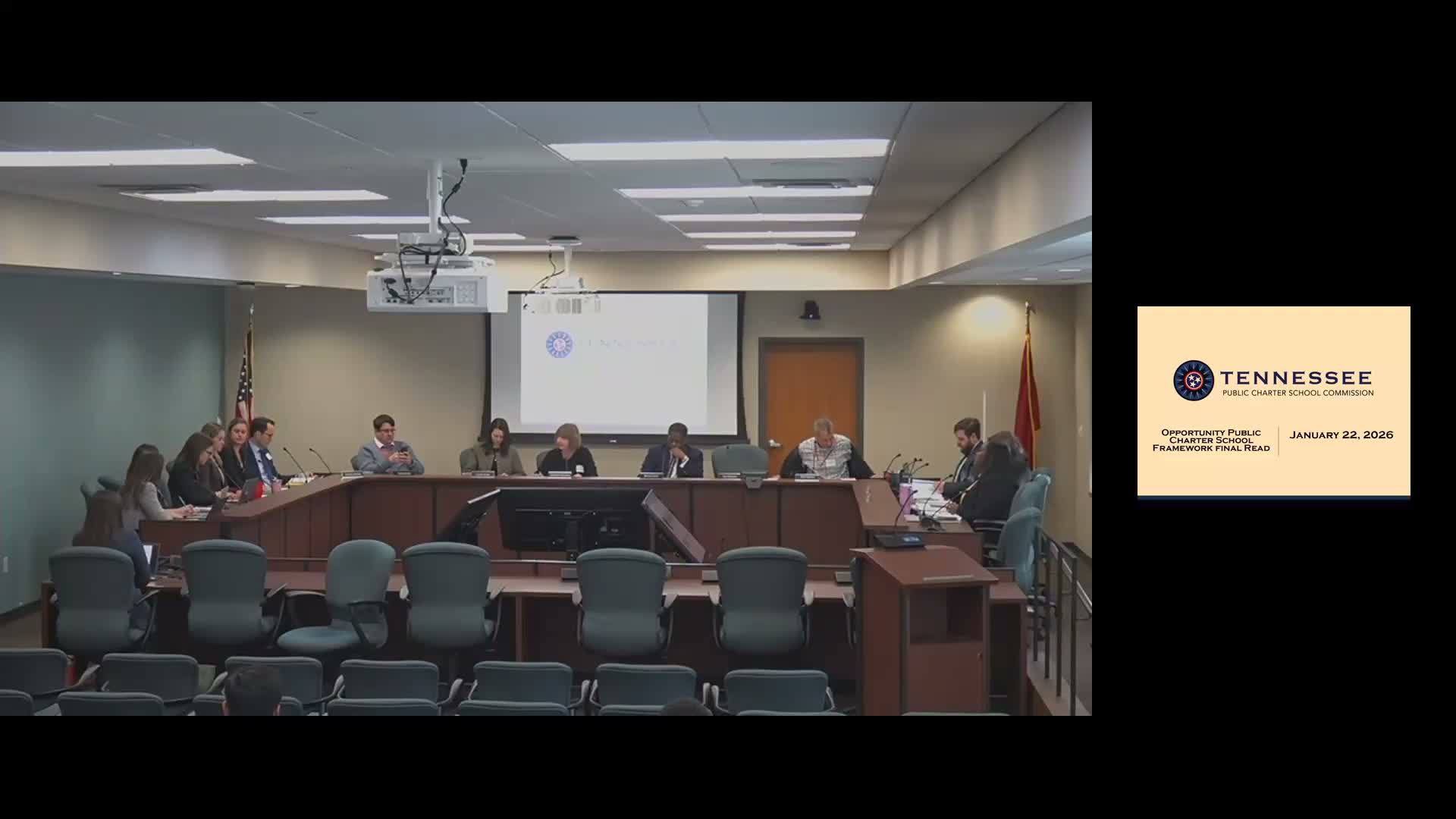
NASHVILLE — On Jan. 22 commission staff presented final-read adjustments to the Opportunity Public Charter School framework, which the Rules, Policy & Governance Committee recommended for approval. The framework is designed for Opportunity Public Charter Schools (statutorily required to serve a high share of at-risk students) and introduces new postsecondary-readiness measures for high schools.
Dr. Maggie Lund and Rebecca Laidebore explained that staff adjusted thresholds in the time-and-model comparative analysis after pressure testing available data and added a postsecondary-readiness academic subsection that carries 10% of the academic weight for high schools. The postsecondary-readiness subsection includes three measures: college-and-career-readiness (CCR) relative to the resident district (within 10 percentage points to meet standard), a one-year graduation-rate measure for students off a traditional timeline, and a credit-attainment progress indicator (75–90% of credits attempted earned to meet standard).
Staff emphasized that some measures use state-calculated CCR pathways (ACT/ASVAB, industry credentials, dual-credit) and that the commission will run the framework for a few years and adjust based on real-world data. Commissioners asked about data availability and vendor/system readiness; staff said they performed pressure testing and are building internal systems to extract credit and CCR metrics. Rock Academy, the first opportunity public charter school authorized by the commission, will be held to this framework once it opens.
The committee recommended the framework on final read and forwarded it for adoption; the rules committee likewise recommended adoption in its meeting later that night.
Dr. Maggie Lund and Rebecca Laidebore explained that staff adjusted thresholds in the time-and-model comparative analysis after pressure testing available data and added a postsecondary-readiness academic subsection that carries 10% of the academic weight for high schools. The postsecondary-readiness subsection includes three measures: college-and-career-readiness (CCR) relative to the resident district (within 10 percentage points to meet standard), a one-year graduation-rate measure for students off a traditional timeline, and a credit-attainment progress indicator (75–90% of credits attempted earned to meet standard).
Staff emphasized that some measures use state-calculated CCR pathways (ACT/ASVAB, industry credentials, dual-credit) and that the commission will run the framework for a few years and adjust based on real-world data. Commissioners asked about data availability and vendor/system readiness; staff said they performed pressure testing and are building internal systems to extract credit and CCR metrics. Rock Academy, the first opportunity public charter school authorized by the commission, will be held to this framework once it opens.
The committee recommended the framework on final read and forwarded it for adoption; the rules committee likewise recommended adoption in its meeting later that night.
Don't Miss a Word: See the Full Meeting!
Go beyond summaries. Unlock every video, transcript, and key insight with a Founder Membership.
✓
Get instant access to full meeting videos
✓
Search and clip any phrase from complete transcripts
✓
Receive AI-powered summaries & custom alerts
✓
Enjoy lifetime, unrestricted access to government data
30-day money-back guarantee
