MDOT forecast shows TTF revenue gains but rising operating costs and new bond issuance
January 26, 2026 | Budget and Taxation Committee, SENATE, SENATE, Committees, Legislative, Maryland
This article was created by AI summarizing key points discussed. AI makes mistakes, so for full details and context, please refer to the video of the full meeting. Please report any errors so we can fix them. Report an error »
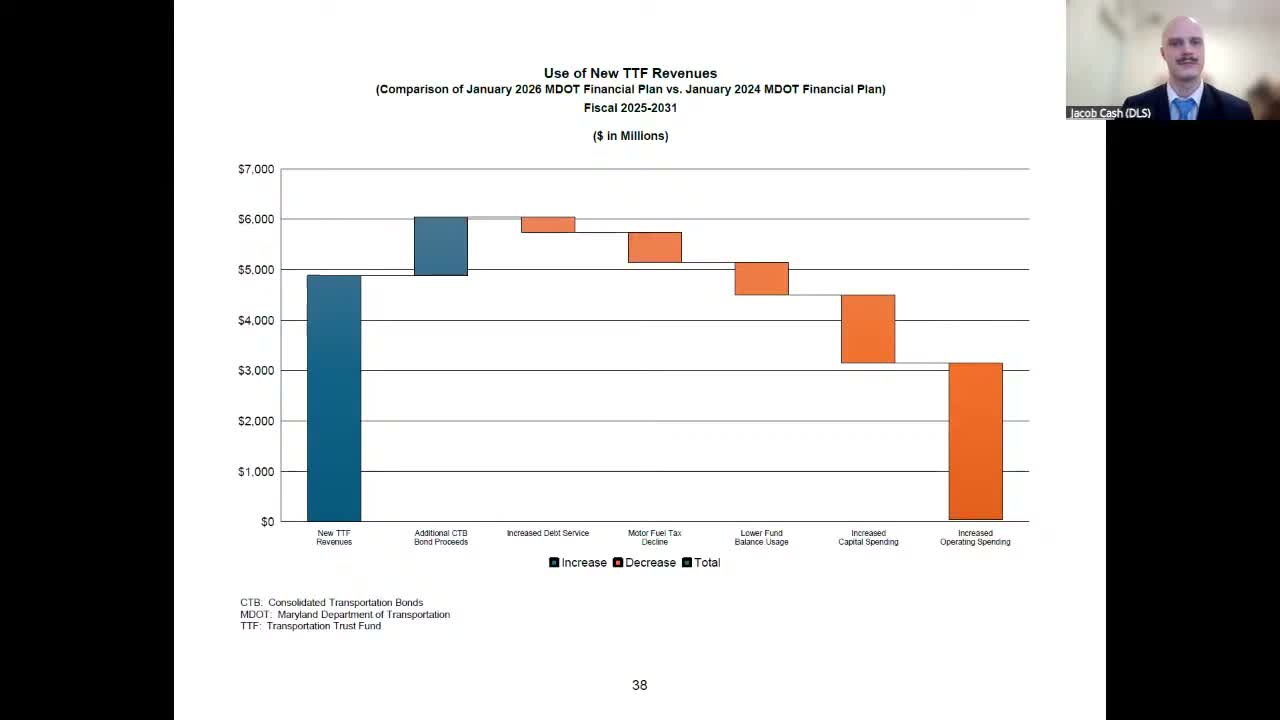
Committee members heard MDOT and DLS staff describe a transportation forecast that reflects recent revenue increases but also growing operating and debt costs that limit near-term spending flexibility.
A transportation presenter said revenues adopted in the 2024 and 2025 sessions are estimated to increase TTF receipts by about $4.9 billion through FY31 and enable roughly $1.2 billion in additional bond proceeds; at the same time, operating expenditures are projected to increase by about $3.1 billion and capital spending by roughly $1.3 billion over the forecast period.
The briefing noted a structural change in revenue composition: vehicle titling taxes are expected to grow and, in the 2026 forecast, surpass motor fuel taxes as the largest state-sourced TTF revenue. MDOT's forecast also projects an increase in debt service tied to additional bond issuances and a projected $600 million decrease in motor fuel tax revenue over the forecast period.
In capital program remarks, presenters described use of new general obligation and academic-revenue bonds and postponements of some capital projects (including a delayed Baltimore therapeutic treatment center start) that created capacity to shift operating relief to bond financing and free funds for legislative initiatives. Presenters said $1.75 billion in new GO bonds is included for FY27 and that some projects were deauthorized or delayed to accommodate those funds.
Members asked about long-term fund balances and the risk that MDOT may not recoup certain previously charged federal costs; staff noted legislative-audit findings raising a possible risk to the TTF if federal reimbursements do not materialize.
The presentation included no formal transportation votes; staff answered member questions and the committee adjourned.
A transportation presenter said revenues adopted in the 2024 and 2025 sessions are estimated to increase TTF receipts by about $4.9 billion through FY31 and enable roughly $1.2 billion in additional bond proceeds; at the same time, operating expenditures are projected to increase by about $3.1 billion and capital spending by roughly $1.3 billion over the forecast period.
The briefing noted a structural change in revenue composition: vehicle titling taxes are expected to grow and, in the 2026 forecast, surpass motor fuel taxes as the largest state-sourced TTF revenue. MDOT's forecast also projects an increase in debt service tied to additional bond issuances and a projected $600 million decrease in motor fuel tax revenue over the forecast period.
In capital program remarks, presenters described use of new general obligation and academic-revenue bonds and postponements of some capital projects (including a delayed Baltimore therapeutic treatment center start) that created capacity to shift operating relief to bond financing and free funds for legislative initiatives. Presenters said $1.75 billion in new GO bonds is included for FY27 and that some projects were deauthorized or delayed to accommodate those funds.
Members asked about long-term fund balances and the risk that MDOT may not recoup certain previously charged federal costs; staff noted legislative-audit findings raising a possible risk to the TTF if federal reimbursements do not materialize.
The presentation included no formal transportation votes; staff answered member questions and the committee adjourned.
View the Full Meeting & All Its Details
This article offers just a summary. Unlock complete video, transcripts, and insights as a Founder Member.
✓
Watch full, unedited meeting videos
✓
Search every word spoken in unlimited transcripts
✓
AI summaries & real-time alerts (all government levels)
✓
Permanent access to expanding government content
30-day money-back guarantee
