Panel warns federal tax‑credit changes will tighten deadlines and alter incentives for Maryland clean‑energy projects
January 23, 2026 | Education, Energy, and the Environment Committee, SENATE, SENATE, Committees, Legislative, Maryland
This article was created by AI summarizing key points discussed. AI makes mistakes, so for full details and context, please refer to the video of the full meeting. Please report any errors so we can fix them. Report an error »
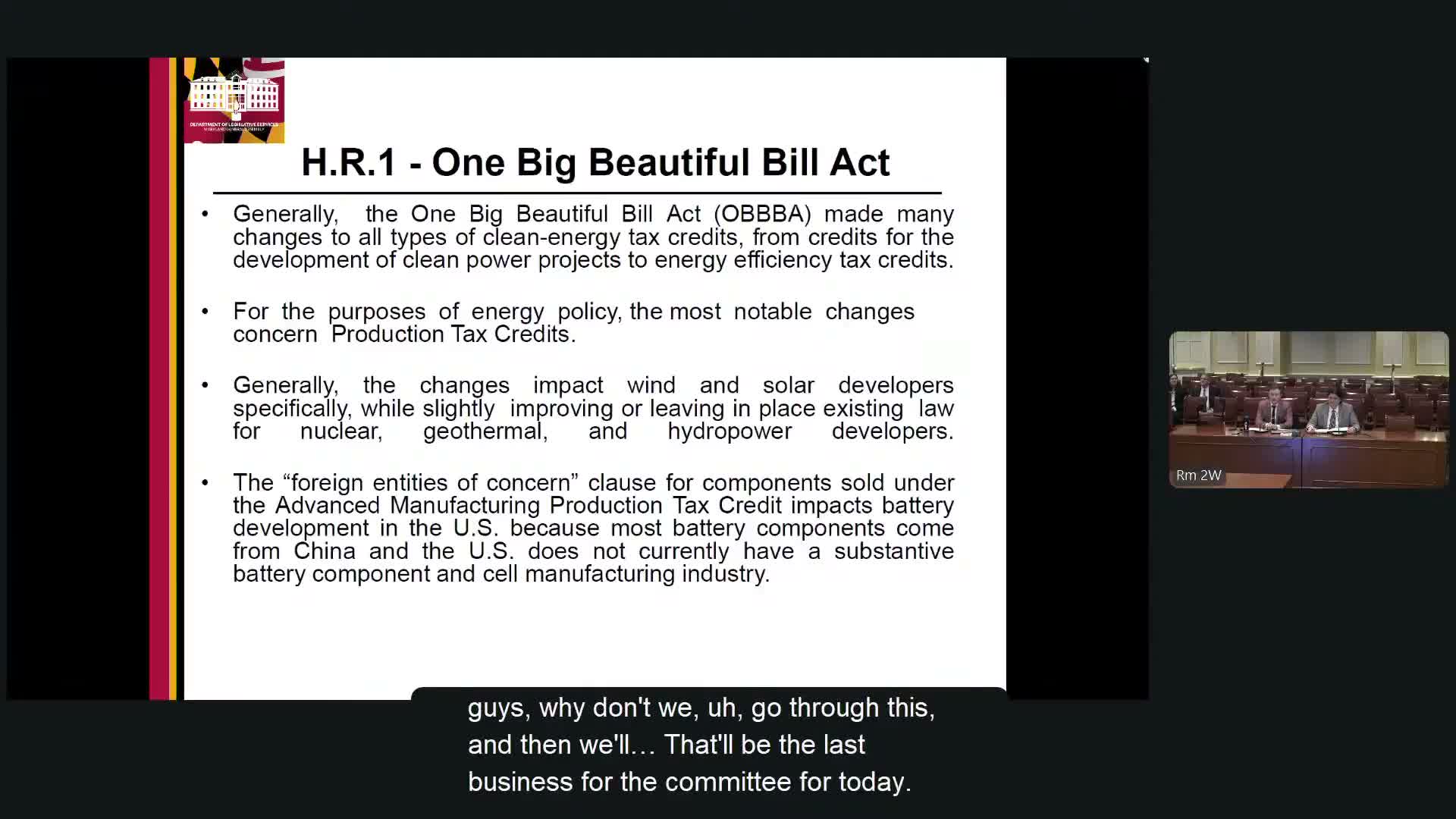
Department of Legislative Services analysts briefed the Education, Energy, and the Environment Committee on how recent federal legislation and administrative decisions could reshape project economics and incentives for clean energy in Maryland.
Tara Moriarty, a policy analyst with the Department of Legislative Services, said the federal measure described in the briefing as the "1 Big Beautiful Bill Act" changes multiple clean energy tax credits and eligibility rules. She told lawmakers that for many wind and solar projects, construction must begin by July 4, 2026, or the project must be placed in service by Dec. 1, 2027, to meet the updated rules. She also said construction for certain technologies such as nuclear, geothermal and hydropower retains later 2032 deadlines but faces phased reductions in credit value thereafter.
Senator Watson raised concerns about near‑term homeowner impacts, saying, "Subsidies go away, how can the normal homeowner afford to go ahead and get solar panels," pointing to households rushing to claim credits before phase‑downs take effect. Moriarty said the presentation was an overview and that DLS could follow up with more targeted financial‑impact analysis.
Analysts highlighted an expanded foreign‑entity‑of‑concern provision tied to advanced manufacturing credits, drawn from prior federal statutes, that could limit credit eligibility for battery components tied to certain foreign jurisdictions and supply chains. They also described changes to the advanced manufacturing production tax credit that eliminate credits for some wind components sold after 2027 and phase solar component credits down between 2030 and 2032.
The briefing also covered changes to the clean hydrogen production tax credit, where analysts said construction generally must now begin before 2027 for projects to qualify. In addition, panelists described uncertainty around federal grant programs connected to the Inflation Reduction Act after agencies paused or rescinded some unobligated amounts and multiple legal challenges were filed.
Why this matters: several committee members said the federal changes will affect state decisions on financing, siting and incentives for renewables, batteries and electric vehicle infrastructure. The chair noted the committee will see bills this session aimed at short‑term grid and demand‑management tools as well as proposals tied to shovel‑ready project financing to speed projects that can be permitted and built quickly.
The committee did not take any votes during the briefing. Analysts and staff offered to provide more granular fiscal and project‑level impact analysis to members on request.
Tara Moriarty, a policy analyst with the Department of Legislative Services, said the federal measure described in the briefing as the "1 Big Beautiful Bill Act" changes multiple clean energy tax credits and eligibility rules. She told lawmakers that for many wind and solar projects, construction must begin by July 4, 2026, or the project must be placed in service by Dec. 1, 2027, to meet the updated rules. She also said construction for certain technologies such as nuclear, geothermal and hydropower retains later 2032 deadlines but faces phased reductions in credit value thereafter.
Senator Watson raised concerns about near‑term homeowner impacts, saying, "Subsidies go away, how can the normal homeowner afford to go ahead and get solar panels," pointing to households rushing to claim credits before phase‑downs take effect. Moriarty said the presentation was an overview and that DLS could follow up with more targeted financial‑impact analysis.
Analysts highlighted an expanded foreign‑entity‑of‑concern provision tied to advanced manufacturing credits, drawn from prior federal statutes, that could limit credit eligibility for battery components tied to certain foreign jurisdictions and supply chains. They also described changes to the advanced manufacturing production tax credit that eliminate credits for some wind components sold after 2027 and phase solar component credits down between 2030 and 2032.
The briefing also covered changes to the clean hydrogen production tax credit, where analysts said construction generally must now begin before 2027 for projects to qualify. In addition, panelists described uncertainty around federal grant programs connected to the Inflation Reduction Act after agencies paused or rescinded some unobligated amounts and multiple legal challenges were filed.
Why this matters: several committee members said the federal changes will affect state decisions on financing, siting and incentives for renewables, batteries and electric vehicle infrastructure. The chair noted the committee will see bills this session aimed at short‑term grid and demand‑management tools as well as proposals tied to shovel‑ready project financing to speed projects that can be permitted and built quickly.
The committee did not take any votes during the briefing. Analysts and staff offered to provide more granular fiscal and project‑level impact analysis to members on request.
Don't Miss a Word: See the Full Meeting!
Go beyond summaries. Unlock every video, transcript, and key insight with a Founder Membership.
✓
Get instant access to full meeting videos
✓
Search and clip any phrase from complete transcripts
✓
Receive AI-powered summaries & custom alerts
✓
Enjoy lifetime, unrestricted access to government data
30-day money-back guarantee
