FERC and PJM actions on large‑load interconnection could reallocate transmission costs, panelists say
January 23, 2026 | Education, Energy, and the Environment Committee, SENATE, SENATE, Committees, Legislative, Maryland
This article was created by AI summarizing key points discussed. AI makes mistakes, so for full details and context, please refer to the video of the full meeting. Please report any errors so we can fix them. Report an error »
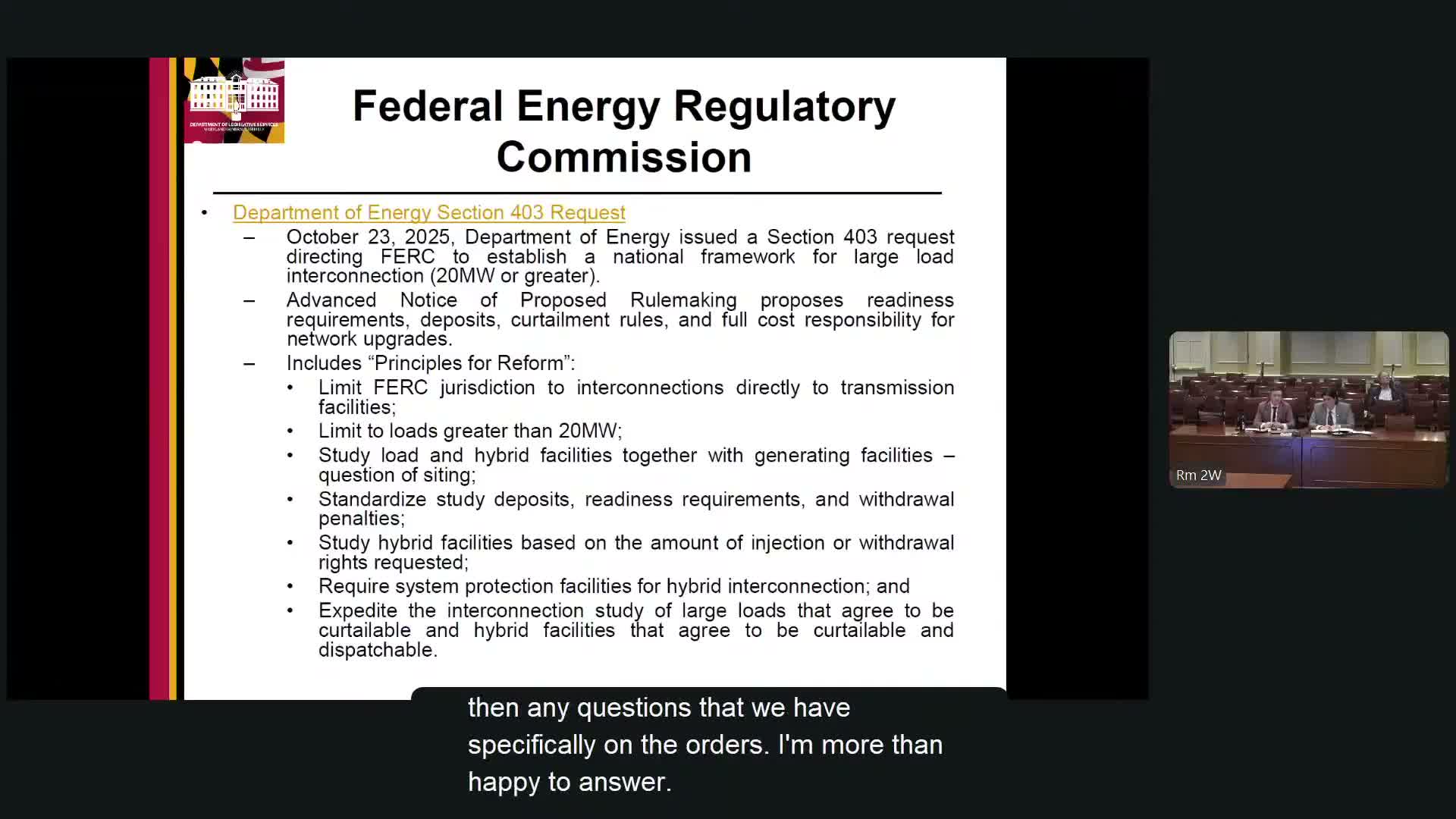
Department of Legislative Services presenters walked committee members through recent federal activity on large‑load interconnection that could affect Maryland's grid and ratepayers.
A presenter who identified himself as Daniel Lopez, describing roughly 20 years in energy policy, said the Department of Energy issued a Section 403 request directing the Federal Energy Regulatory Commission to develop a national framework for large interconnections (generally those 20 megawatts or greater) that could standardize readiness requirements, study deposits, curtailment rules and cost responsibility for network upgrades. Lopez said the DOE request seeks to limit jurisdictional friction between federal and state processes and to speed interconnection for large facilities.
Analysts also pointed to a FERC proceeding that found the PJM tariff did not provide transparent, nondiscriminatory rules for serving large co‑located loads and directed PJM to submit compliance filings and tariff revisions. Lopez said the proceeding emphasized clear rules to support AI‑driven data centers and other large loads while protecting grid reliability in PJM's 13‑state footprint.
Committee members pressed on who would ultimately pay for upgrades and on how PJM might treat new proposals. "Our system is not our system. Our system is part of a bigger system, which is PJM," Lopez said, explaining that many costs currently socialize across PJM and that proposals to allocate more cost responsibility to large loads could change rate dynamics for Maryland households and businesses.
Lawmakers and staff discussed parallel proposals from governors and the PJM stakeholder process, and several members noted they had given testimony to PJM or FERC. Panelists said the PJM proposals still require FERC approval for tariff changes and that outcomes depend on forthcoming filings and legal reviews.
No formal committee action was taken; members asked staff to monitor PJM and FERC compliance filings and to provide additional analysis on cost allocation consequences for the state.
A presenter who identified himself as Daniel Lopez, describing roughly 20 years in energy policy, said the Department of Energy issued a Section 403 request directing the Federal Energy Regulatory Commission to develop a national framework for large interconnections (generally those 20 megawatts or greater) that could standardize readiness requirements, study deposits, curtailment rules and cost responsibility for network upgrades. Lopez said the DOE request seeks to limit jurisdictional friction between federal and state processes and to speed interconnection for large facilities.
Analysts also pointed to a FERC proceeding that found the PJM tariff did not provide transparent, nondiscriminatory rules for serving large co‑located loads and directed PJM to submit compliance filings and tariff revisions. Lopez said the proceeding emphasized clear rules to support AI‑driven data centers and other large loads while protecting grid reliability in PJM's 13‑state footprint.
Committee members pressed on who would ultimately pay for upgrades and on how PJM might treat new proposals. "Our system is not our system. Our system is part of a bigger system, which is PJM," Lopez said, explaining that many costs currently socialize across PJM and that proposals to allocate more cost responsibility to large loads could change rate dynamics for Maryland households and businesses.
Lawmakers and staff discussed parallel proposals from governors and the PJM stakeholder process, and several members noted they had given testimony to PJM or FERC. Panelists said the PJM proposals still require FERC approval for tariff changes and that outcomes depend on forthcoming filings and legal reviews.
No formal committee action was taken; members asked staff to monitor PJM and FERC compliance filings and to provide additional analysis on cost allocation consequences for the state.
Don't Miss a Word: See the Full Meeting!
Go beyond summaries. Unlock every video, transcript, and key insight with a Founder Membership.
✓
Get instant access to full meeting videos
✓
Search and clip any phrase from complete transcripts
✓
Receive AI-powered summaries & custom alerts
✓
Enjoy lifetime, unrestricted access to government data
30-day money-back guarantee
