Maryland’s exchange reports record enrollment but warns subsidy losses raise affordability risks
January 23, 2026 | Finance Committee, SENATE, SENATE, Committees, Legislative, Maryland
This article was created by AI summarizing key points discussed. AI makes mistakes, so for full details and context, please refer to the video of the full meeting. Please report any errors so we can fix them. Report an error »
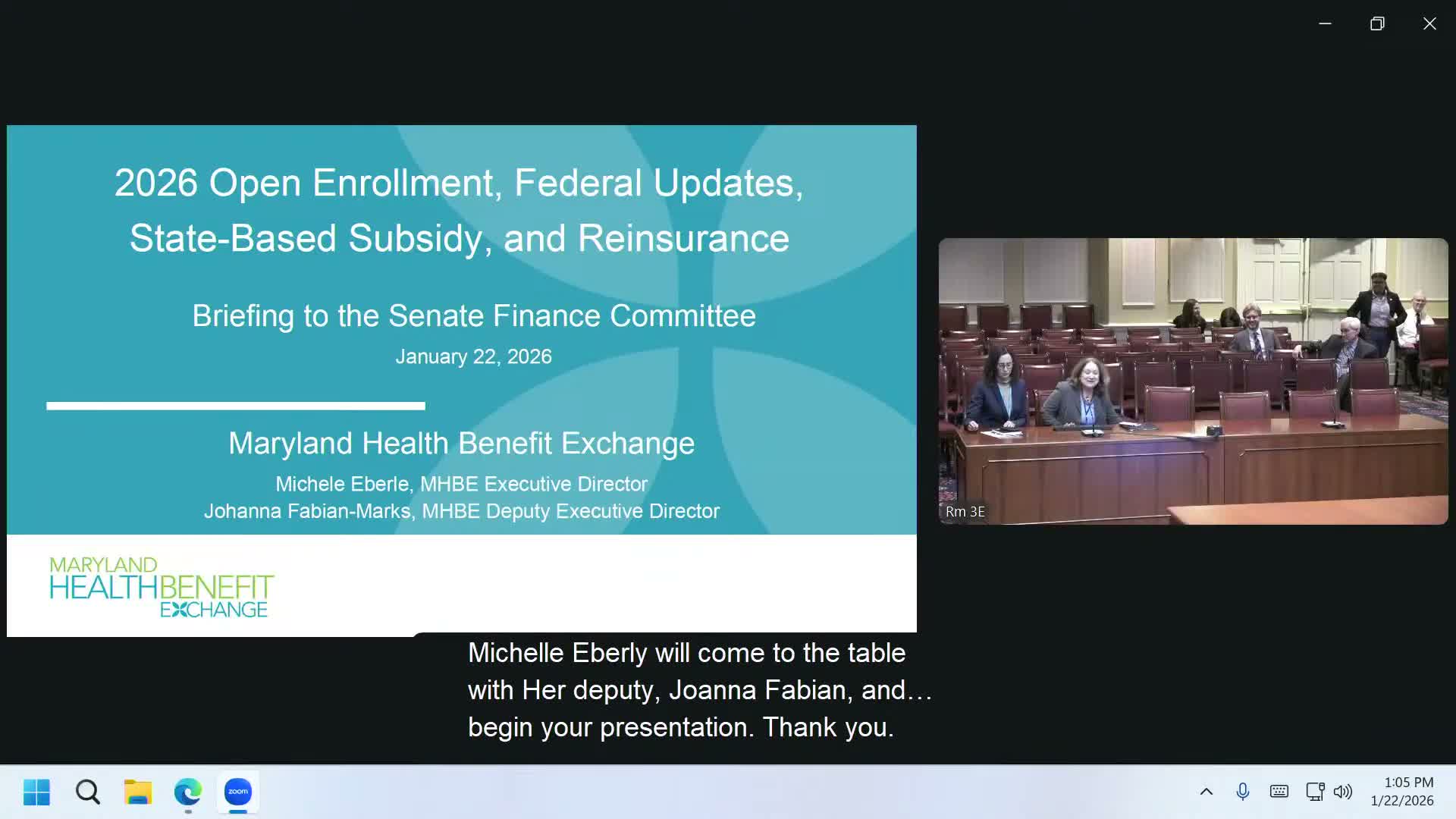
The Maryland Health Benefit Exchange told the Senate Finance Committee on Jan. 22 that the state recorded its highest-ever marketplace enrollment but faces mounting affordability pressures after federal enhanced premium tax credits expired.
"We have over 255,612 people were enrolled in health coverage," Executive Director Michelle Eberly said, citing the Exchange's open-enrollment tally. Eberly and Deputy Joanna Fabian said enrollment rose about 3.4% year-over-year but that new enrollments fell compared with the pandemic-era surge and disenrollments have increased.
Why it matters: Congress’s decision not to renew enhanced premium tax credits left many households with higher premiums. Maryland enacted a state premium assistance program that, officials said, fully backfilled lost federal help for people earning up to 200% of the federal poverty level and partially (on a sliding scale) for those up to 400% of FPL. "We have over a 177,000 Marylanders receiving the state premium assistance at an average of about $94 per month," Fabian said.
Details and scope: Exchange leaders said the state subsidy was funded by reinsurance-related assessments and reserves and was designed as a temporary stopgap to limit enrollment losses while federal action was sought. Officials described how the reinsurance program — operating under a federal waiver — reduces individual-market premiums by about a third relative to what they would be without reinsurance.
Officials cautioned on limits: Eberly and Fabian warned households above 400% of FPL (roughly $64,000 for an individual, $128,000 for a family of four) lost the expanded federal credits and the state lacked resources to fully replace that assistance. That gap led some consumers to shift from gold plans to bronze plans with much higher deductibles, increasing out-of-pocket risk for pre‑retiree age groups.
Reinsurance funding and timing: Fabian said reinsurance is funded by a mix of a 1% assessment on most state-regulated insurance, federal reinsurance payments tied to estimated federal savings, and an early reserve the state is now drawing on to fund the premium-assistance program. The current 1332 waiver and the assessment that funds reinsurance are scheduled to sunset at the end of the waiver period in 2028 without state action; officials said the exchange board will set 2027 program levels while the state decides whether to seek an extension of the waiver and whether to continue the assessment.
Uncertainties and next steps: Exchange staff emphasized that some enrollment measurements are provisional because coverage is not 'effectuated' until the enrollee pays the first bill; they said true dropout numbers will be clearer in March or April. Officials urged careful monitoring and said the subsidy was intended to minimize disruption while the state and federal governments consider longer-term solutions.
Quotes: "People want health insurance," Eberly said, arguing the state action helped keep enrollment from falling as much as projected.
What’s next: Exchange leaders told senators they will keep the committee updated as payment and effectuation data settle in the spring and that 2027 budget and policy choices will be pivotal to sustaining reinsurance and affordability through the waiver period.
"We have over 255,612 people were enrolled in health coverage," Executive Director Michelle Eberly said, citing the Exchange's open-enrollment tally. Eberly and Deputy Joanna Fabian said enrollment rose about 3.4% year-over-year but that new enrollments fell compared with the pandemic-era surge and disenrollments have increased.
Why it matters: Congress’s decision not to renew enhanced premium tax credits left many households with higher premiums. Maryland enacted a state premium assistance program that, officials said, fully backfilled lost federal help for people earning up to 200% of the federal poverty level and partially (on a sliding scale) for those up to 400% of FPL. "We have over a 177,000 Marylanders receiving the state premium assistance at an average of about $94 per month," Fabian said.
Details and scope: Exchange leaders said the state subsidy was funded by reinsurance-related assessments and reserves and was designed as a temporary stopgap to limit enrollment losses while federal action was sought. Officials described how the reinsurance program — operating under a federal waiver — reduces individual-market premiums by about a third relative to what they would be without reinsurance.
Officials cautioned on limits: Eberly and Fabian warned households above 400% of FPL (roughly $64,000 for an individual, $128,000 for a family of four) lost the expanded federal credits and the state lacked resources to fully replace that assistance. That gap led some consumers to shift from gold plans to bronze plans with much higher deductibles, increasing out-of-pocket risk for pre‑retiree age groups.
Reinsurance funding and timing: Fabian said reinsurance is funded by a mix of a 1% assessment on most state-regulated insurance, federal reinsurance payments tied to estimated federal savings, and an early reserve the state is now drawing on to fund the premium-assistance program. The current 1332 waiver and the assessment that funds reinsurance are scheduled to sunset at the end of the waiver period in 2028 without state action; officials said the exchange board will set 2027 program levels while the state decides whether to seek an extension of the waiver and whether to continue the assessment.
Uncertainties and next steps: Exchange staff emphasized that some enrollment measurements are provisional because coverage is not 'effectuated' until the enrollee pays the first bill; they said true dropout numbers will be clearer in March or April. Officials urged careful monitoring and said the subsidy was intended to minimize disruption while the state and federal governments consider longer-term solutions.
Quotes: "People want health insurance," Eberly said, arguing the state action helped keep enrollment from falling as much as projected.
What’s next: Exchange leaders told senators they will keep the committee updated as payment and effectuation data settle in the spring and that 2027 budget and policy choices will be pivotal to sustaining reinsurance and affordability through the waiver period.
View the Full Meeting & All Its Details
This article offers just a summary. Unlock complete video, transcripts, and insights as a Founder Member.
✓
Watch full, unedited meeting videos
✓
Search every word spoken in unlimited transcripts
✓
AI summaries & real-time alerts (all government levels)
✓
Permanent access to expanding government content
30-day money-back guarantee
