Monterey County approves $100,000 discretionary contribution for proposed Alisal arch after heated public debate
January 28, 2026 | Monterey County, California
This article was created by AI summarizing key points discussed. AI makes mistakes, so for full details and context, please refer to the video of the full meeting. Please report any errors so we can fix them. Report an error »
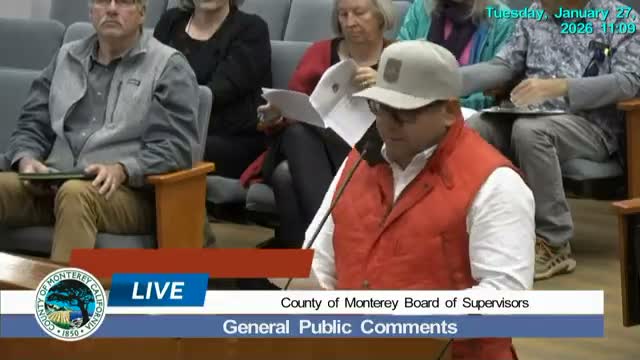
The Monterey County Board of Supervisors approved a $100,000 contribution tied to an invoice from the Community Foundation of Monterey County to support a proposed arch in the East Salinas/Alisal neighborhood after extended public comment and debate. The measure cleared the board on a roll-call vote after members discussed contract language, city involvement, and whether the city of Salinas had formally endorsed the plan.
Opponents from neighborhood groups, small-business associations and residents sharply criticized the proposal during the consent-calendar debate, calling it a “vanity project” and urging county priorities instead be directed to roads, public safety, homeless services and small-business supports. Speakers including LULAC and East Salinas residents said the $100,000 could fund nonprofit services or urgent infrastructure improvements. One caller said, “With all the fiscal turmoil…this is a vanity project for one supervisor’s reelection campaign.”
Supporters, including Supervisor Luis Alejo, framed the contribution as a discretionary, neighborhood-driven investment drawn from a years-long vibrancy plan developed by community members and city staff. Supervisor Chris Lopez and other board members noted prior community meetings and planning documents that included gateways and wayfinding as tools to boost neighborhood pride and economic activity.
Board members raised concerns about how the contract with the Community Foundation was drafted and asked staff to clarify whether the agreement represented the county or an individual, and whether funds could be returned if the city council declined to partner. Following those concerns the board split the consent calendar to take item 33 up separately. After discussion and a brief public hearing, the motion to approve the item passed (4–1).
The board’s approval did not finalize a construction plan or timeline. Several supervisors asked staff to work with the county counsel and the Community Foundation to revise contract language so it unambiguously reflected county authorization and protections, and to report back with clarifications about the city of Salinas’s role before funds are distributed.
The board also invited additional community input and urged the city and county to work together on transparency and fundraising for the project; a number of speakers urged broader investment in the East Salinas area instead of a single built feature. The county clerk’s office will include public comments for the record.
The board’s action was procedural authorization to effectuate the invoice through county contracting if final contract language is corrected and if the city’s role is clarified; it did not approve construction nor set a project schedule.
Opponents from neighborhood groups, small-business associations and residents sharply criticized the proposal during the consent-calendar debate, calling it a “vanity project” and urging county priorities instead be directed to roads, public safety, homeless services and small-business supports. Speakers including LULAC and East Salinas residents said the $100,000 could fund nonprofit services or urgent infrastructure improvements. One caller said, “With all the fiscal turmoil…this is a vanity project for one supervisor’s reelection campaign.”
Supporters, including Supervisor Luis Alejo, framed the contribution as a discretionary, neighborhood-driven investment drawn from a years-long vibrancy plan developed by community members and city staff. Supervisor Chris Lopez and other board members noted prior community meetings and planning documents that included gateways and wayfinding as tools to boost neighborhood pride and economic activity.
Board members raised concerns about how the contract with the Community Foundation was drafted and asked staff to clarify whether the agreement represented the county or an individual, and whether funds could be returned if the city council declined to partner. Following those concerns the board split the consent calendar to take item 33 up separately. After discussion and a brief public hearing, the motion to approve the item passed (4–1).
The board’s approval did not finalize a construction plan or timeline. Several supervisors asked staff to work with the county counsel and the Community Foundation to revise contract language so it unambiguously reflected county authorization and protections, and to report back with clarifications about the city of Salinas’s role before funds are distributed.
The board also invited additional community input and urged the city and county to work together on transparency and fundraising for the project; a number of speakers urged broader investment in the East Salinas area instead of a single built feature. The county clerk’s office will include public comments for the record.
The board’s action was procedural authorization to effectuate the invoice through county contracting if final contract language is corrected and if the city’s role is clarified; it did not approve construction nor set a project schedule.
View the Full Meeting & All Its Details
This article offers just a summary. Unlock complete video, transcripts, and insights as a Founder Member.
✓
Watch full, unedited meeting videos
✓
Search every word spoken in unlimited transcripts
✓
AI summaries & real-time alerts (all government levels)
✓
Permanent access to expanding government content
30-day money-back guarantee
