House Bill 2 sets targets for utilities to expand low‑income heat‑saving programs
January 23, 2026 | 2026 Legislature VA, Virginia
This article was created by AI summarizing key points discussed. AI makes mistakes, so for full details and context, please refer to the video of the full meeting. Please report any errors so we can fix them. Report an error »
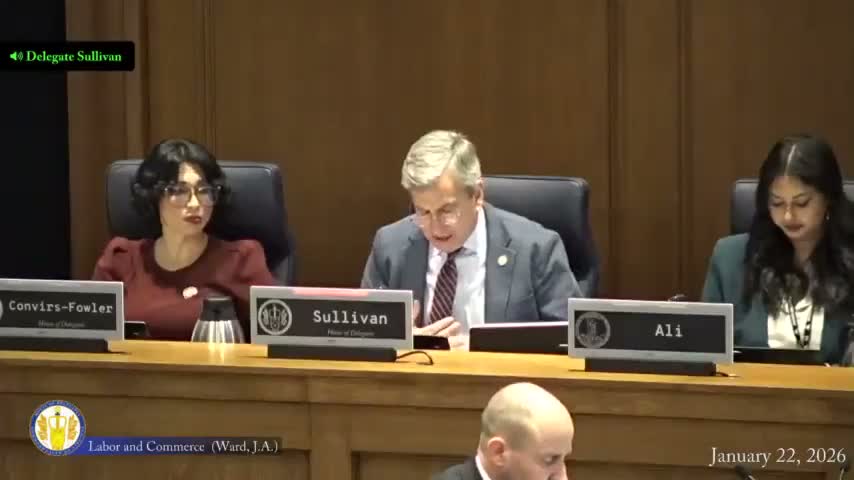
A Commerce Committee substitute for House Bill 2, sponsored by Delegate Carr, directs utilities to expand energy‑efficiency measures aimed at low‑income Virginians and sets a performance target for program delivery by 2031.
The substitute requires Dominion Energy and Appalachian Power Company to make best reasonable efforts to provide prescriptive efficiency measures and related improvements to a defined share of qualifying households and to report to the State Corporation Commission by Jan. 1, 2028, and annually thereafter. The bill excludes fuel‑powered equipment from the definition of certain prescriptive measures and aligns program design with recommendations expected from an Energy Efficiency and Weatherization Task Force established under HB 3.
Proponents said the bill narrows its focus to households with the highest energy burden and urged adoption of heat pumps as a cost‑saving measure: "This bill will save those customers over $1,400 a year," a sponsor said during the hearing. Supporters also argued the program would be self‑funding in part by shifting expenses from oil payments to electric ratepayer investments.
Committee members asked whether the targets would be added to utility rate bases and what additional funding streams could be tapped; witnesses said the actual funding mix could include federal sources (for example, Inflation Reduction Act programs), state housing and weatherization funds administered by the Department of Housing and Community Development, and other streams. The substitute does not impose a statutory civil penalty for failing to hit the targets; sponsors described them as program performance goals rather than mandates.
The committee approved the substitute by a recorded vote of 16–6. The measure will proceed in the legislative process with the substitute in place.
The committee’s action followed a related presentation on HB 3, which would create a task force to study barriers and recommend implementation steps for weatherization and efficiency programs for income‑qualified households.
The substitute requires Dominion Energy and Appalachian Power Company to make best reasonable efforts to provide prescriptive efficiency measures and related improvements to a defined share of qualifying households and to report to the State Corporation Commission by Jan. 1, 2028, and annually thereafter. The bill excludes fuel‑powered equipment from the definition of certain prescriptive measures and aligns program design with recommendations expected from an Energy Efficiency and Weatherization Task Force established under HB 3.
Proponents said the bill narrows its focus to households with the highest energy burden and urged adoption of heat pumps as a cost‑saving measure: "This bill will save those customers over $1,400 a year," a sponsor said during the hearing. Supporters also argued the program would be self‑funding in part by shifting expenses from oil payments to electric ratepayer investments.
Committee members asked whether the targets would be added to utility rate bases and what additional funding streams could be tapped; witnesses said the actual funding mix could include federal sources (for example, Inflation Reduction Act programs), state housing and weatherization funds administered by the Department of Housing and Community Development, and other streams. The substitute does not impose a statutory civil penalty for failing to hit the targets; sponsors described them as program performance goals rather than mandates.
The committee approved the substitute by a recorded vote of 16–6. The measure will proceed in the legislative process with the substitute in place.
The committee’s action followed a related presentation on HB 3, which would create a task force to study barriers and recommend implementation steps for weatherization and efficiency programs for income‑qualified households.
Don't Miss a Word: See the Full Meeting!
Go beyond summaries. Unlock every video, transcript, and key insight with a Founder Membership.
✓
Get instant access to full meeting videos
✓
Search and clip any phrase from complete transcripts
✓
Receive AI-powered summaries & custom alerts
✓
Enjoy lifetime, unrestricted access to government data
30-day money-back guarantee
