House Transportation Committee reports five bills, including parkway enforcement and helmet requirement
January 23, 2026 | 2026 Legislature VA, Virginia
This article was created by AI summarizing key points discussed. AI makes mistakes, so for full details and context, please refer to the video of the full meeting. Please report any errors so we can fix them. Report an error »
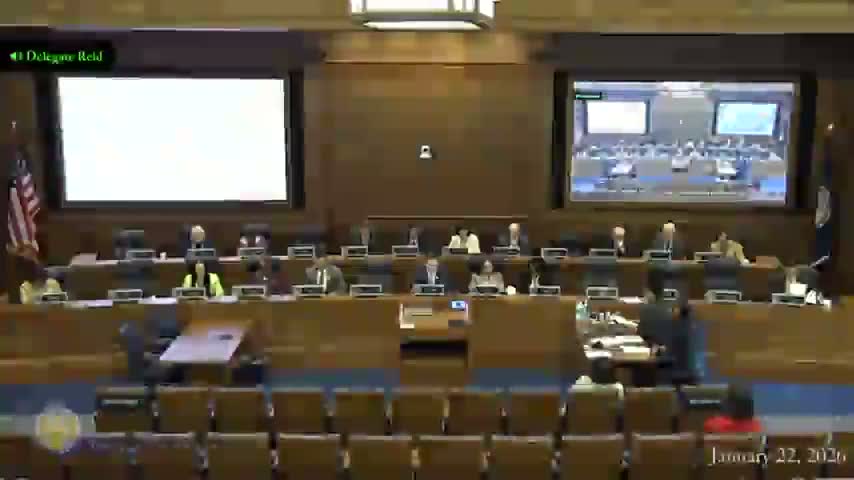
Richmond — The House Committee on Transportation on Thursday received a subcommittee report from Delegate Reid and unanimously voted to report five bills out of committee. The transcript does not specify the meeting date.
"House Bill 77 provides that local state law enforcement may be able to enforce traffic infractions on a small section of the George Washington Parkway in Fairfax County," Delegate Reid said, describing the measure as targeted to an eight-mile stretch currently patrolled by a single federal trooper and stating that infractions would be handled in the local general district court. Reid said the subcommittee recommended an amendment and that the subcommittee vote was 9–0.
The committee recorded the following outcomes during the session: HB77 was reported as amended (roll call recorded as 14–0); a substitute for HB30 (which incorporated House Bill 233, by Delegate Washman) was reported 15–0; HB343, which would require helmets for skateboard and scooter riders, was reported 15–0; HB351 (sponsored in the transcript by Delegate Fagan) would codify an existing memorandum of understanding allowing Fort Pickett emergency vehicles to provide service off base and was reported 15–0; and HB409 (presented by Delegate Reid) clarifies that if a divided highway has an opening it remains a divided highway for purposes of the requirement to stop for a school bus; HB409 was reported 16–0.
On HB351, the record states that roughly "20 to 25" emergency vehicles at Fort Pickett routinely provide emergency support off the military base; the transcript describes the bill as putting that existing arrangement into code via a memorandum of understanding. The transcript does not provide the full text of the MOU or specific code sections affected.
The committee’s proceedings were procedural and brief: after the roll calls and reporting votes, the subcommittee report was closed and a motion to adjourn was approved by voice vote.
What the record does not show: the transcript names delegates associated with the bills (for example, Delegate Reid, Delegate Washman and Delegate Fagan), but does not list individual roll-call votes by member name; specific statutory citations or affected code sections are not provided in the transcript. Several items (the committee chair's personal name and the meeting date) are not specified in the transcript and are therefore presented here as not specified rather than inferred.
Next steps: Reported bills proceed through the legislative process according to chamber rules and calendars; the transcript records only the committee reporting actions and does not reflect final floor votes or enactment.
"House Bill 77 provides that local state law enforcement may be able to enforce traffic infractions on a small section of the George Washington Parkway in Fairfax County," Delegate Reid said, describing the measure as targeted to an eight-mile stretch currently patrolled by a single federal trooper and stating that infractions would be handled in the local general district court. Reid said the subcommittee recommended an amendment and that the subcommittee vote was 9–0.
The committee recorded the following outcomes during the session: HB77 was reported as amended (roll call recorded as 14–0); a substitute for HB30 (which incorporated House Bill 233, by Delegate Washman) was reported 15–0; HB343, which would require helmets for skateboard and scooter riders, was reported 15–0; HB351 (sponsored in the transcript by Delegate Fagan) would codify an existing memorandum of understanding allowing Fort Pickett emergency vehicles to provide service off base and was reported 15–0; and HB409 (presented by Delegate Reid) clarifies that if a divided highway has an opening it remains a divided highway for purposes of the requirement to stop for a school bus; HB409 was reported 16–0.
On HB351, the record states that roughly "20 to 25" emergency vehicles at Fort Pickett routinely provide emergency support off the military base; the transcript describes the bill as putting that existing arrangement into code via a memorandum of understanding. The transcript does not provide the full text of the MOU or specific code sections affected.
The committee’s proceedings were procedural and brief: after the roll calls and reporting votes, the subcommittee report was closed and a motion to adjourn was approved by voice vote.
What the record does not show: the transcript names delegates associated with the bills (for example, Delegate Reid, Delegate Washman and Delegate Fagan), but does not list individual roll-call votes by member name; specific statutory citations or affected code sections are not provided in the transcript. Several items (the committee chair's personal name and the meeting date) are not specified in the transcript and are therefore presented here as not specified rather than inferred.
Next steps: Reported bills proceed through the legislative process according to chamber rules and calendars; the transcript records only the committee reporting actions and does not reflect final floor votes or enactment.
Don't Miss a Word: See the Full Meeting!
Go beyond summaries. Unlock every video, transcript, and key insight with a Founder Membership.
✓
Get instant access to full meeting videos
✓
Search and clip any phrase from complete transcripts
✓
Receive AI-powered summaries & custom alerts
✓
Enjoy lifetime, unrestricted access to government data
30-day money-back guarantee
