Committee reviews Act 43 reports on municipal grant efficiencies and payback rules
January 30, 2026 | Transportation, HOUSE OF REPRESENTATIVES, Committees, Legislative , Vermont
This article was created by AI summarizing key points discussed. AI makes mistakes, so for full details and context, please refer to the video of the full meeting. Please report any errors so we can fix them. Report an error »
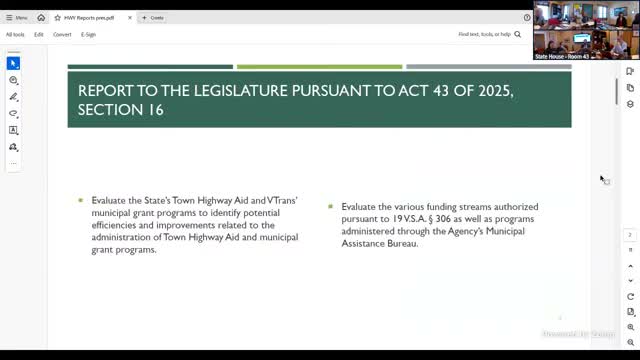
The House Transportation Committee on Jan. 29 received two reports required by Act 43 (2025) that examined municipal grant administration and the payback rules when locally managed projects are canceled.
Jeremy Reed, speaking for the Agency of Transportation, said the two-part review looked at (1) potential efficiencies across multiple town-aid and municipal grant programs and (2) the appropriate payback provisions when a town declines or cancels a project that has state or federal funds committed.
The agency’s high-level findings were that smaller municipalities face a heavy administrative burden to apply for and manage grants, federal funding introduces additional compliance complexity, and inconsistent language in statutes and grant agreements creates uncertainty about payback obligations. Reed said some municipalities lack the fiscal discipline to set aside direct-aid reserve funds, which complicates any proposal to simply "bake" grant dollars into annual aid.
On payback provisions, Reed noted that appeals currently go to the Transportation Board and that statutory language and the grant agreements are ambiguous. He said the current interpretation can require compressed discovery and hearings—"the T Board has to issue a decision within 30 days of the appeal"—which discourages mediation and negotiation. The report recommends clearer statutory language, mandated scoping or scoping-plus before construction grants, targeted training for municipal officials, and revisiting the appeals timeline so mediation can occur.
The agency proposed no immediate statutory changes; Reed said AOT will consult regional planning commissions and the Vermont League of Cities and Towns (VLCT) before proposing revisions. The committee discussed practical options: a single web page for grant opportunities, cloud-based unified applications, and incentives for towns to establish reserve funds.
What happens next: AOT will continue stakeholder engagement with RPCs and VLCT, consider statutory language updates, and return with further recommendations if consensus emerges. The committee may call additional testimony.
Jeremy Reed, speaking for the Agency of Transportation, said the two-part review looked at (1) potential efficiencies across multiple town-aid and municipal grant programs and (2) the appropriate payback provisions when a town declines or cancels a project that has state or federal funds committed.
The agency’s high-level findings were that smaller municipalities face a heavy administrative burden to apply for and manage grants, federal funding introduces additional compliance complexity, and inconsistent language in statutes and grant agreements creates uncertainty about payback obligations. Reed said some municipalities lack the fiscal discipline to set aside direct-aid reserve funds, which complicates any proposal to simply "bake" grant dollars into annual aid.
On payback provisions, Reed noted that appeals currently go to the Transportation Board and that statutory language and the grant agreements are ambiguous. He said the current interpretation can require compressed discovery and hearings—"the T Board has to issue a decision within 30 days of the appeal"—which discourages mediation and negotiation. The report recommends clearer statutory language, mandated scoping or scoping-plus before construction grants, targeted training for municipal officials, and revisiting the appeals timeline so mediation can occur.
The agency proposed no immediate statutory changes; Reed said AOT will consult regional planning commissions and the Vermont League of Cities and Towns (VLCT) before proposing revisions. The committee discussed practical options: a single web page for grant opportunities, cloud-based unified applications, and incentives for towns to establish reserve funds.
What happens next: AOT will continue stakeholder engagement with RPCs and VLCT, consider statutory language updates, and return with further recommendations if consensus emerges. The committee may call additional testimony.
View the Full Meeting & All Its Details
This article offers just a summary. Unlock complete video, transcripts, and insights as a Founder Member.
✓
Watch full, unedited meeting videos
✓
Search every word spoken in unlimited transcripts
✓
AI summaries & real-time alerts (all government levels)
✓
Permanent access to expanding government content
30-day money-back guarantee
