Vermont officials say fiber buildout has reached all but about 1,800 addresses
January 30, 2026 | Environment & Energy, HOUSE OF REPRESENTATIVES, Committees, Legislative , Vermont
This article was created by AI summarizing key points discussed. AI makes mistakes, so for full details and context, please refer to the video of the full meeting. Please report any errors so we can fix them. Report an error »
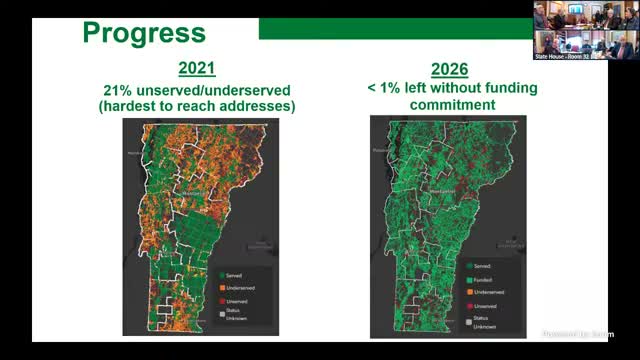
Vermont Community Broadband Board Executive Director Christine Halkwist told the House Energy and Digital Infrastructure Committee on Jan. 29 that the state has connected the vast majority of addresses to broadband and is now focused on the hardest last mile.
"That half percent represents about 1,800 addresses," Halkwist said, summarizing the Board’s assessment of a roughly 315,000‑address inventory. Board officials said they are reviewing each remaining location to identify the most feasible solution, noting some are off‑grid and present higher technical and cost challenges.
The presenters and Communications Union District (CUD) leaders credited Act 71 of 2021 and roughly $250 million in ARPA funding with jump‑starting municipal broadband buildout, and they described a mix of federal grants (USDA Reconnect, Community Connect and the pending BEAD awards), state match and private investment that together have driven construction and private upgrades in previously cable‑only towns.
CUD leaders said fiber‑to‑the‑premises (FTTP) remains the preferred technology for Vermont because it delivers symmetrical speeds and greater long‑term reliability in forested, rural terrain. They warned satellite and some wireless approaches can fail in heavy tree cover or denser clusters of users.
Officials said they are preparing for the final logistics of connecting the remaining addresses and emphasized coordination with towns and developers to reduce future connection costs. The Board and some CUDs are also using customer revenue and limited financing to fill gaps; one CUD leader said the district has committed $10,000,000 in local match financing to strengthen a provisional BEAD award application.
The committee asked staff to provide budget details for the Board’s FY27 recommendation and to follow up on mechanisms to ensure the last addresses receive service. The hearing closed with a promise of additional, targeted follow‑up work by staff and committee members.
"That half percent represents about 1,800 addresses," Halkwist said, summarizing the Board’s assessment of a roughly 315,000‑address inventory. Board officials said they are reviewing each remaining location to identify the most feasible solution, noting some are off‑grid and present higher technical and cost challenges.
The presenters and Communications Union District (CUD) leaders credited Act 71 of 2021 and roughly $250 million in ARPA funding with jump‑starting municipal broadband buildout, and they described a mix of federal grants (USDA Reconnect, Community Connect and the pending BEAD awards), state match and private investment that together have driven construction and private upgrades in previously cable‑only towns.
CUD leaders said fiber‑to‑the‑premises (FTTP) remains the preferred technology for Vermont because it delivers symmetrical speeds and greater long‑term reliability in forested, rural terrain. They warned satellite and some wireless approaches can fail in heavy tree cover or denser clusters of users.
Officials said they are preparing for the final logistics of connecting the remaining addresses and emphasized coordination with towns and developers to reduce future connection costs. The Board and some CUDs are also using customer revenue and limited financing to fill gaps; one CUD leader said the district has committed $10,000,000 in local match financing to strengthen a provisional BEAD award application.
The committee asked staff to provide budget details for the Board’s FY27 recommendation and to follow up on mechanisms to ensure the last addresses receive service. The hearing closed with a promise of additional, targeted follow‑up work by staff and committee members.
Don't Miss a Word: See the Full Meeting!
Go beyond summaries. Unlock every video, transcript, and key insight with a Founder Membership.
✓
Get instant access to full meeting videos
✓
Search and clip any phrase from complete transcripts
✓
Receive AI-powered summaries & custom alerts
✓
Enjoy lifetime, unrestricted access to government data
30-day money-back guarantee
