Vermont board keeps affordable connection programs and apprenticeship pipeline amid federal shifts
January 30, 2026 | Environment & Energy, HOUSE OF REPRESENTATIVES, Committees, Legislative , Vermont
This article was created by AI summarizing key points discussed. AI makes mistakes, so for full details and context, please refer to the video of the full meeting. Please report any errors so we can fix them. Report an error »
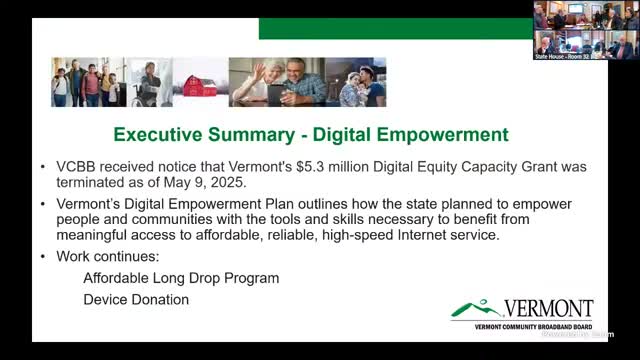
Vermont Community Broadband Board staff told the House committee on Jan. 29 they are pivoting to preserve key affordability and workforce programs after federal changes reduced some digital equity funding.
Halkwist said a planned $5,300,000 digital equity grant was substantially reduced under the new federal administration, but the Board is continuing a limited device donation pilot and other partnerships to keep parts of the program operating. "We are working on a device program working with partners," she said, describing partnerships with institutions that replace devices and then sanitize and refurbish them for distribution to low‑income households.
To lower connection barriers, the Board has allocated $8,000,000 to an 'affordable long drop' program to cover the first segment of an individual customer drop — generally the first 400 feet — when distance or terrain makes installation costly. Board staff said typical drop costs can range from about $2,000 up to $5,000 and that the program prioritizes lowest‑income households.
On workforce, the Board described a pre‑apprenticeship model run with North Country Career Center that provides a three‑week training (including pole‑climbing) and reported about 70% placement of graduates into fiber jobs. Staff said they expect to scale training and add trainers to reach southern parts of the state.
Legislators asked about income verification and program eligibility; the Board said CUDs will work with community action agencies and that low‑income verification uses existing agency procedures while moderate‑income households may use self‑attestation.
Halkwist said a planned $5,300,000 digital equity grant was substantially reduced under the new federal administration, but the Board is continuing a limited device donation pilot and other partnerships to keep parts of the program operating. "We are working on a device program working with partners," she said, describing partnerships with institutions that replace devices and then sanitize and refurbish them for distribution to low‑income households.
To lower connection barriers, the Board has allocated $8,000,000 to an 'affordable long drop' program to cover the first segment of an individual customer drop — generally the first 400 feet — when distance or terrain makes installation costly. Board staff said typical drop costs can range from about $2,000 up to $5,000 and that the program prioritizes lowest‑income households.
On workforce, the Board described a pre‑apprenticeship model run with North Country Career Center that provides a three‑week training (including pole‑climbing) and reported about 70% placement of graduates into fiber jobs. Staff said they expect to scale training and add trainers to reach southern parts of the state.
Legislators asked about income verification and program eligibility; the Board said CUDs will work with community action agencies and that low‑income verification uses existing agency procedures while moderate‑income households may use self‑attestation.
View the Full Meeting & All Its Details
This article offers just a summary. Unlock complete video, transcripts, and insights as a Founder Member.
✓
Watch full, unedited meeting videos
✓
Search every word spoken in unlimited transcripts
✓
AI summaries & real-time alerts (all government levels)
✓
Permanent access to expanding government content
30-day money-back guarantee
