Supervisors consider 'recreation economy' label, weigh low‑intensity camping and TOT uses
January 30, 2026 | Nevada County, California
This article was created by AI summarizing key points discussed. AI makes mistakes, so for full details and context, please refer to the video of the full meeting. Please report any errors so we can fix them. Report an error »
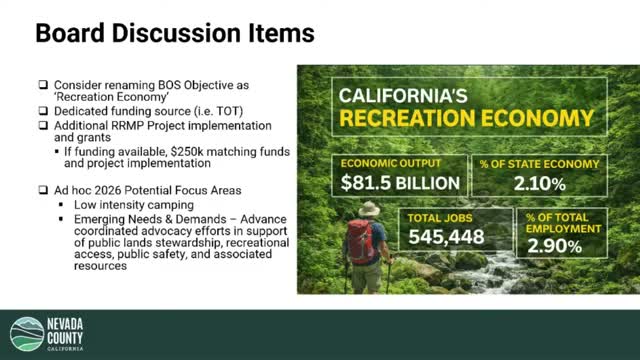
Nevada County supervisors and recreation partners on Jan. 28 debated how to fund and manage a rising recreation economy that supports tourism, events and local parks.
Tricia Tillotson, community development director, framed a morning panel that included park district leaders, nonprofit trail organizations and county staff as they reviewed progress on Pines To Mines signage, the South Yuba River public‑safety cohort and the county’s Outdoor Visitor Safety Fund. "The county basically acts now as a backbone organization for recreation and resilience by bringing our partners together," county staff Shivati Karki Pearl said.
Park district leaders said aging facilities, parking and staffing strains are the most urgent needs. Brandon Linson, chair of the Western Gateway Park board, said his 86‑acre district runs on about $12.94 per parcel and relies heavily on grants and volunteers. "It's just not sustainable to rely on volunteers and poorly paid staff to maintain it all," Linson told supervisors.
Supervisors debated two funding and regulatory choices that staff put before them: (1) changing the objective name to "Recreation Economy" to clarify the county’s role in supporting tourism and events, and (2) whether to pursue a local ordinance to regulate low‑intensity private camping (so‑called Hipcamp/"low impact" sites) under Assembly Bill 518.
Shivati told the board that about 60 private landowners in the county already host low‑intensity sites and that county surveys show visitor spending tied to those stays; a county CFO clarified county TOT revenue and the proportional impact of short‑term rental and camping activity on local receipts.
Supervisor discussion focused on tradeoffs: a permissive, low‑barrier local camping ordinance could expand rural income for landowners and generate TOT revenues, but supervisors also raised concerns about fire risk, sanitation and enforcement. Supervisor Tucker urged that any new local rules include a low‑burden, de minimis pathway to allow small rural operators to participate without protracted permitting.
The board gave staff direction to return with options: (a) a study and draft ordinance on low‑intensity camping that would consider AB 518 and San Benito County’s approach; and (b) further analysis of TOT/TBID mechanisms and whether to dedicate a portion of TOT for recreation projects. Staff will report back with program design alternatives and fiscal estimates.
Why it matters: Recreation and outdoor tourism are major local revenue drivers in Nevada County. Supervisors seek to balance visitor revenue, public safety and neighborhood impacts while providing new tools for small rural landowners to host low‑intensity tourism without creating public hazards.
What to expect next: staff will return with an ordinance/options memorandum for low‑intensity camping and a separate briefing on TOT/TBID options and likely revenue impacts.
Tricia Tillotson, community development director, framed a morning panel that included park district leaders, nonprofit trail organizations and county staff as they reviewed progress on Pines To Mines signage, the South Yuba River public‑safety cohort and the county’s Outdoor Visitor Safety Fund. "The county basically acts now as a backbone organization for recreation and resilience by bringing our partners together," county staff Shivati Karki Pearl said.
Park district leaders said aging facilities, parking and staffing strains are the most urgent needs. Brandon Linson, chair of the Western Gateway Park board, said his 86‑acre district runs on about $12.94 per parcel and relies heavily on grants and volunteers. "It's just not sustainable to rely on volunteers and poorly paid staff to maintain it all," Linson told supervisors.
Supervisors debated two funding and regulatory choices that staff put before them: (1) changing the objective name to "Recreation Economy" to clarify the county’s role in supporting tourism and events, and (2) whether to pursue a local ordinance to regulate low‑intensity private camping (so‑called Hipcamp/"low impact" sites) under Assembly Bill 518.
Shivati told the board that about 60 private landowners in the county already host low‑intensity sites and that county surveys show visitor spending tied to those stays; a county CFO clarified county TOT revenue and the proportional impact of short‑term rental and camping activity on local receipts.
Supervisor discussion focused on tradeoffs: a permissive, low‑barrier local camping ordinance could expand rural income for landowners and generate TOT revenues, but supervisors also raised concerns about fire risk, sanitation and enforcement. Supervisor Tucker urged that any new local rules include a low‑burden, de minimis pathway to allow small rural operators to participate without protracted permitting.
The board gave staff direction to return with options: (a) a study and draft ordinance on low‑intensity camping that would consider AB 518 and San Benito County’s approach; and (b) further analysis of TOT/TBID mechanisms and whether to dedicate a portion of TOT for recreation projects. Staff will report back with program design alternatives and fiscal estimates.
Why it matters: Recreation and outdoor tourism are major local revenue drivers in Nevada County. Supervisors seek to balance visitor revenue, public safety and neighborhood impacts while providing new tools for small rural landowners to host low‑intensity tourism without creating public hazards.
What to expect next: staff will return with an ordinance/options memorandum for low‑intensity camping and a separate briefing on TOT/TBID options and likely revenue impacts.
Don't Miss a Word: See the Full Meeting!
Go beyond summaries. Unlock every video, transcript, and key insight with a Founder Membership.
✓
Get instant access to full meeting videos
✓
Search and clip any phrase from complete transcripts
✓
Receive AI-powered summaries & custom alerts
✓
Enjoy lifetime, unrestricted access to government data
30-day money-back guarantee
