County outlines evacuation study, ZoneHaven tool and targeted fuel‑reduction projects
January 30, 2026 | Nevada County, California
This article was created by AI summarizing key points discussed. AI makes mistakes, so for full details and context, please refer to the video of the full meeting. Please report any errors so we can fix them. Report an error »
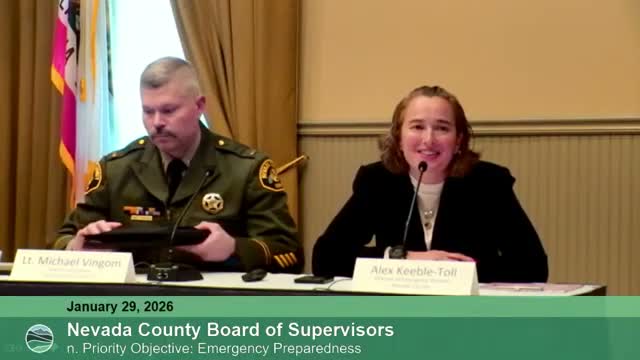
Nevada County emergency managers and law enforcement on Jan. 28 described a coordinated plan to reduce evacuation risk in communities the county’s 2024 evacuation study identified as most vulnerable.
Alex Kibble Toll, director of the Office of Emergency Services, said the county has completed an analysis pinpointing communities and road corridors that would be most affected by wildfire evacuations and is pursuing a mix of grant-funded and local projects. "Our most evacuation impacted communities countywide are Alta Sierra, Greenhorn Road, Cascade Shores, Banner Mountain, Lake Of The Pines, and Lake Wildwood," Kibble Toll said.
The county is advancing several large, grant‑funded projects: a FEMA HMGP‑funded roadside vegetation project in Alta Sierra; a $750,000 USFS‑funded Greenhorn Road/Banner Mountain project to clear hazard along evacuation corridors; an HMGP shaded-fuel-break project for Lake Wildwood (1,100 acres planned, 726 acres along critical corridors); and implementation work done under Good Neighbor agreements with Tahoe National Forest in other areas.
Kibble Toll explained that the county will continue free roadside chipping and green‑waste events for Firewise communities and will prioritize work based on the evacuation study. He also announced an RFP for a replacement alert‑and‑warning platform after November’s CodeRED data breach; the RFP closes Feb. 23 and staff plan a community rollout this spring.
Lieutenant Mike Bingham of the sheriff’s office outlined operational evacuation responsibilities in unincorporated areas: assessing evacuation need, door‑to‑door and siren notification, toggling targeted alert zones and integrating volunteers. Bingham described the county’s SAR EVAC and HEART volunteer teams that assist with people and animal evacuations.
Supervisors supported prioritizing evacuation‑route and roadside fuel treatments and asked staff to pursue grants aggressively while identifying where general‑fund investments would be necessary. Staff proposed a $200,000 community‑scale green‑waste and chipping program for FY 26–27 as a priority with a smaller $47,000 option if no new funds are available.
Why it matters: Nevada County officials say 92 percent of residents live in very‑high fire hazard zones and many households rely on private roads as first‑leg evacuation corridors. Targeted vegetation management and better alerting are key to preventing entrapment and reducing loss.
What to expect next: the board asked staff to prioritize evacuation route projects, coordinate with Caltrans/transportation partners on state routes, continue community engagement, and consider general‑fund requests as part of the FY 26–27 process.
Alex Kibble Toll, director of the Office of Emergency Services, said the county has completed an analysis pinpointing communities and road corridors that would be most affected by wildfire evacuations and is pursuing a mix of grant-funded and local projects. "Our most evacuation impacted communities countywide are Alta Sierra, Greenhorn Road, Cascade Shores, Banner Mountain, Lake Of The Pines, and Lake Wildwood," Kibble Toll said.
The county is advancing several large, grant‑funded projects: a FEMA HMGP‑funded roadside vegetation project in Alta Sierra; a $750,000 USFS‑funded Greenhorn Road/Banner Mountain project to clear hazard along evacuation corridors; an HMGP shaded-fuel-break project for Lake Wildwood (1,100 acres planned, 726 acres along critical corridors); and implementation work done under Good Neighbor agreements with Tahoe National Forest in other areas.
Kibble Toll explained that the county will continue free roadside chipping and green‑waste events for Firewise communities and will prioritize work based on the evacuation study. He also announced an RFP for a replacement alert‑and‑warning platform after November’s CodeRED data breach; the RFP closes Feb. 23 and staff plan a community rollout this spring.
Lieutenant Mike Bingham of the sheriff’s office outlined operational evacuation responsibilities in unincorporated areas: assessing evacuation need, door‑to‑door and siren notification, toggling targeted alert zones and integrating volunteers. Bingham described the county’s SAR EVAC and HEART volunteer teams that assist with people and animal evacuations.
Supervisors supported prioritizing evacuation‑route and roadside fuel treatments and asked staff to pursue grants aggressively while identifying where general‑fund investments would be necessary. Staff proposed a $200,000 community‑scale green‑waste and chipping program for FY 26–27 as a priority with a smaller $47,000 option if no new funds are available.
Why it matters: Nevada County officials say 92 percent of residents live in very‑high fire hazard zones and many households rely on private roads as first‑leg evacuation corridors. Targeted vegetation management and better alerting are key to preventing entrapment and reducing loss.
What to expect next: the board asked staff to prioritize evacuation route projects, coordinate with Caltrans/transportation partners on state routes, continue community engagement, and consider general‑fund requests as part of the FY 26–27 process.
View the Full Meeting & All Its Details
This article offers just a summary. Unlock complete video, transcripts, and insights as a Founder Member.
✓
Watch full, unedited meeting videos
✓
Search every word spoken in unlimited transcripts
✓
AI summaries & real-time alerts (all government levels)
✓
Permanent access to expanding government content
30-day money-back guarantee
