Code compliance staff update procedures; supervisors debate body‑worn cameras' costs and privacy
January 30, 2026 | Nevada County, California
This article was created by AI summarizing key points discussed. AI makes mistakes, so for full details and context, please refer to the video of the full meeting. Please report any errors so we can fix them. Report an error »
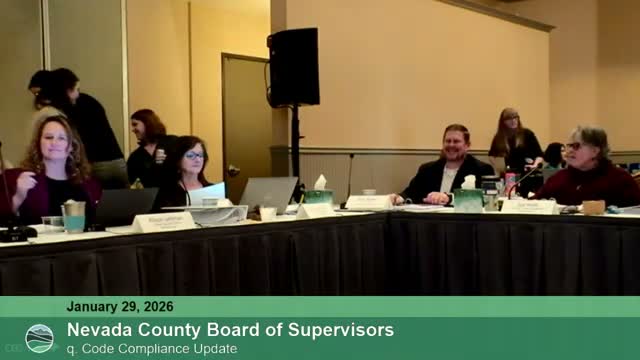
Nevada County code and cannabis compliance staff on Jan. 28 summarized a recent procedural overhaul and discussed whether to pilot body‑worn cameras for non‑law‑enforcement code officers.
Matt Kelly, code division director, described revisions to the department’s procedure manual: standardized case intake, clearer escalation thresholds, defined inspection timelines and stronger documentation to support continuity and consistent enforcement. Supervising officer Kelsey Hess said the team now prioritizes immediate health‑and‑safety concerns and schedules every open case with a next action to prevent old matters from languishing.
Kelsey reported 2025 case statistics: 290 cases opened and 252 closed (an 87% closure rate during a busier year), and said the average code officer manages about 89 active cases. "Every open case has a scheduled action," she said, describing more frequent followups for complex matters.
The board asked about complaints and transparency. Staff noted relatively few appeals or litigation tied to officer conduct (fewer than five cases annually). Staff then summarized a preliminary cost estimate for body‑worn cameras: a five‑year implementation could approach $200,000, not including significant staff time to process public‑records requests and manage stored video. They warned cameras could reduce officer approachability during voluntary‑compliance visits and raise privacy and PRA burdens.
Supervisors asked for more analysis. Some said body‑worn cameras could help resolve disputed interactions and reduce litigation; others, citing staff concerns about approachability and examples of limited appeal cases, asked not to proceed without detailed cost, policy and privacy safeguards.
Next steps: staff will not deploy cameras immediately; the board signalled no objection to a fuller study of costs, legal exposure and data‑management needs to return as a budget‑cycle item if members request it.
Why it matters: Code officers’ interactions with residents are sensitive; transparency tools such as cameras can help factfind but raise privacy, approachability and records‑management tradeoffs.
Matt Kelly, code division director, described revisions to the department’s procedure manual: standardized case intake, clearer escalation thresholds, defined inspection timelines and stronger documentation to support continuity and consistent enforcement. Supervising officer Kelsey Hess said the team now prioritizes immediate health‑and‑safety concerns and schedules every open case with a next action to prevent old matters from languishing.
Kelsey reported 2025 case statistics: 290 cases opened and 252 closed (an 87% closure rate during a busier year), and said the average code officer manages about 89 active cases. "Every open case has a scheduled action," she said, describing more frequent followups for complex matters.
The board asked about complaints and transparency. Staff noted relatively few appeals or litigation tied to officer conduct (fewer than five cases annually). Staff then summarized a preliminary cost estimate for body‑worn cameras: a five‑year implementation could approach $200,000, not including significant staff time to process public‑records requests and manage stored video. They warned cameras could reduce officer approachability during voluntary‑compliance visits and raise privacy and PRA burdens.
Supervisors asked for more analysis. Some said body‑worn cameras could help resolve disputed interactions and reduce litigation; others, citing staff concerns about approachability and examples of limited appeal cases, asked not to proceed without detailed cost, policy and privacy safeguards.
Next steps: staff will not deploy cameras immediately; the board signalled no objection to a fuller study of costs, legal exposure and data‑management needs to return as a budget‑cycle item if members request it.
Why it matters: Code officers’ interactions with residents are sensitive; transparency tools such as cameras can help factfind but raise privacy, approachability and records‑management tradeoffs.
View the Full Meeting & All Its Details
This article offers just a summary. Unlock complete video, transcripts, and insights as a Founder Member.
✓
Watch full, unedited meeting videos
✓
Search every word spoken in unlimited transcripts
✓
AI summaries & real-time alerts (all government levels)
✓
Permanent access to expanding government content
30-day money-back guarantee
