Virginia Legal Aid Society pilots voice-based AI intake after $900,000 gift
January 30, 2026 | Legal Services Corporation, Independent Federal Agency, Executive, Federal
This article was created by AI summarizing key points discussed. AI makes mistakes, so for full details and context, please refer to the video of the full meeting. Please report any errors so we can fix them. Report an error »
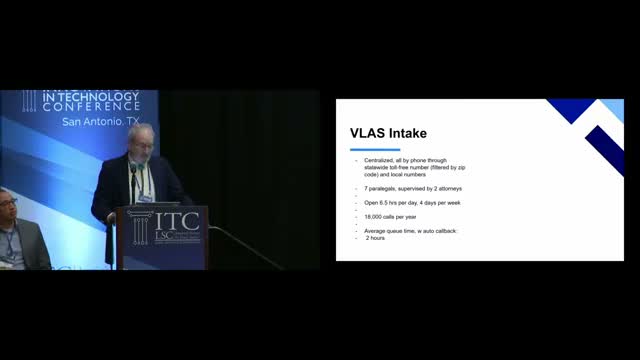
Virginia Legal Aid Society is piloting a voice-first intake system that uses artificial intelligence to collect caller information, check conflicts and populate the agency’s LegalServer case-management fields, a former executive said at a panel on Jan. 30.
David Neumeier, speaking as a former executive director of Virginia Legal Aid Society, described a statewide toll-free phone intake that handles roughly 18,000 calls a year and historically produced an average queue time of about two hours. The pilot aims to shorten waits by having an AI agent conduct the verbal intake, record answers into LegalServer via API, and surface a summarized intake for a paralegal to review and accept or revise.
The project’s funding and technical choices shaped the pilot. Neumeier said the program received an unrestricted $900,000 gift from a private donor to support the work; the AI portion being developed by Quintin Stenhouse’s consulting firm is about $30,000 so far. The program moved its case-management platform to LegalServer and selected Dialpad as the telecom vendor to support the voice-AI integration. Neumeier cited testing of voice-generation technology such as Safe Haven AI and said the project has prioritized multilingual support and accuracy of speech-to-text.
On conflicts, Neumeier and the moderator said intake records are run through LegalServer’s API to perform an automatic conflict check as part of the intake process; paralegals can re-run or confirm checks live if there is ambiguity. The pilot also includes design choices intended to preserve client safety and fairness: AI-generated recommendations are reviewed by staff, and the system is intended as an assistant rather than a decision-maker.
Neumeier described operational trade-offs the team is testing: ensuring conversational pacing, managing speakerphone audio degradation, and selecting models that balance response speed and classification accuracy. He said the pilot is not yet live to the public and is awaiting final integration with the phone vendor before launch.
The program plans customer-satisfaction follow-ups, including mailed surveys, to assess the caller experience. Neumeier said local managing attorneys retain authority to close intake for overloaded case types, which provides a manual control to manage any increase in eligible cases that automated intake might produce.
The next procedural step is completing Dialpad integration and finishing internal tests before a public launch; the team encouraged attendees to use demo resources for the AI voices referenced during the session.
David Neumeier, speaking as a former executive director of Virginia Legal Aid Society, described a statewide toll-free phone intake that handles roughly 18,000 calls a year and historically produced an average queue time of about two hours. The pilot aims to shorten waits by having an AI agent conduct the verbal intake, record answers into LegalServer via API, and surface a summarized intake for a paralegal to review and accept or revise.
The project’s funding and technical choices shaped the pilot. Neumeier said the program received an unrestricted $900,000 gift from a private donor to support the work; the AI portion being developed by Quintin Stenhouse’s consulting firm is about $30,000 so far. The program moved its case-management platform to LegalServer and selected Dialpad as the telecom vendor to support the voice-AI integration. Neumeier cited testing of voice-generation technology such as Safe Haven AI and said the project has prioritized multilingual support and accuracy of speech-to-text.
On conflicts, Neumeier and the moderator said intake records are run through LegalServer’s API to perform an automatic conflict check as part of the intake process; paralegals can re-run or confirm checks live if there is ambiguity. The pilot also includes design choices intended to preserve client safety and fairness: AI-generated recommendations are reviewed by staff, and the system is intended as an assistant rather than a decision-maker.
Neumeier described operational trade-offs the team is testing: ensuring conversational pacing, managing speakerphone audio degradation, and selecting models that balance response speed and classification accuracy. He said the pilot is not yet live to the public and is awaiting final integration with the phone vendor before launch.
The program plans customer-satisfaction follow-ups, including mailed surveys, to assess the caller experience. Neumeier said local managing attorneys retain authority to close intake for overloaded case types, which provides a manual control to manage any increase in eligible cases that automated intake might produce.
The next procedural step is completing Dialpad integration and finishing internal tests before a public launch; the team encouraged attendees to use demo resources for the AI voices referenced during the session.
Don't Miss a Word: See the Full Meeting!
Go beyond summaries. Unlock every video, transcript, and key insight with a Founder Membership.
✓
Get instant access to full meeting videos
✓
Search and clip any phrase from complete transcripts
✓
Receive AI-powered summaries & custom alerts
✓
Enjoy lifetime, unrestricted access to government data
30-day money-back guarantee
