VTrans presents statewide Mobility Service Guide to House Transportation committee
January 30, 2026 | Transportation, HOUSE OF REPRESENTATIVES, Committees, Legislative , Vermont
This article was created by AI summarizing key points discussed. AI makes mistakes, so for full details and context, please refer to the video of the full meeting. Please report any errors so we can fix them. Report an error »
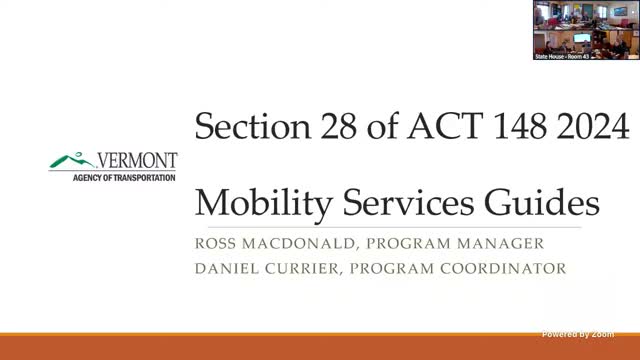
Vermont Agency of Transportation officials on Jan. 29 told the House Transportation Committee they have completed a web-based Mobility Service Guide required by Section 28 of Act 148 (2024) and hosted it on the GoVermont platform to centralize transportation options across the state.
“For the record, I’m Dan Currier,” said Dan Currier, public transit coordinator at VTrans, as he opened the overview. Currier said the guide is intended to present program types, estimated costs, service characteristics, revenue‑capture options and potential funding sources to help towns and nonprofits consider mobility alternatives.
The guide is structured in four sections — active transportation, passenger transportation, ride sharing and public transit (including school‑service mapping). Currier described active transportation as “human powered transportation” and listed local providers and programs highlighted in the guide, including Local Motion, the VTrans bike‑and‑ped program, Burlington’s bike‑share through the Chittenden County Transportation Management Association and a nonprofit called Walk to Shop. He also said the Mobility Transportation Innovation Grant has funded much of that work.
On passenger transportation, VTrans highlighted tools for transit discovery, including the GoVermont trip planner and a transit app referred to in testimony as Transit Royale. Currier told the committee that the app is a free download from the GoVermont pages and that a premium backend feature previously carried a roughly $10,000 startup and a $15,000 ongoing cost; VTrans declined renewal of the $15,000 backing while the free app remains available.
The guide catalogs microtransit (on‑demand public transit), university shuttles, door‑to‑door operators that work with Medicaid, and regional providers such as Gopher, Neighborhood Connections and SSTA; Currier noted service patterns vary by region and that some programs maintain explicit eligibility criteria. He recommended the guide include clear notes directing users to each provider’s homepage for eligibility details.
Currier also summarized the vanpool program operated through a contract with “Commute with Enterprise,” saying the program currently averages about 19 active vanpools statewide with seasonal fluctuation and that a subsidy covers a portion of ongoing costs. He described a guaranteed ride‑home benefit that reimburses eligible riders up to four times per year (up to $70 per trip) in emergencies.
On maintenance, Currier said the GoVermont program contracts annually with a marketing firm to update web resources and that VTrans and regional coordinators will include the mobility guide in their yearly resource review and updates. He said contact information for regional coordinators and a GoVermont main contact will be added to the guide to provide warm handoffs for users seeking help.
Committee members repeatedly asked whether the guide should be more explicit about eligibility rules for programs targeted to seniors or Medicaid recipients; Currier said some program parameters cannot be fully captured in a single page and recommended linking directly to provider pages. He also said VTrans will accept committee and nonprofit feedback and revise the guide as needed.
The presentation closed with committee members encouraging VTrans to distribute the resource through regional planning commissions and municipalities as a conversation starter for communities considering local service changes. VTrans committed to preserving accessibility for screen readers and to incorporating suggested edits from stakeholders.
Next steps: VTrans will add contact details and regional coordinator information to the GoVermont page, include the guide in its annual resource review and follow up with committee members on suggested edits. No formal action or vote occurred during the hearing.
“For the record, I’m Dan Currier,” said Dan Currier, public transit coordinator at VTrans, as he opened the overview. Currier said the guide is intended to present program types, estimated costs, service characteristics, revenue‑capture options and potential funding sources to help towns and nonprofits consider mobility alternatives.
The guide is structured in four sections — active transportation, passenger transportation, ride sharing and public transit (including school‑service mapping). Currier described active transportation as “human powered transportation” and listed local providers and programs highlighted in the guide, including Local Motion, the VTrans bike‑and‑ped program, Burlington’s bike‑share through the Chittenden County Transportation Management Association and a nonprofit called Walk to Shop. He also said the Mobility Transportation Innovation Grant has funded much of that work.
On passenger transportation, VTrans highlighted tools for transit discovery, including the GoVermont trip planner and a transit app referred to in testimony as Transit Royale. Currier told the committee that the app is a free download from the GoVermont pages and that a premium backend feature previously carried a roughly $10,000 startup and a $15,000 ongoing cost; VTrans declined renewal of the $15,000 backing while the free app remains available.
The guide catalogs microtransit (on‑demand public transit), university shuttles, door‑to‑door operators that work with Medicaid, and regional providers such as Gopher, Neighborhood Connections and SSTA; Currier noted service patterns vary by region and that some programs maintain explicit eligibility criteria. He recommended the guide include clear notes directing users to each provider’s homepage for eligibility details.
Currier also summarized the vanpool program operated through a contract with “Commute with Enterprise,” saying the program currently averages about 19 active vanpools statewide with seasonal fluctuation and that a subsidy covers a portion of ongoing costs. He described a guaranteed ride‑home benefit that reimburses eligible riders up to four times per year (up to $70 per trip) in emergencies.
On maintenance, Currier said the GoVermont program contracts annually with a marketing firm to update web resources and that VTrans and regional coordinators will include the mobility guide in their yearly resource review and updates. He said contact information for regional coordinators and a GoVermont main contact will be added to the guide to provide warm handoffs for users seeking help.
Committee members repeatedly asked whether the guide should be more explicit about eligibility rules for programs targeted to seniors or Medicaid recipients; Currier said some program parameters cannot be fully captured in a single page and recommended linking directly to provider pages. He also said VTrans will accept committee and nonprofit feedback and revise the guide as needed.
The presentation closed with committee members encouraging VTrans to distribute the resource through regional planning commissions and municipalities as a conversation starter for communities considering local service changes. VTrans committed to preserving accessibility for screen readers and to incorporating suggested edits from stakeholders.
Next steps: VTrans will add contact details and regional coordinator information to the GoVermont page, include the guide in its annual resource review and follow up with committee members on suggested edits. No formal action or vote occurred during the hearing.
View the Full Meeting & All Its Details
This article offers just a summary. Unlock complete video, transcripts, and insights as a Founder Member.
✓
Watch full, unedited meeting videos
✓
Search every word spoken in unlimited transcripts
✓
AI summaries & real-time alerts (all government levels)
✓
Permanent access to expanding government content
30-day money-back guarantee
