VTrans unveils draft Vermont Multimodal Roadway Guidance, targets July 2026 completion
January 29, 2026 | Transportation, HOUSE OF REPRESENTATIVES, Committees, Legislative , Vermont
This article was created by AI summarizing key points discussed. AI makes mistakes, so for full details and context, please refer to the video of the full meeting. Please report any errors so we can fix them. Report an error »
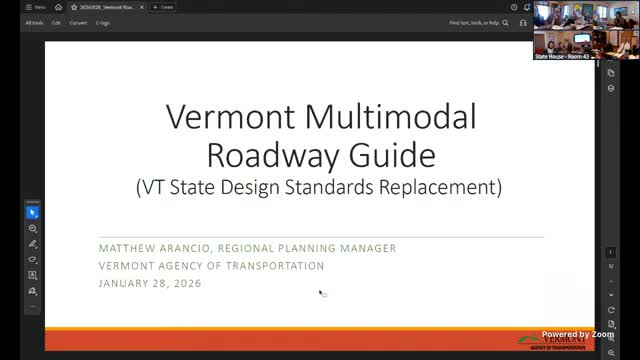
Matthew Arancio, regional planning manager for the Vermont Agency of Transportation (VTrans), told the House Transportation Committee on Jan. 20 that the agency has completed a draft Vermont Multimodal Roadway Guidance to update state design standards last comprehensively revised in 1997.
Arancio said the guidance emphasizes context-based design: planning and design choices should reflect adjacent land use, safety, capacity and modal focus so that designers can choose from a menu of options rather than follow a single prescriptive standard. The work was supported by an external consultant team (BHP), three advisory groups (external stakeholders, an internal technical working group, and a steering committee) and public engagement including surveys.
Arancio said VTrans completed an annotated outline in April 2025, submitted a draft word document and a fully formatted chapter to the legislature in January 2026, and opened the draft to agency and external review. The agency is targeting a July 2026 completion, followed by implementation and training for agency staff and external designers.
Committee members asked whether the guidance would effectively ‘dictate’ road design or add another regulatory review. Arancio and other agency staff (including Erin Sisson, deputy chief engineer, and Ed McGuire) said the guidance is intended for agency designers and municipal planners as a common vocabulary and set of options; final decisions depend on who owns the road (town vs. state) and local planning processes. The guidance will include case studies of Vermont projects and design menus (for example, curb extensions, bike facilities and ADA considerations) and encourage consultation with local planners during project design.
Arancio said that images in the draft are conceptual and that designers will vet detailed designs through standard project development processes. He emphasized stakeholder engagement will continue through spring and early summer 2026 and that the guidance will be a tool to align roadway design with Act 181 land-use objectives.
The committee did not take formal action on the guidance during the hearing. Arancio said VTrans will continue external review and return with follow-up as needed during the review window.
Arancio said the guidance emphasizes context-based design: planning and design choices should reflect adjacent land use, safety, capacity and modal focus so that designers can choose from a menu of options rather than follow a single prescriptive standard. The work was supported by an external consultant team (BHP), three advisory groups (external stakeholders, an internal technical working group, and a steering committee) and public engagement including surveys.
Arancio said VTrans completed an annotated outline in April 2025, submitted a draft word document and a fully formatted chapter to the legislature in January 2026, and opened the draft to agency and external review. The agency is targeting a July 2026 completion, followed by implementation and training for agency staff and external designers.
Committee members asked whether the guidance would effectively ‘dictate’ road design or add another regulatory review. Arancio and other agency staff (including Erin Sisson, deputy chief engineer, and Ed McGuire) said the guidance is intended for agency designers and municipal planners as a common vocabulary and set of options; final decisions depend on who owns the road (town vs. state) and local planning processes. The guidance will include case studies of Vermont projects and design menus (for example, curb extensions, bike facilities and ADA considerations) and encourage consultation with local planners during project design.
Arancio said that images in the draft are conceptual and that designers will vet detailed designs through standard project development processes. He emphasized stakeholder engagement will continue through spring and early summer 2026 and that the guidance will be a tool to align roadway design with Act 181 land-use objectives.
The committee did not take formal action on the guidance during the hearing. Arancio said VTrans will continue external review and return with follow-up as needed during the review window.
Don't Miss a Word: See the Full Meeting!
Go beyond summaries. Unlock every video, transcript, and key insight with a Founder Membership.
✓
Get instant access to full meeting videos
✓
Search and clip any phrase from complete transcripts
✓
Receive AI-powered summaries & custom alerts
✓
Enjoy lifetime, unrestricted access to government data
30-day money-back guarantee
