Legislative committee hears JFO on governor's FY27 transportation budget; $33 million shortfall offset with indirect-cost shift, layoffs and scaled-back work
January 29, 2026 | Transportation, HOUSE OF REPRESENTATIVES, Committees, Legislative , Vermont
This article was created by AI summarizing key points discussed. AI makes mistakes, so for full details and context, please refer to the video of the full meeting. Please report any errors so we can fix them. Report an error »
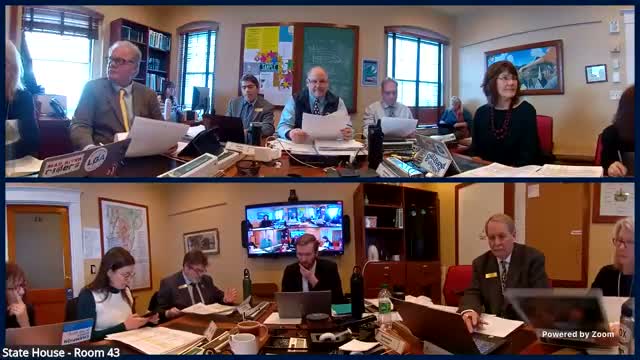
Logan Moberry of the Joint Fiscal Office opened the committee's review of the governor's FY27 transportation recommendation, presenting a fund-by-fund spreadsheet that lays out T Fund, federal, local/other and internal-service accounts.
"These documents are the same format as you saw last year," Moberry said as he walked members through the spreadsheet and comparison to the FY26 enacted budget.
Chair Walker told the committee that the recommended budget attempts to close a roughly $33 million shortfall. "Now everybody knows that there was a $32,000,000 hole," Walker said, and the recommendation fills that gap through several distinct moves rather than a single cut.
Moberry and Walker detailed how the shortfall is composed and addressed. The largest single offset is a change in the agency's indirect cost approach that the JFO estimated would free about $12 million by using federal funds to cover certain overhead costs rather than project match. Committee members were told that this item is a temporary budgeting approach in recent tight years and is not necessarily intended as a permanent funding shift.
Additional reductions include roughly $8 million from staffing reductions (about $4.1 million in a fall reduction and $3.3 million in the current recommendation), and removal or scaling back of roughly $5.4 million in highway projects that were in the white book but were not included in the governor's recommendation. Moberry also identified smaller reductions across programs: approximately $1 million in aviation and $3 million in rail plus several smaller maintenance reductions.
Walker emphasized that the $10 million from the purchase-and-use (education) revenue stream is not being used to fill the initial $33 million gap; instead the budget uses that $10 million to leverage additional federal matching and accelerate paving projects. "The 10,000,000 is not part of that $33,000,000 hole. It is about leveraging more projects," Walker said.
The committee pressed agency capacity questions: members noted the budget shows a roughly 44% increase in paving spending compared to FY26 (an increase JFO listed at roughly $45 million) and asked whether contractors and agency staff can deliver that increase in work this construction season. Moberry and members said the committee will request testimony from the agency and industry representatives to confirm whether the higher paving total is feasible.
What happens next: committee members asked JFO and the agency for more line-item detail (including BlackBook references) on interdepartmental transfers and on which projects were scaled back. The committee also signaled it will summon the agency's chief engineer and affected program managers for follow-up testimony before finalizing changes.
"These documents are the same format as you saw last year," Moberry said as he walked members through the spreadsheet and comparison to the FY26 enacted budget.
Chair Walker told the committee that the recommended budget attempts to close a roughly $33 million shortfall. "Now everybody knows that there was a $32,000,000 hole," Walker said, and the recommendation fills that gap through several distinct moves rather than a single cut.
Moberry and Walker detailed how the shortfall is composed and addressed. The largest single offset is a change in the agency's indirect cost approach that the JFO estimated would free about $12 million by using federal funds to cover certain overhead costs rather than project match. Committee members were told that this item is a temporary budgeting approach in recent tight years and is not necessarily intended as a permanent funding shift.
Additional reductions include roughly $8 million from staffing reductions (about $4.1 million in a fall reduction and $3.3 million in the current recommendation), and removal or scaling back of roughly $5.4 million in highway projects that were in the white book but were not included in the governor's recommendation. Moberry also identified smaller reductions across programs: approximately $1 million in aviation and $3 million in rail plus several smaller maintenance reductions.
Walker emphasized that the $10 million from the purchase-and-use (education) revenue stream is not being used to fill the initial $33 million gap; instead the budget uses that $10 million to leverage additional federal matching and accelerate paving projects. "The 10,000,000 is not part of that $33,000,000 hole. It is about leveraging more projects," Walker said.
The committee pressed agency capacity questions: members noted the budget shows a roughly 44% increase in paving spending compared to FY26 (an increase JFO listed at roughly $45 million) and asked whether contractors and agency staff can deliver that increase in work this construction season. Moberry and members said the committee will request testimony from the agency and industry representatives to confirm whether the higher paving total is feasible.
What happens next: committee members asked JFO and the agency for more line-item detail (including BlackBook references) on interdepartmental transfers and on which projects were scaled back. The committee also signaled it will summon the agency's chief engineer and affected program managers for follow-up testimony before finalizing changes.
Don't Miss a Word: See the Full Meeting!
Go beyond summaries. Unlock every video, transcript, and key insight with a Founder Membership.
✓
Get instant access to full meeting videos
✓
Search and clip any phrase from complete transcripts
✓
Receive AI-powered summaries & custom alerts
✓
Enjoy lifetime, unrestricted access to government data
30-day money-back guarantee
