VTrans reports pilot pollinator plantings and rotational mowing; FHWA $150,000 grant status unclear
January 29, 2026 | Transportation, HOUSE OF REPRESENTATIVES, Committees, Legislative , Vermont
This article was created by AI summarizing key points discussed. AI makes mistakes, so for full details and context, please refer to the video of the full meeting. Please report any errors so we can fix them. Report an error »
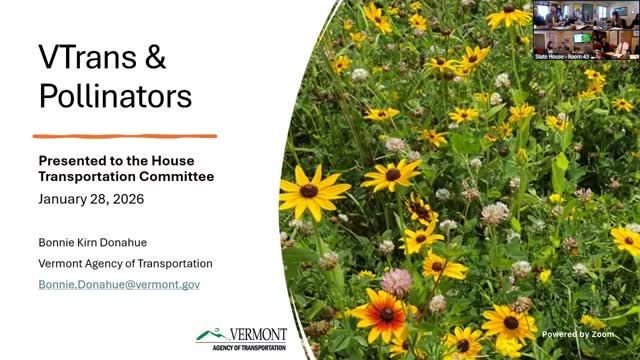
Bonnie Donahue, landscape architect with the Vermont Agency of Transportation (VTrans), told the House Transportation Committee on Jan. 20 that VTrans has tested and installed pollinator-friendly seed mixes and plantings across the state since 2021, including a pollinator seed trial on I‑91 in Lyndon and native plantings on Route 16 in Hardwick.
Donahue said VTrans has completed 28 projects with pollinator seed, 31 projects with plantings and mapped more than 16 acres of pollinator seed in GIS to track spread across Vermont. The agency uses rotational mowing—mowing one-third of a limited-access right-of-way in a year and leaving two-thirds idle—to preserve safety-clear zones while supporting flowering plants in idle strips.
She described a federal FHWA roadside pollinator grant process: VTrans had proposed 5–10 half-acre pollinator seed sites and educational signage and understood a $150,000 award was anticipated. In August 2025 FHWA informed VTrans that eight of the 12 grants were moving forward but Vermont was not on that list; Donahue said it was unclear whether this was a delay or a longer-term outcome and that VTrans is ready to proceed quickly if the opportunity is reopened.
Committee members asked about maintenance and weeds; Donahue said the pilot plantings were designed to fit current maintenance regimes and that VTrans has not been conducting additional weed removal but is monitoring plant survival and the relationship between weeds and native pollinator species. Donahue also noted VTrans joined a Candidate Conservation Agreement with Assurances (CCAA) for the monarch butterfly in 2020; under that agreement the agency commits to practices such as rotational mowing and planting habitat to reduce permitting burdens if the species is listed.
Members expressed support and asked VTrans to provide more details on timelines, cost savings from reduced mowing and whether the agency could quantify maintenance needs. Donahue said VTrans can provide additional information and is testing techniques to reduce costs while expanding habitat.
Donahue said VTrans has completed 28 projects with pollinator seed, 31 projects with plantings and mapped more than 16 acres of pollinator seed in GIS to track spread across Vermont. The agency uses rotational mowing—mowing one-third of a limited-access right-of-way in a year and leaving two-thirds idle—to preserve safety-clear zones while supporting flowering plants in idle strips.
She described a federal FHWA roadside pollinator grant process: VTrans had proposed 5–10 half-acre pollinator seed sites and educational signage and understood a $150,000 award was anticipated. In August 2025 FHWA informed VTrans that eight of the 12 grants were moving forward but Vermont was not on that list; Donahue said it was unclear whether this was a delay or a longer-term outcome and that VTrans is ready to proceed quickly if the opportunity is reopened.
Committee members asked about maintenance and weeds; Donahue said the pilot plantings were designed to fit current maintenance regimes and that VTrans has not been conducting additional weed removal but is monitoring plant survival and the relationship between weeds and native pollinator species. Donahue also noted VTrans joined a Candidate Conservation Agreement with Assurances (CCAA) for the monarch butterfly in 2020; under that agreement the agency commits to practices such as rotational mowing and planting habitat to reduce permitting burdens if the species is listed.
Members expressed support and asked VTrans to provide more details on timelines, cost savings from reduced mowing and whether the agency could quantify maintenance needs. Donahue said VTrans can provide additional information and is testing techniques to reduce costs while expanding habitat.
View the Full Meeting & All Its Details
This article offers just a summary. Unlock complete video, transcripts, and insights as a Founder Member.
✓
Watch full, unedited meeting videos
✓
Search every word spoken in unlimited transcripts
✓
AI summaries & real-time alerts (all government levels)
✓
Permanent access to expanding government content
30-day money-back guarantee
