Florida committee advances bill to allow state designation of domestic terrorist organizations; critics warn of vagueness
January 29, 2026 | 2026 Legislature FL, Florida
This article was created by AI summarizing key points discussed. AI makes mistakes, so for full details and context, please refer to the video of the full meeting. Please report any errors so we can fix them. Report an error »
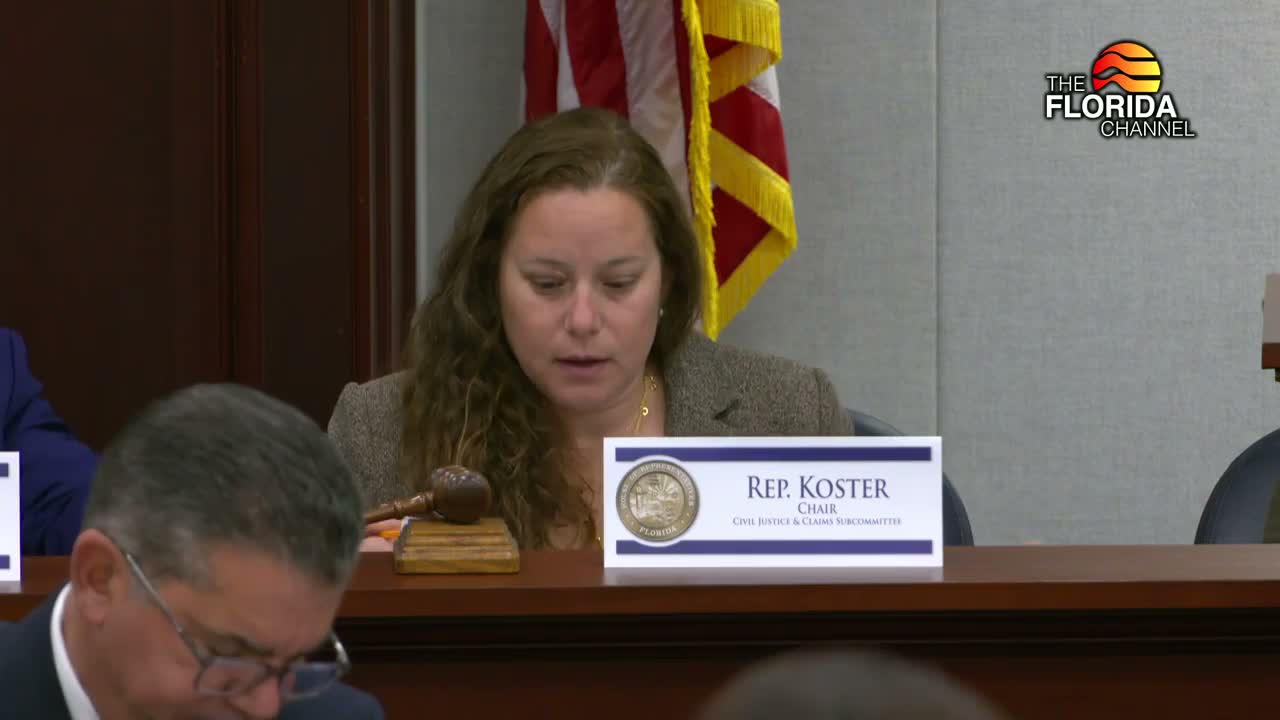
TALLAHASSEE — The Florida House Civil Justice & Claims Subcommittee voted to report HB 14‑71 favorably after more than three hours of debate and a flood of public testimony both for and against the proposal.
Representative Hilary Cassell, the bill sponsor, described the measure as “a constitution‑first public safety bill” that would (1) bar courts from enforcing foreign or religious law in ways that contradict the U.S. or Florida constitutions, (2) create a state process for designating domestic terrorist organizations that requires written findings by Florida’s chief domestic security officer and cabinet approval, and (3) prohibit taxpayer dollars from supporting groups the state designates as terrorist organizations. “We copy” federal and existing Florida definitions of terrorism, Cassell said during questioning, and the bill focuses on conduct rather than ideology.
Opponents — including the ACLU of Florida, the Southern Poverty Law Center, university students and multiple civil‑liberties organizations — urged the committee to reject or substantially rewrite the bill, saying key terms such as “promotion,” “material support,” “intimidate” and “ongoing threat” are not clearly defined in the statutory text. Jonathan Weber of the Southern Poverty Law Center said the proposal raises “a fundamental federalism problem” and risks allowing a state process to criminalize or stigmatize lawful advocacy. Naomi Levy of Sea Alliance and other campus groups warned the bill’s education penalties and vague definitions could chill student organizing.
Public testimony emphasized due‑process concerns. Several speakers pointed out the bill allows the FDLE chief of domestic security to make threshold findings that are later reviewed by the cabinet, with judicial review available afterward in Leon County’s second judicial circuit. Critics argued that withholding security‑critical evidence from public records could impede meaningful predesignation challenges; sponsor Cassell and supporters said courts can review evidence (and sensitive national‑security material could be reviewed under seal).
Members pressed the sponsor on how the statute will distinguish speech from violent conduct. Representative Gottlieb, a lawyer who said he reviewed the language closely, supported the bill but acknowledged the need to work on due process; Representative Rayner and others said they feared the label “terrorist” could be used politically without stronger statutory guardrails.
The committee adopted no floor amendments to HB 14‑71 at the hearing and voted to report the bill favorably (14 yeas, 3 nays). The committee also advanced HB 14‑73, a companion measure that creates a public‑records exemption for security‑critical material used in designations; supporters said the exemption is limited to national‑security details, while critics said it risks hiding rationale and reducing transparency.
What happens next: HB 14‑71 and its public‑records companion will proceed through the House process. Supporters say the bills give law enforcement tools to protect the state from violent, organized threats; opponents say the legislature should narrow definitions and add explicit predesignation procedural protections before permitting a state designation process that carries reputational and legal consequences.
Vote at a glance: HB 14‑71 reported favorably by the subcommittee (14‑3). HB 14‑73 (public records exemption) reported favorably (14‑2).
Representative Hilary Cassell, the bill sponsor, described the measure as “a constitution‑first public safety bill” that would (1) bar courts from enforcing foreign or religious law in ways that contradict the U.S. or Florida constitutions, (2) create a state process for designating domestic terrorist organizations that requires written findings by Florida’s chief domestic security officer and cabinet approval, and (3) prohibit taxpayer dollars from supporting groups the state designates as terrorist organizations. “We copy” federal and existing Florida definitions of terrorism, Cassell said during questioning, and the bill focuses on conduct rather than ideology.
Opponents — including the ACLU of Florida, the Southern Poverty Law Center, university students and multiple civil‑liberties organizations — urged the committee to reject or substantially rewrite the bill, saying key terms such as “promotion,” “material support,” “intimidate” and “ongoing threat” are not clearly defined in the statutory text. Jonathan Weber of the Southern Poverty Law Center said the proposal raises “a fundamental federalism problem” and risks allowing a state process to criminalize or stigmatize lawful advocacy. Naomi Levy of Sea Alliance and other campus groups warned the bill’s education penalties and vague definitions could chill student organizing.
Public testimony emphasized due‑process concerns. Several speakers pointed out the bill allows the FDLE chief of domestic security to make threshold findings that are later reviewed by the cabinet, with judicial review available afterward in Leon County’s second judicial circuit. Critics argued that withholding security‑critical evidence from public records could impede meaningful predesignation challenges; sponsor Cassell and supporters said courts can review evidence (and sensitive national‑security material could be reviewed under seal).
Members pressed the sponsor on how the statute will distinguish speech from violent conduct. Representative Gottlieb, a lawyer who said he reviewed the language closely, supported the bill but acknowledged the need to work on due process; Representative Rayner and others said they feared the label “terrorist” could be used politically without stronger statutory guardrails.
The committee adopted no floor amendments to HB 14‑71 at the hearing and voted to report the bill favorably (14 yeas, 3 nays). The committee also advanced HB 14‑73, a companion measure that creates a public‑records exemption for security‑critical material used in designations; supporters said the exemption is limited to national‑security details, while critics said it risks hiding rationale and reducing transparency.
What happens next: HB 14‑71 and its public‑records companion will proceed through the House process. Supporters say the bills give law enforcement tools to protect the state from violent, organized threats; opponents say the legislature should narrow definitions and add explicit predesignation procedural protections before permitting a state designation process that carries reputational and legal consequences.
Vote at a glance: HB 14‑71 reported favorably by the subcommittee (14‑3). HB 14‑73 (public records exemption) reported favorably (14‑2).
Don't Miss a Word: See the Full Meeting!
Go beyond summaries. Unlock every video, transcript, and key insight with a Founder Membership.
✓
Get instant access to full meeting videos
✓
Search and clip any phrase from complete transcripts
✓
Receive AI-powered summaries & custom alerts
✓
Enjoy lifetime, unrestricted access to government data
30-day money-back guarantee
