Kansas committee hears bill to license pump installers, require reporting and plugging of hazardous wells
January 23, 2026 | Committee on Water, Standing, HOUSE OF REPRESENTATIVES, Committees, Legislative, Kansas
This article was created by AI summarizing key points discussed. AI makes mistakes, so for full details and context, please refer to the video of the full meeting. Please report any errors so we can fix them. Report an error »
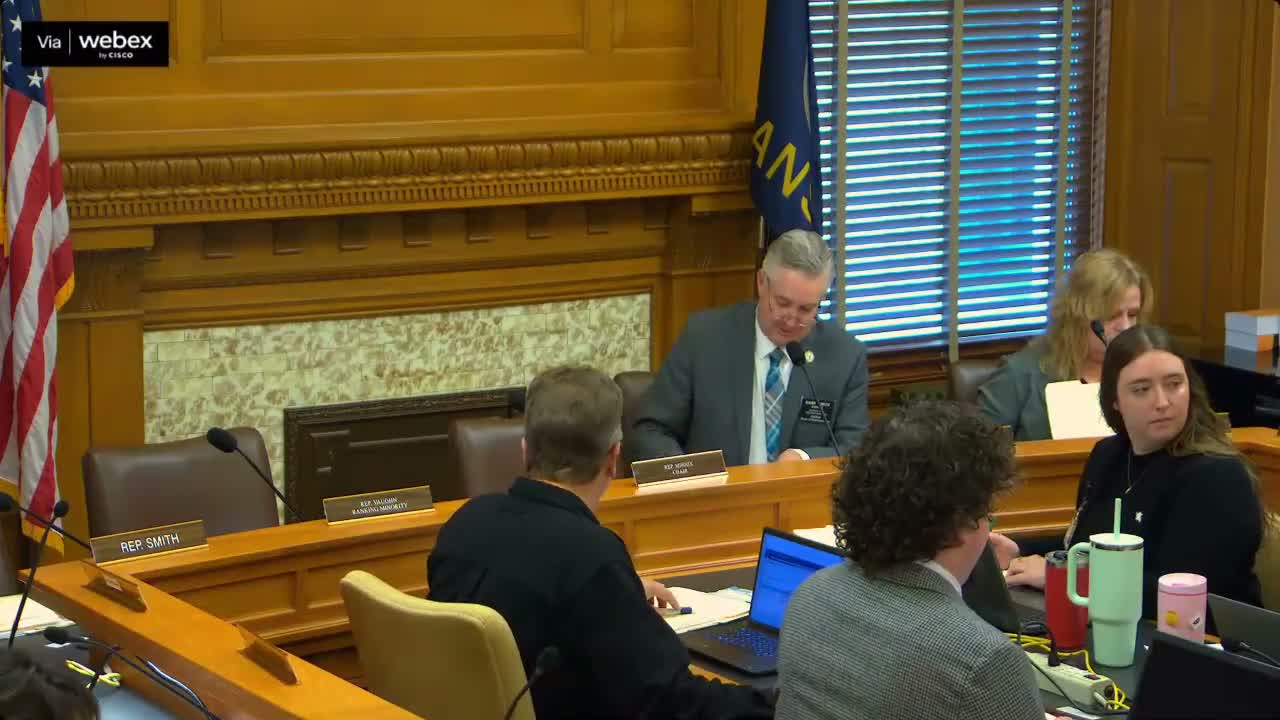
A state House Committee on Water heard testimony on House Bill 24-24, a proposal to establish licensure, training and reporting requirements for pump installation contractors and to require the plugging of some pre‑existing unplugged wells that pose health or environmental threats.
KDHE’s William Carr, director of the Bureau of Water, told the committee the department supports the bill’s goal and said the agency’s existing water well contractor licensing infrastructure "can absorb" additional reporting responsibilities with little to no additional inspection expenditures. "We stand in support of House Bill 24-24," Carr said, adding that licensing would set minimum standards and give the department legal recourse when standards are violated.
Supporters from the Kansas Groundwater Association, represented by Tony Bridal, said the change is industry‑led. Bridal said the association’s survey found strong backing among members and argued licensing would protect aquifers and public health: "85% of Kansans directly rely on groundwater," he said, urging the committee to stop practices he described as risky and unregulated.
Opponents cautioned that the bill, as drafted, leaves open important details on fee caps, required experience and the administrative burden on small operators. Desiree Petra said many contractors are unaware of the proposal and warned that continuing education and licensing requirements could become a burden for small or aging operators. "I think the licensing is gonna become a burden," Petra testified, and said several practical questions — including who pays and how often fees are set — remain unanswered.
Committee members pressed KDHE and proponents on several specifics: the bill contains inconsistent language about whether fee rulemaking is biannual or annual; the bill would require experience (for example, two years under a licensed well contractor for some applicants) in addition to passing an exam; and KDHE would have rulemaking authority to determine when an older unplugged well poses a threat and must be plugged. KDHE staff said those procedural and enforcement details are expected to be established in rules and regulations the Secretary would adopt.
Elena Rudder of Legislative Research summarized the fiscal note, saying the Division of the Budget and KDHE estimate new fee revenues of roughly $41,000 in fiscal year 2028 from new applications, licensure and potential civil penalties, and about $28,000 in subsequent years. Rudder also noted the Office of Judicial Administration cautioned the bill could increase district court filings because it would create a new offense.
No committee vote was held on HB 24-24 during the hearing. The chair closed the hearing after proponents and opponents gave oral and written testimony and moved to the next bill.
The bill’s next procedural step was not recorded in the hearing record. Committee members asked KDHE and bill sponsors to clarify fee caps, experience requirements and the mechanics of plugging orders as they consider possible amendments.
KDHE’s William Carr, director of the Bureau of Water, told the committee the department supports the bill’s goal and said the agency’s existing water well contractor licensing infrastructure "can absorb" additional reporting responsibilities with little to no additional inspection expenditures. "We stand in support of House Bill 24-24," Carr said, adding that licensing would set minimum standards and give the department legal recourse when standards are violated.
Supporters from the Kansas Groundwater Association, represented by Tony Bridal, said the change is industry‑led. Bridal said the association’s survey found strong backing among members and argued licensing would protect aquifers and public health: "85% of Kansans directly rely on groundwater," he said, urging the committee to stop practices he described as risky and unregulated.
Opponents cautioned that the bill, as drafted, leaves open important details on fee caps, required experience and the administrative burden on small operators. Desiree Petra said many contractors are unaware of the proposal and warned that continuing education and licensing requirements could become a burden for small or aging operators. "I think the licensing is gonna become a burden," Petra testified, and said several practical questions — including who pays and how often fees are set — remain unanswered.
Committee members pressed KDHE and proponents on several specifics: the bill contains inconsistent language about whether fee rulemaking is biannual or annual; the bill would require experience (for example, two years under a licensed well contractor for some applicants) in addition to passing an exam; and KDHE would have rulemaking authority to determine when an older unplugged well poses a threat and must be plugged. KDHE staff said those procedural and enforcement details are expected to be established in rules and regulations the Secretary would adopt.
Elena Rudder of Legislative Research summarized the fiscal note, saying the Division of the Budget and KDHE estimate new fee revenues of roughly $41,000 in fiscal year 2028 from new applications, licensure and potential civil penalties, and about $28,000 in subsequent years. Rudder also noted the Office of Judicial Administration cautioned the bill could increase district court filings because it would create a new offense.
No committee vote was held on HB 24-24 during the hearing. The chair closed the hearing after proponents and opponents gave oral and written testimony and moved to the next bill.
The bill’s next procedural step was not recorded in the hearing record. Committee members asked KDHE and bill sponsors to clarify fee caps, experience requirements and the mechanics of plugging orders as they consider possible amendments.
View the Full Meeting & All Its Details
This article offers just a summary. Unlock complete video, transcripts, and insights as a Founder Member.
✓
Watch full, unedited meeting videos
✓
Search every word spoken in unlimited transcripts
✓
AI summaries & real-time alerts (all government levels)
✓
Permanent access to expanding government content
30-day money-back guarantee
