Kansas DCF Secretary outlines child-welfare declines, CCWIS modernization and early HB 20-75 impacts
January 23, 2026 | Public Health and Welfare, Standing, Senate, Committees, Legislative, Kansas
This article was created by AI summarizing key points discussed. AI makes mistakes, so for full details and context, please refer to the video of the full meeting. Please report any errors so we can fix them. Report an error »
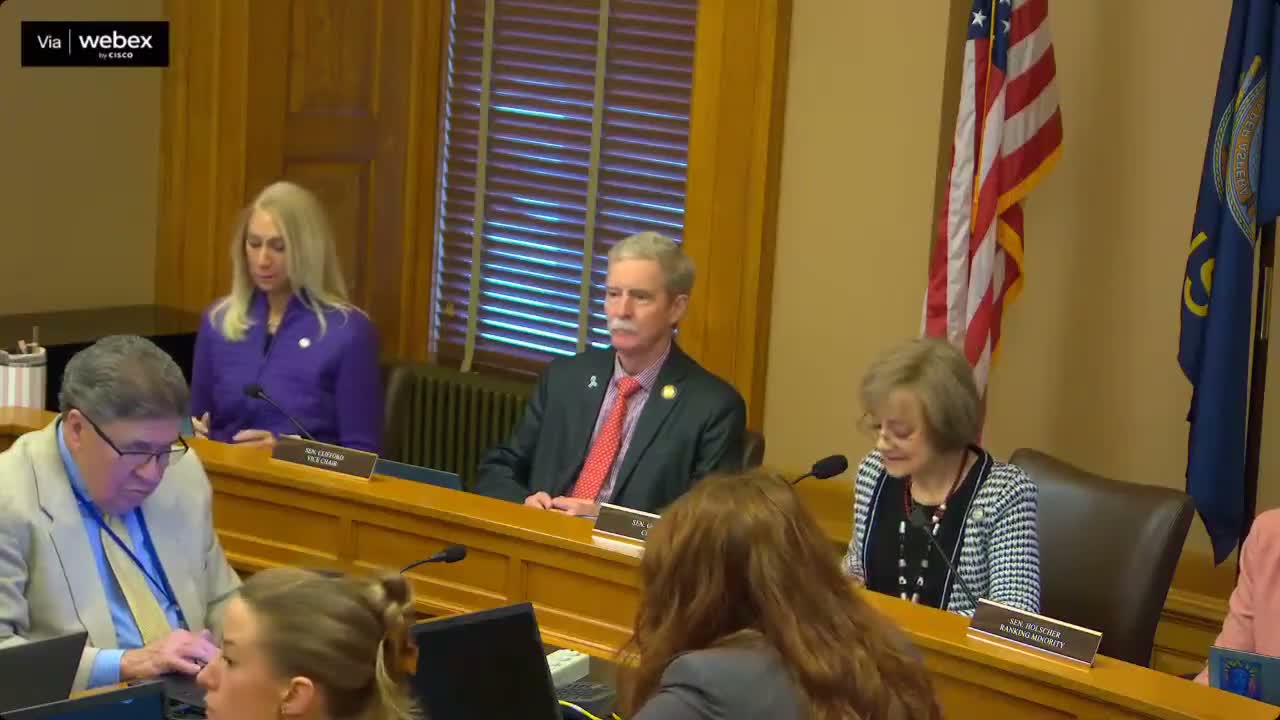
Laura Howard, secretary of the Kansas Department for Children and Families, told the Senate Public Health and Welfare committee that the state currently serves "just over 5,400 youth in foster care today," a decline she said amounts to roughly 25% fewer children in care than in 2019.
Howard framed the trend as the result of expanded front-end services under the federal Families First Act and state investments in prevention. "Since those referrals began in 2019, we've had great success with, really, holding to 90 percent of those children being able to be cared for safely in their homes and not entering into care with those services," she said, pointing to programs that include mental-health supports, substance-use services and home visiting.
Why this matters: fewer children in foster care can reduce trauma and long-term cost. Howard told senators DCF now spends about $20 million on Families First front-end prevention services and that the department measures a mix of indicators — reports, investigations and service-utilization — to track outcomes.
Howard also described an information-technology project she said will modernize case management statewide. DCF announced an award for a Comprehensive Child Welfare Information System (CCWIS) contract and has engaged independent verification and validation (Maximus) and quality-assurance (CSG Government Solutions) contractors to oversee implementation. The department presented a timeline that targets a November 2028 go-live for the consolidated system.
Howard reviewed changes originating with last year's House Bill 20-75, which shortened the time to an initial permanency hearing and required DCF to respond to law-enforcement reports within 24 hours. "From July 1 to December 31, we saw a 42% reduction in police protective custody removals," she said, adding that reductions were seen across regions and that Wichita's region showed about a 46% decline in that six-month window. Howard cautioned that these are early data and that the department will continue to track whether the reductions affect later-entry or other downstream measures.
On benefits for youth aging out of care, Howard said an executive order by Governor Laura Kelly (January 2025) halted the prior practice of using certain Social Security benefits to offset foster-care costs and directed DCF to preserve those funds for youth. "We have established more than 600 ABLE accounts for youth in foster care," Howard said, and DCF and partner agencies are providing financial-education programming for youth and guardians.
Committee follow-up and access to data: senators asked for more granular charts and exit-placement breakdowns (reunification, adoption, independent living) and Howard offered to provide detailed caseload and exits data. Deputy Secretary Tanya Keyes summarized a Guardian ad Litem review and said the report recommends exploring a statewide office to improve GAL recruitment, retention and service administration.
The committee heard that DCF continues to pilot therapeutic foster-care models and expanded Medicaid-funded behavior-intervention services designed to support families and specialized foster homes for youth with high behavioral-health needs.
Next steps: DCF will provide requested charts on entries/exits, continue CCWIS implementation under federal certification requirements, track HB 20-75 metrics, and brief the committee further as more data become available.
Howard framed the trend as the result of expanded front-end services under the federal Families First Act and state investments in prevention. "Since those referrals began in 2019, we've had great success with, really, holding to 90 percent of those children being able to be cared for safely in their homes and not entering into care with those services," she said, pointing to programs that include mental-health supports, substance-use services and home visiting.
Why this matters: fewer children in foster care can reduce trauma and long-term cost. Howard told senators DCF now spends about $20 million on Families First front-end prevention services and that the department measures a mix of indicators — reports, investigations and service-utilization — to track outcomes.
Howard also described an information-technology project she said will modernize case management statewide. DCF announced an award for a Comprehensive Child Welfare Information System (CCWIS) contract and has engaged independent verification and validation (Maximus) and quality-assurance (CSG Government Solutions) contractors to oversee implementation. The department presented a timeline that targets a November 2028 go-live for the consolidated system.
Howard reviewed changes originating with last year's House Bill 20-75, which shortened the time to an initial permanency hearing and required DCF to respond to law-enforcement reports within 24 hours. "From July 1 to December 31, we saw a 42% reduction in police protective custody removals," she said, adding that reductions were seen across regions and that Wichita's region showed about a 46% decline in that six-month window. Howard cautioned that these are early data and that the department will continue to track whether the reductions affect later-entry or other downstream measures.
On benefits for youth aging out of care, Howard said an executive order by Governor Laura Kelly (January 2025) halted the prior practice of using certain Social Security benefits to offset foster-care costs and directed DCF to preserve those funds for youth. "We have established more than 600 ABLE accounts for youth in foster care," Howard said, and DCF and partner agencies are providing financial-education programming for youth and guardians.
Committee follow-up and access to data: senators asked for more granular charts and exit-placement breakdowns (reunification, adoption, independent living) and Howard offered to provide detailed caseload and exits data. Deputy Secretary Tanya Keyes summarized a Guardian ad Litem review and said the report recommends exploring a statewide office to improve GAL recruitment, retention and service administration.
The committee heard that DCF continues to pilot therapeutic foster-care models and expanded Medicaid-funded behavior-intervention services designed to support families and specialized foster homes for youth with high behavioral-health needs.
Next steps: DCF will provide requested charts on entries/exits, continue CCWIS implementation under federal certification requirements, track HB 20-75 metrics, and brief the committee further as more data become available.
View the Full Meeting & All Its Details
This article offers just a summary. Unlock complete video, transcripts, and insights as a Founder Member.
✓
Watch full, unedited meeting videos
✓
Search every word spoken in unlimited transcripts
✓
AI summaries & real-time alerts (all government levels)
✓
Permanent access to expanding government content
30-day money-back guarantee
