Evansville council adopts revised parking code with new credits for green space and EV infrastructure
December 15, 2025 | Evansville City, Vanderburgh County, Indiana
This article was created by AI summarizing key points discussed. AI makes mistakes, so for full details and context, please refer to the video of the full meeting. Please report any errors so we can fix them. Report an error »
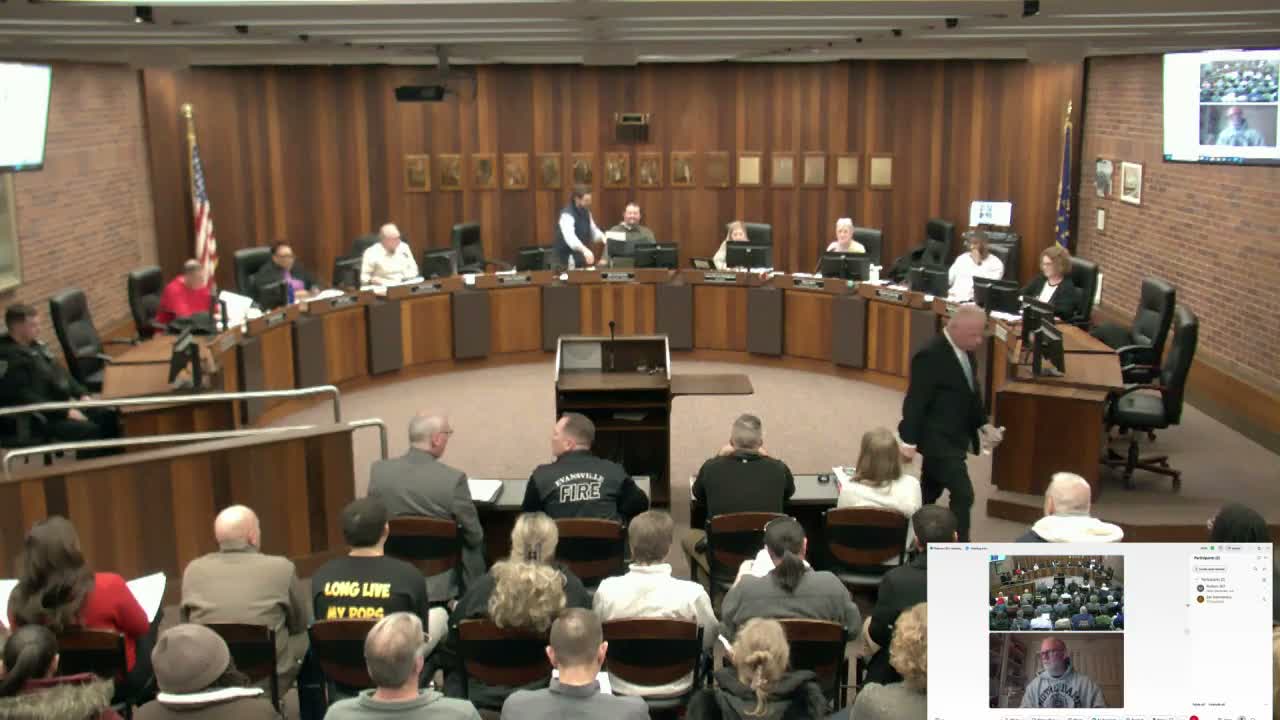
The Evansville Common Council voted unanimously Dec. 15 to adopt Ordinance G2025-27, a rewrite of the city's parking rules that lowers many minimum parking requirements and establishes a menu of "parking credits" for green space, trees, bicycle racks and electric-vehicle charging stations.
Ron (planning staff), who led the code rewrite, told councilors the changes followed about a year to 18 months of work and drew on variance histories and practices from other Indiana communities. "You're going to see that there's some pretty big reductions in the amount of parking that's required," he said, and noted the proposal is intended to encourage more street trees and green islands.
The ordinance calculates minimum parking based on unit type rather than household occupancy; planners said a one-bedroom typically requires one space while a three-bedroom may require two. For large retail, staff said they used typical counts from developers and variance applications to set new standards.
Several residents and neighborhood advocates asked for additional review time, warning the credit system could reduce required parking by up to 35 percent and citing experiences in other cities where reduced off-street parking strained nearby streets. Shauna Jarveau told council she needed more time to study the proposal: "The community needs more time to look at this so that we can actually...voice considerations."
Councilors and staff replied that the code applies primarily to new development and additions, that variances and planned-unit developments (PUDs) remain available, and that the city had held prior public engagement during the UDO process. Staff posted a sample comparison chart showing existing and proposed parking for typical uses and provided office contact details for follow-up.
The council moved to adopt G2025-27 in one evening and approved it on a roll-call vote of 8–0. The ordinance takes effect as part of the Evansville Municipal Code; projects filed before the change were described by staff as subject to the prior code unless applicants choose to rely on the updated standards.
Ron (planning staff), who led the code rewrite, told councilors the changes followed about a year to 18 months of work and drew on variance histories and practices from other Indiana communities. "You're going to see that there's some pretty big reductions in the amount of parking that's required," he said, and noted the proposal is intended to encourage more street trees and green islands.
The ordinance calculates minimum parking based on unit type rather than household occupancy; planners said a one-bedroom typically requires one space while a three-bedroom may require two. For large retail, staff said they used typical counts from developers and variance applications to set new standards.
Several residents and neighborhood advocates asked for additional review time, warning the credit system could reduce required parking by up to 35 percent and citing experiences in other cities where reduced off-street parking strained nearby streets. Shauna Jarveau told council she needed more time to study the proposal: "The community needs more time to look at this so that we can actually...voice considerations."
Councilors and staff replied that the code applies primarily to new development and additions, that variances and planned-unit developments (PUDs) remain available, and that the city had held prior public engagement during the UDO process. Staff posted a sample comparison chart showing existing and proposed parking for typical uses and provided office contact details for follow-up.
The council moved to adopt G2025-27 in one evening and approved it on a roll-call vote of 8–0. The ordinance takes effect as part of the Evansville Municipal Code; projects filed before the change were described by staff as subject to the prior code unless applicants choose to rely on the updated standards.
View the Full Meeting & All Its Details
This article offers just a summary. Unlock complete video, transcripts, and insights as a Founder Member.
✓
Watch full, unedited meeting videos
✓
Search every word spoken in unlimited transcripts
✓
AI summaries & real-time alerts (all government levels)
✓
Permanent access to expanding government content
30-day money-back guarantee
