Rutherford County advances six-month programming study to address jail overcrowding
January 30, 2026 | Rutherford County, Tennessee
This article was created by AI summarizing key points discussed. AI makes mistakes, so for full details and context, please refer to the video of the full meeting. Please report any errors so we can fix them. Report an error »
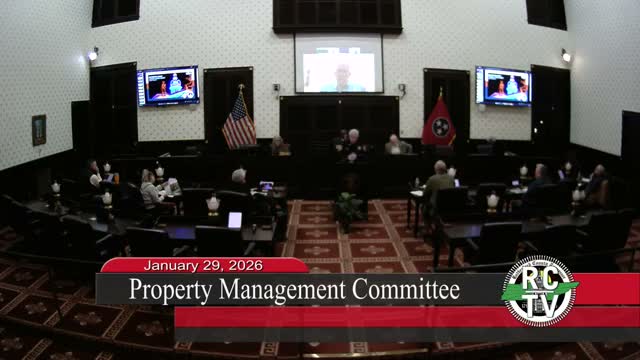
The Rutherford County Commission voted to advance a six-month programming study to evaluate options for renovating or replacing the county jail and consolidating related law-enforcement facilities.
Consultants told commissioners that the county’s detention capacity, listed in the study as 977 beds, routinely exceeds safe classification thresholds. "The capacity of your facility is currently 977 beds," Jim Hart, jail consultant with the University of Tennessee County Technical Assistance Service, said, adding that the commonly used 85% classification threshold is 830 beds and that the jail logged 1,160 inmates on Jan. 22. Hart said his projections extend to 2045 and forecast substantial growth that will increase correctional needs if current trends continue.
County and state corrections experts and the sheriff’s office described a facility and support buildings that have aged and been reconfigured over time. Presenters said double-bunking, constrained sally-port capacity, undersized laundry and program spaces, and evidence-storage risks make operations difficult and could expose the county to legal and safety risks. "A new facility is an investment in safety, accountability, and the future for Rutherford County," a presenter stated to describe the rationale for taking the next step.
Consultant Bart Klein of Klein City Associates outlined the programming phase as a six-month, three-part effort—programming, site investigations and master planning—intended to produce space needs, adjacency diagrams, cost ranges and staffing analyses. Klein said the programming team includes a range of consultants who will assess medical, mental-health, staffing and operational needs and that the full schedule from programming to construction could be about 60 months if the county proceeds immediately.
Commissioners asked detailed questions about the methodology and assumptions. Hart said forecasts are based on historical average daily population over a 10-year period, peaking factors, and community growth; he also noted that contracted state inmates are counted differently than non-contracted state inmates when assessing local capacity. The consultants warned about the consequences of inaction, including potential decertification by the Tennessee Corrections Institute and, in extreme cases, federal intervention through a consent decree if capacity-related federal lawsuits were successful.
Commissioner Jeff Phillips moved to forward the programming concept to the county budget office so officials could identify funding sources for the six-month study; the motion was seconded and approved by roll call. The approved action directs staff and the programming team to proceed with the information-gathering and analysis phase and return to the commission with interim updates and final recommendations.
Next steps: the county will conduct programming work over approximately six months, with planned interim presentations to county committees and a final package of options and cost ranges for the commission to consider before any construction decision.
Consultants told commissioners that the county’s detention capacity, listed in the study as 977 beds, routinely exceeds safe classification thresholds. "The capacity of your facility is currently 977 beds," Jim Hart, jail consultant with the University of Tennessee County Technical Assistance Service, said, adding that the commonly used 85% classification threshold is 830 beds and that the jail logged 1,160 inmates on Jan. 22. Hart said his projections extend to 2045 and forecast substantial growth that will increase correctional needs if current trends continue.
County and state corrections experts and the sheriff’s office described a facility and support buildings that have aged and been reconfigured over time. Presenters said double-bunking, constrained sally-port capacity, undersized laundry and program spaces, and evidence-storage risks make operations difficult and could expose the county to legal and safety risks. "A new facility is an investment in safety, accountability, and the future for Rutherford County," a presenter stated to describe the rationale for taking the next step.
Consultant Bart Klein of Klein City Associates outlined the programming phase as a six-month, three-part effort—programming, site investigations and master planning—intended to produce space needs, adjacency diagrams, cost ranges and staffing analyses. Klein said the programming team includes a range of consultants who will assess medical, mental-health, staffing and operational needs and that the full schedule from programming to construction could be about 60 months if the county proceeds immediately.
Commissioners asked detailed questions about the methodology and assumptions. Hart said forecasts are based on historical average daily population over a 10-year period, peaking factors, and community growth; he also noted that contracted state inmates are counted differently than non-contracted state inmates when assessing local capacity. The consultants warned about the consequences of inaction, including potential decertification by the Tennessee Corrections Institute and, in extreme cases, federal intervention through a consent decree if capacity-related federal lawsuits were successful.
Commissioner Jeff Phillips moved to forward the programming concept to the county budget office so officials could identify funding sources for the six-month study; the motion was seconded and approved by roll call. The approved action directs staff and the programming team to proceed with the information-gathering and analysis phase and return to the commission with interim updates and final recommendations.
Next steps: the county will conduct programming work over approximately six months, with planned interim presentations to county committees and a final package of options and cost ranges for the commission to consider before any construction decision.
View the Full Meeting & All Its Details
This article offers just a summary. Unlock complete video, transcripts, and insights as a Founder Member.
✓
Watch full, unedited meeting videos
✓
Search every word spoken in unlimited transcripts
✓
AI summaries & real-time alerts (all government levels)
✓
Permanent access to expanding government content
30-day money-back guarantee
