Committee debates penalties, juvenile treatment for nonconsensual disclosure and sextortion
January 29, 2026 | Judiciary, HOUSE OF REPRESENTATIVES, Committees, Legislative , Vermont
This article was created by AI summarizing key points discussed. AI makes mistakes, so for full details and context, please refer to the video of the full meeting. Please report any errors so we can fix them. Report an error »
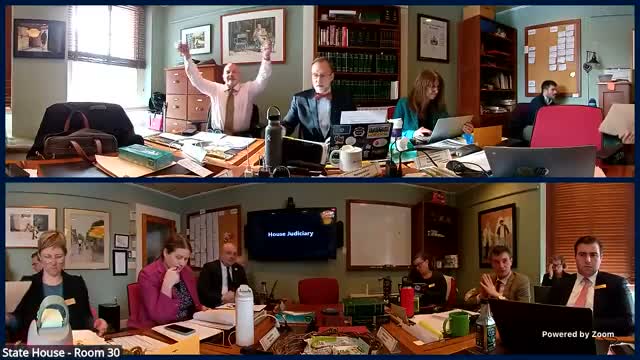
The House Judiciary Committee spent substantial time wrestling with penalty levels and age-based exceptions for proposed offenses addressing nonconsensual disclosure of explicit images and sextortion. Committee members identified a discrepancy in the draft: one provision listed a 5-year felony while another appeared as a 2-year misdemeanor, prompting debate over whether the misdemeanor option provides needed prosecutorial flexibility.
Prosecutors' representatives, including Kim McManus from the Department of State's Attorneys and Sheriffs, supported retaining multiple culpability standards so prosecutors would have options if they could not prove nonconsensual taking. "We appreciate having the two different standards we can work with depending on the facts," McManus said. Members discussed moving the consensual-image-then-disclosure offense from a misdemeanor to a 3-year felony while also making that felony sealable to avoid lifelong collateral consequences for young people.
Members raised juvenile-justice concerns repeatedly: because family court handles delinquency in many cases involving minors, making the offense categorically felonious could prevent transfer opportunities and have long-term consequences for young defendants. The committee discussed models used in other states — including Pennsylvania, which was cited as having a misdemeanor with enhancements to a felony in certain circumstances — and asked advocates to help map how other states handle offender age and victim characteristics.
Charlie Glesserman, policy director at the Vermont Network Against Domestic and Sexual Violence, urged caution about unintended consequences of elevating these offenses to felonies for young people and noted the nonconsensual-disclosure statute as drafted already covers AI-generated and digitized images. "These are behaviors that have very serious harm...nonconsensual disclosure of explicit images statute does include AI generated and digitized images," Glesserman said, adding concern about how often these harms are committed by younger people.
The committee did not adopt final penalty language during this session. Members asked staff to research sealing/expungement rules, cross-check existing extortion and criminal threatening statutes (noting extortion was referenced as a 3-year felony in current statute), and consider targeted enhancements for cases involving adults who victimize minors or victims with disabilities. The panel signaled interest in a 3-year felony for some sextortion provisions, paired with explicit sealing language if the offense is elevated.
Prosecutors' representatives, including Kim McManus from the Department of State's Attorneys and Sheriffs, supported retaining multiple culpability standards so prosecutors would have options if they could not prove nonconsensual taking. "We appreciate having the two different standards we can work with depending on the facts," McManus said. Members discussed moving the consensual-image-then-disclosure offense from a misdemeanor to a 3-year felony while also making that felony sealable to avoid lifelong collateral consequences for young people.
Members raised juvenile-justice concerns repeatedly: because family court handles delinquency in many cases involving minors, making the offense categorically felonious could prevent transfer opportunities and have long-term consequences for young defendants. The committee discussed models used in other states — including Pennsylvania, which was cited as having a misdemeanor with enhancements to a felony in certain circumstances — and asked advocates to help map how other states handle offender age and victim characteristics.
Charlie Glesserman, policy director at the Vermont Network Against Domestic and Sexual Violence, urged caution about unintended consequences of elevating these offenses to felonies for young people and noted the nonconsensual-disclosure statute as drafted already covers AI-generated and digitized images. "These are behaviors that have very serious harm...nonconsensual disclosure of explicit images statute does include AI generated and digitized images," Glesserman said, adding concern about how often these harms are committed by younger people.
The committee did not adopt final penalty language during this session. Members asked staff to research sealing/expungement rules, cross-check existing extortion and criminal threatening statutes (noting extortion was referenced as a 3-year felony in current statute), and consider targeted enhancements for cases involving adults who victimize minors or victims with disabilities. The panel signaled interest in a 3-year felony for some sextortion provisions, paired with explicit sealing language if the offense is elevated.
Don't Miss a Word: See the Full Meeting!
Go beyond summaries. Unlock every video, transcript, and key insight with a Founder Membership.
✓
Get instant access to full meeting videos
✓
Search and clip any phrase from complete transcripts
✓
Receive AI-powered summaries & custom alerts
✓
Enjoy lifetime, unrestricted access to government data
30-day money-back guarantee
