House Judiciary Committee reviews revised H 66, creates new extortion section for nonconsensual image disclosure
January 29, 2026 | Judiciary, HOUSE OF REPRESENTATIVES, Committees, Legislative , Vermont
This article was created by AI summarizing key points discussed. AI makes mistakes, so for full details and context, please refer to the video of the full meeting. Please report any errors so we can fix them. Report an error »
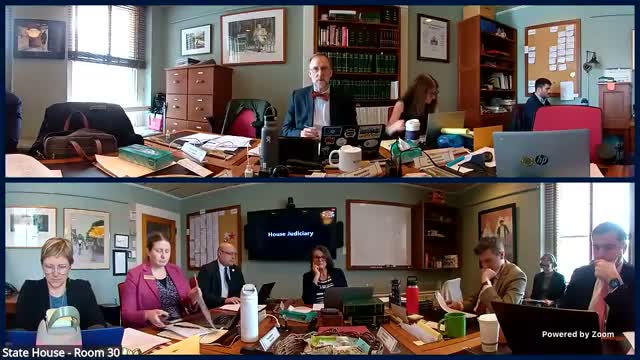
The House Judiciary Committee spent its Jan. 20 meeting reviewing draft 2.2 of H 66, a revision that moves provisions on threatening the disclosure of explicit images into a new extortion statute and adds a definition of "harm," legislative staff said. Michelle Charles of the Office of Legislative Council walked the committee through the changes, noting technical cross-reference fixes and policy clarifications.
The draft would relocate extortion language out of the existing dissemination statute into a new section (described in the draft as creating section 2607) and preserve the offense elements while adding a standalone definition of harm. "I added a definition of harm on there," Charles told committee members during the walkthrough, and she said the definition mirrors language in the existing dissemination provision so civil and criminal provisions align.
Under the penalties described in the draft, the base extortion provision would carry a penalty aligned with the general extortion statute: a five-year felony and a $5,000 fine. The draft proposes an enhanced penalty of up to 10 years and $10,000 when the victim is under 18, and an enhancement up to 15 years if a violation results in serious bodily injury or death, Charles said. The draft also includes a Good-Samaritan–style immunity clause modeled on other statutes that would protect people who, in good faith and in a timely manner, report the offense from prosecution under certain obscenity/dissemination provisions.
Committee members pressed the drafters on several substantive issues. Members debated whether to retain language that makes "without the person's consent" an element in multiple sections. One member noted practical problems with requiring a depicted person to ask each website to remove material that can reappear elsewhere; another urged caution because the element has supported case law in the past. Kim McNattis of the Department of States Attorneys and Sharps said the change "tracks" with moving extortion out of voyeurism but recommended the committee review the Van Buren case before removing consent language from sections that have relied on it.
Members also questioned how the draft treats the mental state for an enhancement tied to serious bodily injury or death. That discussion focused on whether the enhancement should require proof of recklessness, negligence, or another mens rea to avoid imposing a strict-liability result if, for example, a threatened disclosure coincided with a victim's later self-harm. A representative associated with the defender general's office cautioned that "the civil section really doesn't add anything to existing law" and warned that statutory torts can unintentionally limit or alter remedies that common-law claims cover.
The committee flagged the proposed 40-year statute of limitations for certain voyeurism and disclosure offenses and discussed practical issues about when an offense is considered to have been committed or discovered. Members heard that the 40-year window would extend the time to bring prosecutions compared with the existing three-year period for some voyeurism cases, and prosecutors indicated the longer window would help in older cases while noting tolling and discovery issues can be complicated in practice.
Committee members directed drafters to consider specific edits and to solicit additional testimony from state’s attorneys and the defender general’s office. The committee agreed to strike a consent-related phrase in one section as an interim edit and scheduled follow-up discussion and possible finalization in an afternoon slot at 2:30 p.m. (with a backup meeting at 2:00 p.m. the next day).
The committee did not take a formal vote on the bill during the session. Lawmakers and staff indicated several drafting choices remain unresolved—particularly the treatment of consent language, the mens rea standard for injury/death enhancements, and the scope and timing of immunity—so they will return with further revisions and testimony before any final action.
The draft would relocate extortion language out of the existing dissemination statute into a new section (described in the draft as creating section 2607) and preserve the offense elements while adding a standalone definition of harm. "I added a definition of harm on there," Charles told committee members during the walkthrough, and she said the definition mirrors language in the existing dissemination provision so civil and criminal provisions align.
Under the penalties described in the draft, the base extortion provision would carry a penalty aligned with the general extortion statute: a five-year felony and a $5,000 fine. The draft proposes an enhanced penalty of up to 10 years and $10,000 when the victim is under 18, and an enhancement up to 15 years if a violation results in serious bodily injury or death, Charles said. The draft also includes a Good-Samaritan–style immunity clause modeled on other statutes that would protect people who, in good faith and in a timely manner, report the offense from prosecution under certain obscenity/dissemination provisions.
Committee members pressed the drafters on several substantive issues. Members debated whether to retain language that makes "without the person's consent" an element in multiple sections. One member noted practical problems with requiring a depicted person to ask each website to remove material that can reappear elsewhere; another urged caution because the element has supported case law in the past. Kim McNattis of the Department of States Attorneys and Sharps said the change "tracks" with moving extortion out of voyeurism but recommended the committee review the Van Buren case before removing consent language from sections that have relied on it.
Members also questioned how the draft treats the mental state for an enhancement tied to serious bodily injury or death. That discussion focused on whether the enhancement should require proof of recklessness, negligence, or another mens rea to avoid imposing a strict-liability result if, for example, a threatened disclosure coincided with a victim's later self-harm. A representative associated with the defender general's office cautioned that "the civil section really doesn't add anything to existing law" and warned that statutory torts can unintentionally limit or alter remedies that common-law claims cover.
The committee flagged the proposed 40-year statute of limitations for certain voyeurism and disclosure offenses and discussed practical issues about when an offense is considered to have been committed or discovered. Members heard that the 40-year window would extend the time to bring prosecutions compared with the existing three-year period for some voyeurism cases, and prosecutors indicated the longer window would help in older cases while noting tolling and discovery issues can be complicated in practice.
Committee members directed drafters to consider specific edits and to solicit additional testimony from state’s attorneys and the defender general’s office. The committee agreed to strike a consent-related phrase in one section as an interim edit and scheduled follow-up discussion and possible finalization in an afternoon slot at 2:30 p.m. (with a backup meeting at 2:00 p.m. the next day).
The committee did not take a formal vote on the bill during the session. Lawmakers and staff indicated several drafting choices remain unresolved—particularly the treatment of consent language, the mens rea standard for injury/death enhancements, and the scope and timing of immunity—so they will return with further revisions and testimony before any final action.
View the Full Meeting & All Its Details
This article offers just a summary. Unlock complete video, transcripts, and insights as a Founder Member.
✓
Watch full, unedited meeting videos
✓
Search every word spoken in unlimited transcripts
✓
AI summaries & real-time alerts (all government levels)
✓
Permanent access to expanding government content
30-day money-back guarantee
