Senator Harrison proposes enhanced VEGI incentive for employee‑owned, member‑owned firms
January 29, 2026 | Economic Development, Housing & General Affairs, SENATE, Committees, Legislative , Vermont
This article was created by AI summarizing key points discussed. AI makes mistakes, so for full details and context, please refer to the video of the full meeting. Please report any errors so we can fix them. Report an error »
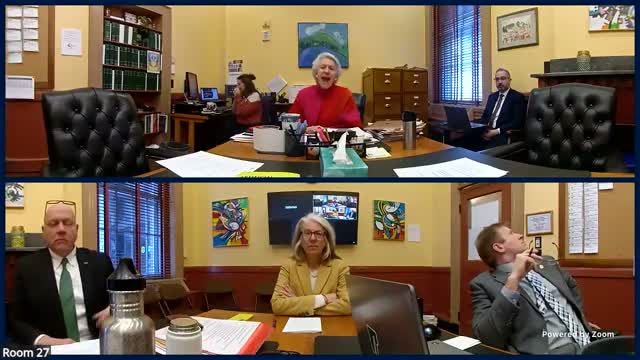
Sen. Wendy Harrison (Windham district) introduced S.88, a bill to add an enhanced incentive under the Vermont Employment Growth Incentive (VEGI) program for employee‑ and member‑owned businesses, including worker cooperatives and employee stock ownership plans (ESOPs). Harrison said the proposal aims to reward businesses that are rooted in the state, tend to pay higher wages and offer strong benefits.
"They typically have good benefits. They're rooted in the community," Harrison said, urging the committee to consider employee ownership as a public‑policy priority. She suggested the committee hear from Chroma (a prior VEGI recipient), Matt Cropp of the Vermont Employee Ownership Center and Michael Knapp (retired founder of Green River) to better assess the proposal.
Rick Segal of the Office of Legislative Council outlined how S.88 would define qualifying entities, saying the bill cross‑references federal ESOP definitions and explicitly includes worker cooperatives and organizations in which employees constitute a membership majority and elect board control on a one‑person, one‑vote basis. Segal said the draft attempts to cast a wide net to capture different forms of member ownership.
Segal also reviewed key VEGI mechanics: applications are reviewed by the council; applicants must meet mandatory criteria set out in statute, and awards are performance‑based. "But for" language requires the council to determine the proposed economic activity would not occur or would occur in a materially different way without the incentive, Segal said, noting that the VEGI process is designed to protect state funds by paying only after revenue increases are verified.
Committee members raised practical questions about stage‑of‑life for firms that convert to employee ownership (some transitions occur late in a firm's lifecycle) and whether ESOPs—primarily retirement vehicles—should be treated differently than worker cooperatives. Members agreed staff should track how many Vermont businesses would qualify, whether the incentive calculation would be workable for the VEGI council, and whether to include the change in the committee's broader economic development bill or proceed with a standalone measure.
Next steps: committee staff will provide statutory language and a spreadsheet comparing definitions and incidence; the committee also asked to hear from practitioners and prior VEGI recipients before deciding whether to add the provision to the committee bill.
"They typically have good benefits. They're rooted in the community," Harrison said, urging the committee to consider employee ownership as a public‑policy priority. She suggested the committee hear from Chroma (a prior VEGI recipient), Matt Cropp of the Vermont Employee Ownership Center and Michael Knapp (retired founder of Green River) to better assess the proposal.
Rick Segal of the Office of Legislative Council outlined how S.88 would define qualifying entities, saying the bill cross‑references federal ESOP definitions and explicitly includes worker cooperatives and organizations in which employees constitute a membership majority and elect board control on a one‑person, one‑vote basis. Segal said the draft attempts to cast a wide net to capture different forms of member ownership.
Segal also reviewed key VEGI mechanics: applications are reviewed by the council; applicants must meet mandatory criteria set out in statute, and awards are performance‑based. "But for" language requires the council to determine the proposed economic activity would not occur or would occur in a materially different way without the incentive, Segal said, noting that the VEGI process is designed to protect state funds by paying only after revenue increases are verified.
Committee members raised practical questions about stage‑of‑life for firms that convert to employee ownership (some transitions occur late in a firm's lifecycle) and whether ESOPs—primarily retirement vehicles—should be treated differently than worker cooperatives. Members agreed staff should track how many Vermont businesses would qualify, whether the incentive calculation would be workable for the VEGI council, and whether to include the change in the committee's broader economic development bill or proceed with a standalone measure.
Next steps: committee staff will provide statutory language and a spreadsheet comparing definitions and incidence; the committee also asked to hear from practitioners and prior VEGI recipients before deciding whether to add the provision to the committee bill.
View the Full Meeting & All Its Details
This article offers just a summary. Unlock complete video, transcripts, and insights as a Founder Member.
✓
Watch full, unedited meeting videos
✓
Search every word spoken in unlimited transcripts
✓
AI summaries & real-time alerts (all government levels)
✓
Permanent access to expanding government content
30-day money-back guarantee
