Senate committee previews economic development bill: downtown tax cap, small‑business legal aid, microbusiness grants and task forces
January 29, 2026 | Economic Development, Housing & General Affairs, SENATE, Committees, Legislative , Vermont
This article was created by AI summarizing key points discussed. AI makes mistakes, so for full details and context, please refer to the video of the full meeting. Please report any errors so we can fix them. Report an error »
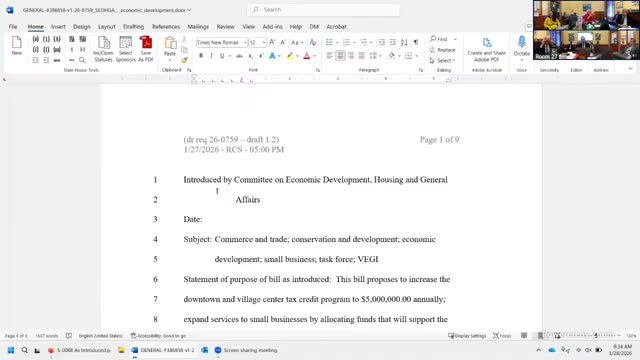
Committee counsel presented Draft 1.2 of the Senate Economic Development, Housing & General Affairs Committee’s economic development bill and walked through key sections for members.
The bill’s purpose is to strengthen Vermont businesses, support downtowns and provide targeted financial and technical assistance across business stages. Major committee proposals include raising the Downtown and Village Center Tax program cap from $3 million to $5 million annually; a $300,000 allocation in 2027 to sustain the Vermont Small Business Law Center’s free legal help to small businesses; a $689,000 grant to the Vermont Small Business Development Center to expand no‑fee advising; and a $594,000 allocation to support microbusiness programs run through Community Action Partnership offices (BCAP).
The draft also includes $3 million for brownfields remediation grants, a $200,000 add to an outdoor recreation economic study (on top of a $500,000 governor recommendation), and $150,000 for the International Business Office (Montreal). Section 7 would recreate a task force to inventory resources at each stage of business development and to recommend how the state might better access capital and market available services to entrepreneurs. Members discussed membership, timelines and deliverables; staff suggested an interim report and noted the task force could ask for more time if needed.
During the presentation members raised practical questions: where requested amounts would be found in agency budgets, which items are in the governor’s recommendation, what existing federal funds are expiring (notably for legal services), and how the task force would avoid duplicative work. Counsel said appropriations and ACCD would need to identify funds and that some items are requests to the appropriations committees rather than guaranteed appropriations.
Separately, Section 8 would repeal VEGI’s scheduled sunset (01/01/2027) so VEGI continues indefinitely; Section 9 would increase the allowed meetings for a convention center/performance venue task force (from six to 14 meetings) following requests from that group. The committee paused to take a break and asked staff to provide a clean draft of housing and the committee bill for review before voting on a work‑in‑progress.
Next steps: staff will provide detailed line‑item budget sources, invite stakeholders (Small Business Development Center, Community Action partners, outdoor recreation collaborative) to testify, and return with a redraft for committee consideration.
The bill’s purpose is to strengthen Vermont businesses, support downtowns and provide targeted financial and technical assistance across business stages. Major committee proposals include raising the Downtown and Village Center Tax program cap from $3 million to $5 million annually; a $300,000 allocation in 2027 to sustain the Vermont Small Business Law Center’s free legal help to small businesses; a $689,000 grant to the Vermont Small Business Development Center to expand no‑fee advising; and a $594,000 allocation to support microbusiness programs run through Community Action Partnership offices (BCAP).
The draft also includes $3 million for brownfields remediation grants, a $200,000 add to an outdoor recreation economic study (on top of a $500,000 governor recommendation), and $150,000 for the International Business Office (Montreal). Section 7 would recreate a task force to inventory resources at each stage of business development and to recommend how the state might better access capital and market available services to entrepreneurs. Members discussed membership, timelines and deliverables; staff suggested an interim report and noted the task force could ask for more time if needed.
During the presentation members raised practical questions: where requested amounts would be found in agency budgets, which items are in the governor’s recommendation, what existing federal funds are expiring (notably for legal services), and how the task force would avoid duplicative work. Counsel said appropriations and ACCD would need to identify funds and that some items are requests to the appropriations committees rather than guaranteed appropriations.
Separately, Section 8 would repeal VEGI’s scheduled sunset (01/01/2027) so VEGI continues indefinitely; Section 9 would increase the allowed meetings for a convention center/performance venue task force (from six to 14 meetings) following requests from that group. The committee paused to take a break and asked staff to provide a clean draft of housing and the committee bill for review before voting on a work‑in‑progress.
Next steps: staff will provide detailed line‑item budget sources, invite stakeholders (Small Business Development Center, Community Action partners, outdoor recreation collaborative) to testify, and return with a redraft for committee consideration.
View the Full Meeting & All Its Details
This article offers just a summary. Unlock complete video, transcripts, and insights as a Founder Member.
✓
Watch full, unedited meeting videos
✓
Search every word spoken in unlimited transcripts
✓
AI summaries & real-time alerts (all government levels)
✓
Permanent access to expanding government content
30-day money-back guarantee
