Franklin County reports near-budget revenues, strong interest income; bond and state funding cited
January 29, 2026 | Franklin County, Pennsylvania
This article was created by AI summarizing key points discussed. AI makes mistakes, so for full details and context, please refer to the video of the full meeting. Please report any errors so we can fix them. Report an error »
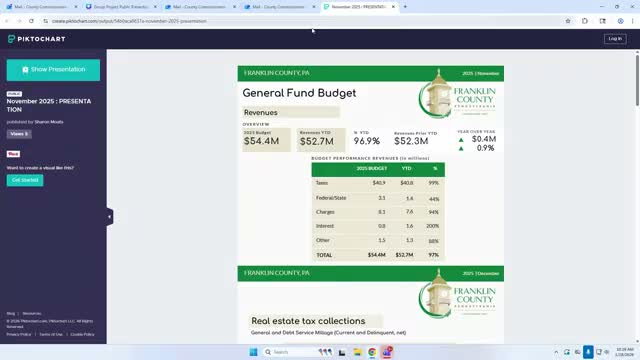
Franklin County’s finance officials told the Board of Commissioners on Jan. 28 that the county is tracking close to budget for 2025, with tax collections and unexpectedly strong investment income helping offset slower state grant receipts.
"We've recognized $52,700,000 of our $54,400,000 budget, or 96.9%," said Teresa Beckner, chief financial officer, summarizing general fund revenues through November. She said taxes accounted for $40,800,000, or roughly 99% of the tax budget, and countywide tax collections for 2025 totaled about $47,500,000 — roughly 99.8% of what was budgeted to be collected.
Beckner and Director Janelle Friese told commissioners that federal and state revenue recognition was lagging — "This is where the state budget impasse is still having a small impact on our budget," Beckner said — because some grants and allocations have not yet been awarded. They cautioned that federal/state revenues in the general fund often align with spending on tied grants, meaning slower spending can depress recognized revenue.
The presenters highlighted investment income as a positive variance. "Interest is at 200%," Beckner said, attributing the performance to higher-than-anticipated interest rates and noting the county adjusted conservatively for 2026. On expenditures, the county had spent about $50.2 million of a $60.8 million general fund expense budget (82.5%), reflecting trends consistent with reporting through November (about 92% of the year).
Friese and Beckner also reviewed countywide results, saying the picture across all county operations (excluding fiduciary or trust funds) showed revenues recognized of $119 million of a $133.2 million plan (89.4%) and expenditures at roughly 79.4% of a $149.6 million budget. They explained a $10 million bond issued in June 2024 to wrap up court facility improvements accounts for much of the year-to-year variance in revenue and miscellaneous categories.
Commissioners asked clarifying questions. One commissioner confirmed that the debt service millage is included in the collection figures and that library allocations are treated separately. A commissioner pressed for a public record that the apparent reduction in labor costs reflected budgeting for vacancies rather than actual cuts; Beckner confirmed 2026 uses a target-based budgeting approach that built in a vacancy factor.
The county finance staff closed by saying final December numbers were still being finalized and that the November numbers provide a good outlook for year-end results. No formal action beyond receiving the report was taken at the meeting; the board moved into executive session at the end of the public portion of the agenda.
"We've recognized $52,700,000 of our $54,400,000 budget, or 96.9%," said Teresa Beckner, chief financial officer, summarizing general fund revenues through November. She said taxes accounted for $40,800,000, or roughly 99% of the tax budget, and countywide tax collections for 2025 totaled about $47,500,000 — roughly 99.8% of what was budgeted to be collected.
Beckner and Director Janelle Friese told commissioners that federal and state revenue recognition was lagging — "This is where the state budget impasse is still having a small impact on our budget," Beckner said — because some grants and allocations have not yet been awarded. They cautioned that federal/state revenues in the general fund often align with spending on tied grants, meaning slower spending can depress recognized revenue.
The presenters highlighted investment income as a positive variance. "Interest is at 200%," Beckner said, attributing the performance to higher-than-anticipated interest rates and noting the county adjusted conservatively for 2026. On expenditures, the county had spent about $50.2 million of a $60.8 million general fund expense budget (82.5%), reflecting trends consistent with reporting through November (about 92% of the year).
Friese and Beckner also reviewed countywide results, saying the picture across all county operations (excluding fiduciary or trust funds) showed revenues recognized of $119 million of a $133.2 million plan (89.4%) and expenditures at roughly 79.4% of a $149.6 million budget. They explained a $10 million bond issued in June 2024 to wrap up court facility improvements accounts for much of the year-to-year variance in revenue and miscellaneous categories.
Commissioners asked clarifying questions. One commissioner confirmed that the debt service millage is included in the collection figures and that library allocations are treated separately. A commissioner pressed for a public record that the apparent reduction in labor costs reflected budgeting for vacancies rather than actual cuts; Beckner confirmed 2026 uses a target-based budgeting approach that built in a vacancy factor.
The county finance staff closed by saying final December numbers were still being finalized and that the November numbers provide a good outlook for year-end results. No formal action beyond receiving the report was taken at the meeting; the board moved into executive session at the end of the public portion of the agenda.
View the Full Meeting & All Its Details
This article offers just a summary. Unlock complete video, transcripts, and insights as a Founder Member.
✓
Watch full, unedited meeting videos
✓
Search every word spoken in unlimited transcripts
✓
AI summaries & real-time alerts (all government levels)
✓
Permanent access to expanding government content
30-day money-back guarantee
