DHRM trainer: Utah state workforce can build 'business agility' through cognitive practice and culture shifts
October 30, 2024 | Human Resources, Utah Government Trust, Utah Government Divisions, Utah Legislative Branch, Utah
This article was created by AI summarizing key points discussed. AI makes mistakes, so for full details and context, please refer to the video of the full meeting. Please report any errors so we can fix them. Report an error »
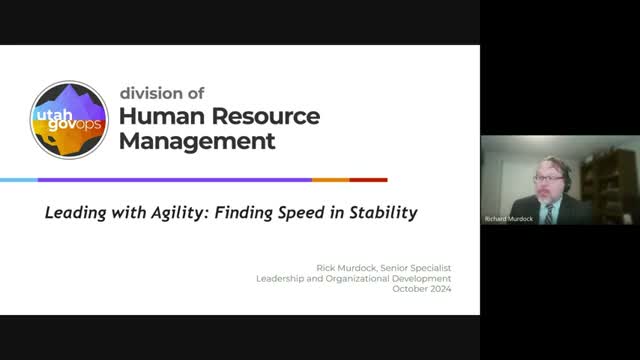
Rick Murdoch, a leadership trainer with the Department of Human Resource Management's leadership and organizational development group (GovOps), used a recorded staff webinar to argue that Utah state agencies can and should cultivate "business agility" to respond faster to changing laws, customer needs and emergencies.
Murdoch said agility is more than speed or technical skill: it combines physical capacity, technical habits and, most importantly, cognitive practice. "The only way to get more agile is through practicing cognitive stuff," he said, describing the cognitive elements as "visual scanning, anticipation, pattern recognition and knowledge of the situation, context."
Why it matters: Murdoch framed agility as a practical tool for public agencies that must implement laws, executive directions or federal grants on tight timelines. He pointed to the state's rapid shift to remote work in 2020 as an example of employees adapting under pressure and cited recent improvements at the driver's license division as evidence that large, regulated agencies can deliver change.
Murdoch outlined five domains of business agility agencies can develop: engagement culture, responsive customer focus, people-first leadership, flexible operations and value-based delivery. On engagement culture, he urged transparency, cross-training and psychological safety so teams can learn from mistakes without fear of punishment. On customer focus, he said employees should identify who they serve—other agencies, the governor, the legislature or the public—and prioritize delivering value to those customers.
On leadership and accountability, Murdoch recommended leaders assign ownership from a project's start to finish and use regular check-ins to track progress rather than punitive after-the-fact blame. He acknowledged limits in state government—budgets and structures that are often rigid—but said strategic approaches can allow agencies to "deliver needed outcomes within our mandated structures."
Murdoch also reviewed agile's software-development origins and the broader "business agility" idea, quoting a definition that describes it as "a set of organizational capabilities, behaviors and ways of working that afford your team the freedom, flexibility and resilience to achieve its purpose." He encouraged participants to "look at your team's processes" and to scan for emergent opportunities that could be adopted within existing constraints.
The session was recorded and will be shared with participants; Murdoch corrected his contact email to rsmurdock@utah.gov and invited follow-up engagement. He also reminded listeners that the next webinar, "Winning with Workplace Wellness" by Sydney Alton, is scheduled for the last Wednesday of November at 10 a.m.
Murdoch said agility is more than speed or technical skill: it combines physical capacity, technical habits and, most importantly, cognitive practice. "The only way to get more agile is through practicing cognitive stuff," he said, describing the cognitive elements as "visual scanning, anticipation, pattern recognition and knowledge of the situation, context."
Why it matters: Murdoch framed agility as a practical tool for public agencies that must implement laws, executive directions or federal grants on tight timelines. He pointed to the state's rapid shift to remote work in 2020 as an example of employees adapting under pressure and cited recent improvements at the driver's license division as evidence that large, regulated agencies can deliver change.
Murdoch outlined five domains of business agility agencies can develop: engagement culture, responsive customer focus, people-first leadership, flexible operations and value-based delivery. On engagement culture, he urged transparency, cross-training and psychological safety so teams can learn from mistakes without fear of punishment. On customer focus, he said employees should identify who they serve—other agencies, the governor, the legislature or the public—and prioritize delivering value to those customers.
On leadership and accountability, Murdoch recommended leaders assign ownership from a project's start to finish and use regular check-ins to track progress rather than punitive after-the-fact blame. He acknowledged limits in state government—budgets and structures that are often rigid—but said strategic approaches can allow agencies to "deliver needed outcomes within our mandated structures."
Murdoch also reviewed agile's software-development origins and the broader "business agility" idea, quoting a definition that describes it as "a set of organizational capabilities, behaviors and ways of working that afford your team the freedom, flexibility and resilience to achieve its purpose." He encouraged participants to "look at your team's processes" and to scan for emergent opportunities that could be adopted within existing constraints.
The session was recorded and will be shared with participants; Murdoch corrected his contact email to rsmurdock@utah.gov and invited follow-up engagement. He also reminded listeners that the next webinar, "Winning with Workplace Wellness" by Sydney Alton, is scheduled for the last Wednesday of November at 10 a.m.
View the Full Meeting & All Its Details
This article offers just a summary. Unlock complete video, transcripts, and insights as a Founder Member.
✓
Watch full, unedited meeting videos
✓
Search every word spoken in unlimited transcripts
✓
AI summaries & real-time alerts (all government levels)
✓
Permanent access to expanding government content
30-day money-back guarantee
