Oviedo CRC debates district seats vs. at‑large elections for four council seats
January 29, 2026 | Oviedo, Seminole County, Florida
This article was created by AI summarizing key points discussed. AI makes mistakes, so for full details and context, please refer to the video of the full meeting. Please report any errors so we can fix them. Report an error »
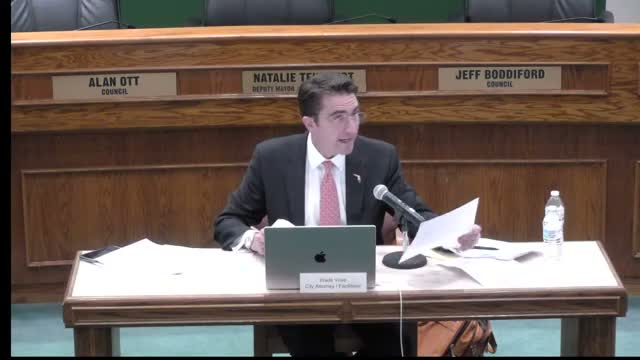
The Oviedo Charter Review Committee on Monday opened a broad conversation about how the city elects its council members, weighing a long-standing at‑large system against proposals for district or hybrid elections.
Committee members heard that the current charter establishes a five‑member council — one mayor and four at‑large council members — and that, under at‑large rules, "everyone in the city, all registered voters within the city, can vote on each of their elections," the committee's moderator said. That structure means candidates need not live in a particular part of town to run, and seats are identified by number and staggered election timing.
Kevin Hypes, a committee member who spoke from experience serving in Sanford, said district seats can create a closer constituent relationship: "The folks in my community, they knew who I was, and they knew I lived in their community," Hypes said, arguing residents would have a clearer local point of contact for development or neighborhood issues.
Supporters of the at‑large model told the committee it helps ensure citywide perspective and fairness in resource distribution. One member argued that having the entire city vote for each representative prevents pitting one neighborhood against another and keeps councilors responsible for the whole municipality rather than a single pocket of voters.
Moderator commentary clarified common district permutations: residency districts that require living in a zone but still permit citywide voting for that seat, and single‑member districts where only district voters elect their representative. He also noted legal requirements for districts: "those districts have to have, as, equal, equal population as practice," and federal and state civil‑rights considerations apply when drawing lines.
Members raised practical concerns: Oviedo covers about 16 square miles and has uneven pockets of population density, which could produce districts with differing internal characteristics. They also discussed voter recruitment challenges in small districts and whether any change would require creating new seats (the moderator said the working proposal envisages converting the existing four seats, not adding seats).
No formal recommendation or charter amendment was made. The committee agreed the question merits further study and prioritization as part of its continuing review of the charter.
The committee adjourned at the end of the meeting; the panel plans to revisit the district-versus-at-large question at a future session.
Committee members heard that the current charter establishes a five‑member council — one mayor and four at‑large council members — and that, under at‑large rules, "everyone in the city, all registered voters within the city, can vote on each of their elections," the committee's moderator said. That structure means candidates need not live in a particular part of town to run, and seats are identified by number and staggered election timing.
Kevin Hypes, a committee member who spoke from experience serving in Sanford, said district seats can create a closer constituent relationship: "The folks in my community, they knew who I was, and they knew I lived in their community," Hypes said, arguing residents would have a clearer local point of contact for development or neighborhood issues.
Supporters of the at‑large model told the committee it helps ensure citywide perspective and fairness in resource distribution. One member argued that having the entire city vote for each representative prevents pitting one neighborhood against another and keeps councilors responsible for the whole municipality rather than a single pocket of voters.
Moderator commentary clarified common district permutations: residency districts that require living in a zone but still permit citywide voting for that seat, and single‑member districts where only district voters elect their representative. He also noted legal requirements for districts: "those districts have to have, as, equal, equal population as practice," and federal and state civil‑rights considerations apply when drawing lines.
Members raised practical concerns: Oviedo covers about 16 square miles and has uneven pockets of population density, which could produce districts with differing internal characteristics. They also discussed voter recruitment challenges in small districts and whether any change would require creating new seats (the moderator said the working proposal envisages converting the existing four seats, not adding seats).
No formal recommendation or charter amendment was made. The committee agreed the question merits further study and prioritization as part of its continuing review of the charter.
The committee adjourned at the end of the meeting; the panel plans to revisit the district-versus-at-large question at a future session.
Don't Miss a Word: See the Full Meeting!
Go beyond summaries. Unlock every video, transcript, and key insight with a Founder Membership.
✓
Get instant access to full meeting videos
✓
Search and clip any phrase from complete transcripts
✓
Receive AI-powered summaries & custom alerts
✓
Enjoy lifetime, unrestricted access to government data
30-day money-back guarantee
