Marshall County planners recommend battery storage ordinance with larger setback; send draft to commissioners
January 22, 2026 | Marshall County, Indiana
This article was created by AI summarizing key points discussed. AI makes mistakes, so for full details and context, please refer to the video of the full meeting. Please report any errors so we can fix them. Report an error »
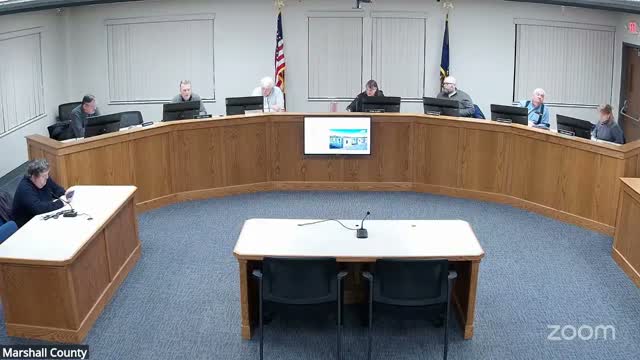
The Marshall County Planning Commission on Jan. 22 recommended that county commissioners consider an amended ordinance establishing rules for battery energy storage systems and voted to forward the draft with a key edit increasing the adjacent‑property setback from 500 feet to 1,000 feet.
The recommendation stems from a months‑long subcommittee review and legal input as staff presented a revised draft incorporating new definitions, changes to zoning treatment by project tier, revised application requirements and decommissioning plans. Planning staff said the draft was updated “based on your comments at the initial reading of the ordinance and after legal counsel comment.”
Under the draft staff reviewed, tier 1 systems (up to 100 kilowatts) would be permitted across many zoning districts, while larger installations would be limited to industrial districts or to a proposed new Energy Generation and Storage (EGS) zoning district. Staff said tier 3 in earlier drafts has been folded into tier 2. The record shows the draft removes prior special‑use conditional allowances, deletes a foreign‑control prohibition from one paragraph, and requires that all necessary state and federal permits be provided to planning staff.
The draft also adds operational safeguards: an escrow mechanism to be established “in the amount specified by the county commissioners and county council” to cover road repair and emergency response costs, and a second decommissioning plan addressing unplanned events such as equipment failure or fire, with instructions for removal, on‑site containment, approved transporters and refurbish/recycling options. Planning staff emphasized that technical components of projects would be reviewed by a project‑specific technical review committee.
Public comment was limited. Bill Woodward of 12094 Peach Road in Plymouth told the commission that no specific sites are public yet but that reviewing standards now would put the county “ahead of the game” should interest materialize. Woodward asked whether a potential site would require rezoning; staff said larger projects would typically need rezoning and are more likely to be sited near transmission lines.
Commissioners focused much of their substantive debate on residential setbacks. Several members and participants argued the draft’s 500‑foot adjacent‑property setback could be insufficient for nearby residents. One commissioner said living next to a battery facility raised concerns about smoke and fumes; another urged that neighbors be treated fairly. The commission voted by voice to change the adjacent‑property setback from 500 to 1,000 feet and later, on roll call, approved forwarding the revised draft to the county commissioners.
The ordinance references state law and recent session language in the record (noted in the transcript as IC 22‑14‑8 and Indiana HEA 11/2023) for coordination with emergency responders; staff said they will continue to refine inspection language and that licensed third‑party professionals will be used for technical verification. Insurance and liability limits are written to be “suitable to the county commissioners,” with deducibles similarly left to county discretion.
Next steps: the Planning Commission’s recommendation, including the 1,000‑foot setback and the other agreed edits, will be transmitted to the Marshall County commissioners for their consideration and any formal action.
The recommendation stems from a months‑long subcommittee review and legal input as staff presented a revised draft incorporating new definitions, changes to zoning treatment by project tier, revised application requirements and decommissioning plans. Planning staff said the draft was updated “based on your comments at the initial reading of the ordinance and after legal counsel comment.”
Under the draft staff reviewed, tier 1 systems (up to 100 kilowatts) would be permitted across many zoning districts, while larger installations would be limited to industrial districts or to a proposed new Energy Generation and Storage (EGS) zoning district. Staff said tier 3 in earlier drafts has been folded into tier 2. The record shows the draft removes prior special‑use conditional allowances, deletes a foreign‑control prohibition from one paragraph, and requires that all necessary state and federal permits be provided to planning staff.
The draft also adds operational safeguards: an escrow mechanism to be established “in the amount specified by the county commissioners and county council” to cover road repair and emergency response costs, and a second decommissioning plan addressing unplanned events such as equipment failure or fire, with instructions for removal, on‑site containment, approved transporters and refurbish/recycling options. Planning staff emphasized that technical components of projects would be reviewed by a project‑specific technical review committee.
Public comment was limited. Bill Woodward of 12094 Peach Road in Plymouth told the commission that no specific sites are public yet but that reviewing standards now would put the county “ahead of the game” should interest materialize. Woodward asked whether a potential site would require rezoning; staff said larger projects would typically need rezoning and are more likely to be sited near transmission lines.
Commissioners focused much of their substantive debate on residential setbacks. Several members and participants argued the draft’s 500‑foot adjacent‑property setback could be insufficient for nearby residents. One commissioner said living next to a battery facility raised concerns about smoke and fumes; another urged that neighbors be treated fairly. The commission voted by voice to change the adjacent‑property setback from 500 to 1,000 feet and later, on roll call, approved forwarding the revised draft to the county commissioners.
The ordinance references state law and recent session language in the record (noted in the transcript as IC 22‑14‑8 and Indiana HEA 11/2023) for coordination with emergency responders; staff said they will continue to refine inspection language and that licensed third‑party professionals will be used for technical verification. Insurance and liability limits are written to be “suitable to the county commissioners,” with deducibles similarly left to county discretion.
Next steps: the Planning Commission’s recommendation, including the 1,000‑foot setback and the other agreed edits, will be transmitted to the Marshall County commissioners for their consideration and any formal action.
View the Full Meeting & All Its Details
This article offers just a summary. Unlock complete video, transcripts, and insights as a Founder Member.
✓
Watch full, unedited meeting videos
✓
Search every word spoken in unlimited transcripts
✓
AI summaries & real-time alerts (all government levels)
✓
Permanent access to expanding government content
30-day money-back guarantee
