DreamKey presents city survey showing widespread housing instability and student-driven rental pressure in Columbia
January 23, 2026 | Columbia City, Richland County, South Carolina
This article was created by AI summarizing key points discussed. AI makes mistakes, so for full details and context, please refer to the video of the full meeting. Please report any errors so we can fix them. Report an error »
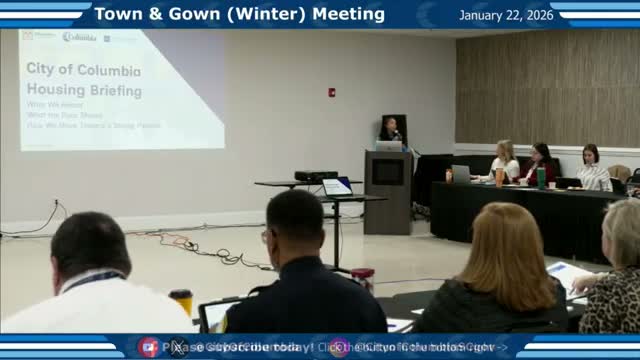
Erin Farbee, chief strategy officer for DreamKey Partners, presented the results of the nonprofit’s 2025 community engagement work to the City of Columbia Town & Gown Committee, saying the outreach included events, roundtables and a citywide survey. "Thirty‑five percent of residents reported experiencing housing instability," Farbee told the committee, a figure she characterized as “significantly higher than expected for a mid‑sized city.”
Farbee said DreamKey captured survey responses across multiple ZIP codes and age groups and that the primary driver named by respondents was a gap between housing costs and household income. She said 715 respondents (reported in presentation as 56%) cited combined cost and wage barriers and 236 identified low wages specifically.
The presentation flagged a recurring community concern that off‑campus student housing and investor activity are increasing rents and changing neighborhood character. "We overwhelmingly heard more about USC," Farbee said, summarizing respondents’ comments that off‑campus students and investors converting single‑family homes into multiple rented units were adding upward pressure on rents. The presentation also stated, verbatim from the slides, that off‑campus rentals made up about "26.1 of all rental units in Columbia." DreamKey described that finding as consistent with both the survey data and qualitative conversations.
Farbee outlined additional themes: differing definitions of safety between homeowners and renters; limited access to essential services and transit in some neighborhoods; a bifurcated housing market that preserves some naturally affordable older stock while newer mixed‑income or tax‑credit projects lease up unevenly; and a pronounced demand for lower‑rent units, especially for seniors and families. DreamKey said many residents reported they needed units renting for under $1,000 a month to be affordable.
Farbee recommended closer, data‑driven coordination between the city and each college and university. Citing a Charlotte example, she proposed meeting individually with institutional planners to overlay campus growth projections and student housing plans with transportation and neighborhood data. The committee announced a housing subcommittee kickoff after the meeting to begin that work.
The presentation closed with a supply snapshot: DreamKey said much new production was occurring in outer and emerging markets and cautioned the city should pursue preservation of existing nonprofit and naturally affordable units alongside targeted new construction.
Next steps noted by the committee included forming the housing subcommittee and follow‑up meetings between city staff, DreamKey and individual institutions to refine data sharing and align strategies.
Farbee said DreamKey captured survey responses across multiple ZIP codes and age groups and that the primary driver named by respondents was a gap between housing costs and household income. She said 715 respondents (reported in presentation as 56%) cited combined cost and wage barriers and 236 identified low wages specifically.
The presentation flagged a recurring community concern that off‑campus student housing and investor activity are increasing rents and changing neighborhood character. "We overwhelmingly heard more about USC," Farbee said, summarizing respondents’ comments that off‑campus students and investors converting single‑family homes into multiple rented units were adding upward pressure on rents. The presentation also stated, verbatim from the slides, that off‑campus rentals made up about "26.1 of all rental units in Columbia." DreamKey described that finding as consistent with both the survey data and qualitative conversations.
Farbee outlined additional themes: differing definitions of safety between homeowners and renters; limited access to essential services and transit in some neighborhoods; a bifurcated housing market that preserves some naturally affordable older stock while newer mixed‑income or tax‑credit projects lease up unevenly; and a pronounced demand for lower‑rent units, especially for seniors and families. DreamKey said many residents reported they needed units renting for under $1,000 a month to be affordable.
Farbee recommended closer, data‑driven coordination between the city and each college and university. Citing a Charlotte example, she proposed meeting individually with institutional planners to overlay campus growth projections and student housing plans with transportation and neighborhood data. The committee announced a housing subcommittee kickoff after the meeting to begin that work.
The presentation closed with a supply snapshot: DreamKey said much new production was occurring in outer and emerging markets and cautioned the city should pursue preservation of existing nonprofit and naturally affordable units alongside targeted new construction.
Next steps noted by the committee included forming the housing subcommittee and follow‑up meetings between city staff, DreamKey and individual institutions to refine data sharing and align strategies.
View the Full Meeting & All Its Details
This article offers just a summary. Unlock complete video, transcripts, and insights as a Founder Member.
✓
Watch full, unedited meeting videos
✓
Search every word spoken in unlimited transcripts
✓
AI summaries & real-time alerts (all government levels)
✓
Permanent access to expanding government content
30-day money-back guarantee
