House Education hears H750 to exclude voter-approved bond payments from excess-spending calculation
January 29, 2026 | Education, HOUSE OF REPRESENTATIVES, Committees, Legislative , Vermont
This article was created by AI summarizing key points discussed. AI makes mistakes, so for full details and context, please refer to the video of the full meeting. Please report any errors so we can fix them. Report an error »
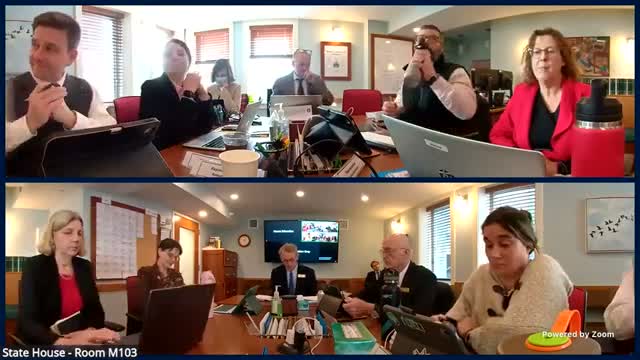
Representative Charlie Kimball introduced H750 on Jan. 28, 2026, telling the House Education Committee the bill would remove a key fiscal disincentive that has kept many school construction projects on hold.
"Today, I'm introducing H750," Kimball said, "its purpose is to exclude capital construction costs from the definition of education spending for purposes of calculating excess spending and also to deem as having good cause to commence construction before final approval under the state aid for construction program." He told the committee that including bond principal and interest in the excess spending calculation has led some districts to delay projects to avoid property-tax penalties tied to the excess-spending threshold.
Kimball and counsel described H750 as a two-part measure. The first would expand an existing exclusion so that voter-approved bond payments for capital construction would not be counted in the calculation of excess spending. The second would amend the State Aid for School Construction rules so that any district that begins construction before the state program is operational (the program is expected to take effect 07/01/2026) would be deemed to have "good cause" for commencing construction and therefore would not be penalized under the draft program rules.
Kimball cited local examples intended to illustrate the bill’s impact. He said Mountain View School District previously lost a roughly $99 million bond vote and plans to ask voters again in March for a $111 million bond. He described facility problems — including sewage backups, a heating system installed in 1958 and a building that does not meet current ADA standards — to underscore the urgency for replacement or renovation.
Kimball offered a fiscal example to show how inclusion of bond payments can affect property taxes: he told the committee that, under illustrative assumptions for a $400,000 home, the tax liability could be roughly $4,000 higher if bond payments are counted in excess spending. In a separate set of assumptions he cited a projection of about $15,489 in year 2037 with bond inclusion versus $11,122 without it; Kimball listed the assumptions used for that projection (project cost, stable average daily membership, 3.5% annual budget growth, 3.5% yield growth and 2.5% annual penalty-threshold growth).
A member asked for enrollment and geography details; Kimball said the Woodstock school has about 600 students while the Mountain View district has been about 1,001 students as of the October count used for calculations, and that the district draws students from a broad radius (he estimated up to 40 miles for some students). He also said Mountain View has previously passed an older $4,000,000 bond (pre‑07/01/2024) that was excluded from excess-spending calculations because it predated the current rule.
John Gray, introduced in the transcript as "John Gray, office of pledge that have counsel," walked the committee through the bill’s statutory mechanics. He said the first section would expand the existing exclusion to cover all voter‑approved capital construction bond payments rather than only those approved before 07/01/2024. The second section would add a proviso to the State Aid for School Construction preliminary/final approval language, so districts that begin construction before the program’s effective date would be treated as having "good cause." Gray emphasized the bill takes a targeted approach and does not purport to resolve unanswered questions about a revenue source or final program administration.
Committee members probed timing: several asked whether a district could realistically begin construction in time to meet the bill’s safe-harbor date if the state program is stood up by 07/01/2026. Kimball said he was unsure whether the program could be fully operational by that date, but that the bill would place districts in a better posture to proceed without being penalized.
No formal action or vote on H750 occurred during the hearing; the committee adjourned after the presentation. The bill’s proponents and counsel asked the committee to consider the narrow changes as a way to remove disincentives while the State Aid program and broader funding architecture are still being finalized.
"Today, I'm introducing H750," Kimball said, "its purpose is to exclude capital construction costs from the definition of education spending for purposes of calculating excess spending and also to deem as having good cause to commence construction before final approval under the state aid for construction program." He told the committee that including bond principal and interest in the excess spending calculation has led some districts to delay projects to avoid property-tax penalties tied to the excess-spending threshold.
Kimball and counsel described H750 as a two-part measure. The first would expand an existing exclusion so that voter-approved bond payments for capital construction would not be counted in the calculation of excess spending. The second would amend the State Aid for School Construction rules so that any district that begins construction before the state program is operational (the program is expected to take effect 07/01/2026) would be deemed to have "good cause" for commencing construction and therefore would not be penalized under the draft program rules.
Kimball cited local examples intended to illustrate the bill’s impact. He said Mountain View School District previously lost a roughly $99 million bond vote and plans to ask voters again in March for a $111 million bond. He described facility problems — including sewage backups, a heating system installed in 1958 and a building that does not meet current ADA standards — to underscore the urgency for replacement or renovation.
Kimball offered a fiscal example to show how inclusion of bond payments can affect property taxes: he told the committee that, under illustrative assumptions for a $400,000 home, the tax liability could be roughly $4,000 higher if bond payments are counted in excess spending. In a separate set of assumptions he cited a projection of about $15,489 in year 2037 with bond inclusion versus $11,122 without it; Kimball listed the assumptions used for that projection (project cost, stable average daily membership, 3.5% annual budget growth, 3.5% yield growth and 2.5% annual penalty-threshold growth).
A member asked for enrollment and geography details; Kimball said the Woodstock school has about 600 students while the Mountain View district has been about 1,001 students as of the October count used for calculations, and that the district draws students from a broad radius (he estimated up to 40 miles for some students). He also said Mountain View has previously passed an older $4,000,000 bond (pre‑07/01/2024) that was excluded from excess-spending calculations because it predated the current rule.
John Gray, introduced in the transcript as "John Gray, office of pledge that have counsel," walked the committee through the bill’s statutory mechanics. He said the first section would expand the existing exclusion to cover all voter‑approved capital construction bond payments rather than only those approved before 07/01/2024. The second section would add a proviso to the State Aid for School Construction preliminary/final approval language, so districts that begin construction before the program’s effective date would be treated as having "good cause." Gray emphasized the bill takes a targeted approach and does not purport to resolve unanswered questions about a revenue source or final program administration.
Committee members probed timing: several asked whether a district could realistically begin construction in time to meet the bill’s safe-harbor date if the state program is stood up by 07/01/2026. Kimball said he was unsure whether the program could be fully operational by that date, but that the bill would place districts in a better posture to proceed without being penalized.
No formal action or vote on H750 occurred during the hearing; the committee adjourned after the presentation. The bill’s proponents and counsel asked the committee to consider the narrow changes as a way to remove disincentives while the State Aid program and broader funding architecture are still being finalized.
View the Full Meeting & All Its Details
This article offers just a summary. Unlock complete video, transcripts, and insights as a Founder Member.
✓
Watch full, unedited meeting videos
✓
Search every word spoken in unlimited transcripts
✓
AI summaries & real-time alerts (all government levels)
✓
Permanent access to expanding government content
30-day money-back guarantee
