Fayetteville updates Pick Me Up cleanup program, expands hazardous-waste drop-off staffing
January 26, 2026 | Fayetteville City, Washington County, Arkansas
This article was created by AI summarizing key points discussed. AI makes mistakes, so for full details and context, please refer to the video of the full meeting. Please report any errors so we can fix them. Report an error »
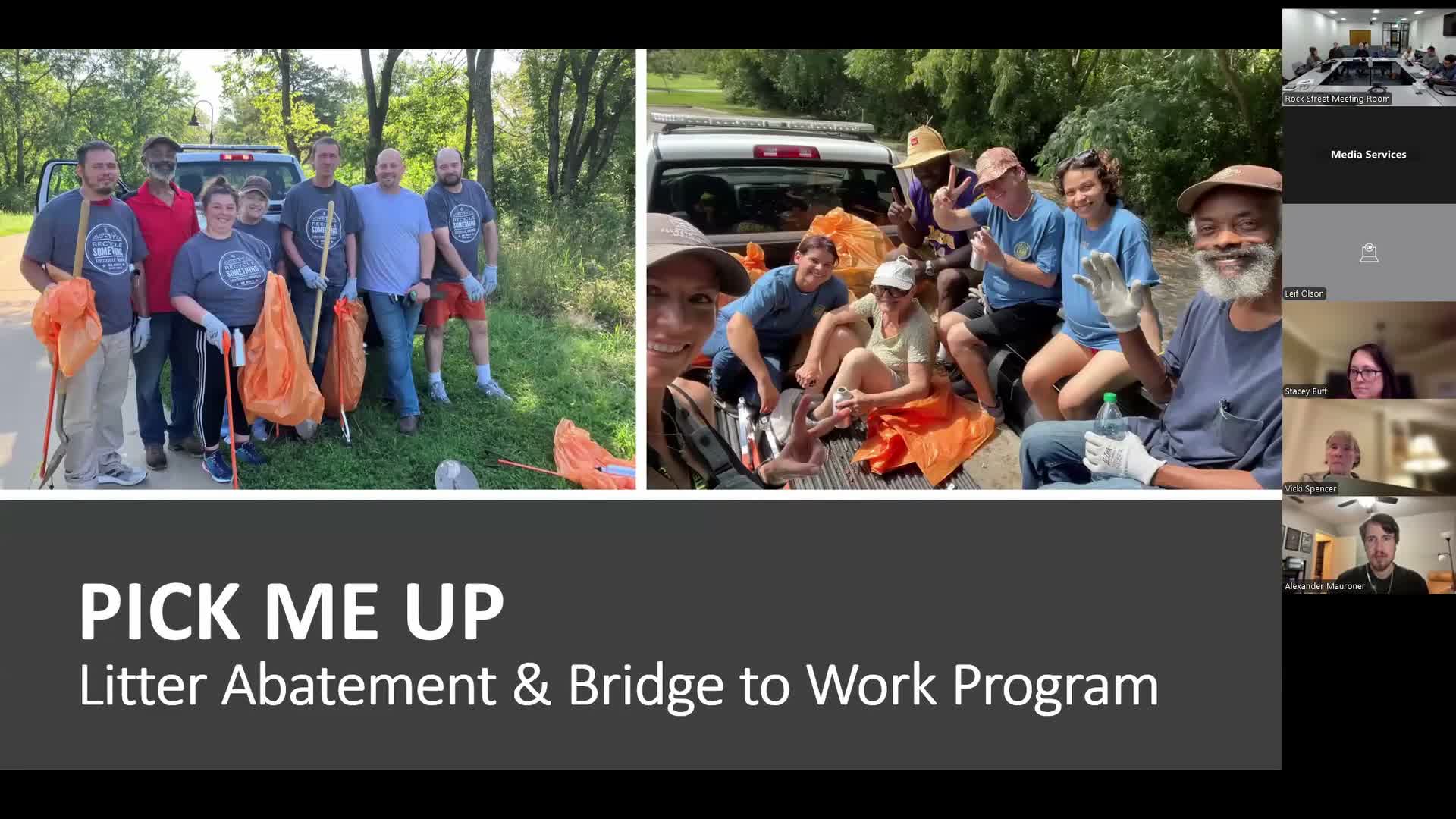
Heather Els, environmental educator for the city of Fayetteville, updated the Environmental Action Committee on the Pick Me Up litter-removal program and related partnerships.
Els said the effort began as a 2022 pilot that “cleared out over 66,000 pounds of litter in 4 months.” After a 2023 presentation to city council, the program received full funding and expanded. In 2023 the crew collected about 140,000 pounds; in 2024 it collected about 130,000 pounds and won the mayor’s stewardship award. Els said 2025’s budget extension doubled the crew to 10 members and moved the program to month-long cohorts to improve continuity and connections to social services.
Els described participant supports tied to the month-long model: regular check-ins, meals and access to clothing and casework through Genesis Church partnerships, and on-site connections to services that helped some participants obtain housing or disability benefits. She said program pay is roughly $12.50 per hour, which she summarized as “about $150” for a three-day, four-hour-per-day week and about $600 for a month-long assignment.
Committee members pressed staff on operations and funding. Peter Niergarten, environmental director for the city, said funding for the program is “in the budget that was approved by council last month for 2026,” and added he will bring the contract to city council at its first meeting in January. He also noted a larger external grant the city had pursued — “the grant we submitted was for 20,000,000” — was not secured.
Els described partnerships that support program operations: Genesis Church and its coordinator Josh Park for program staffing and meals; Boston Mountain for the hazardous-waste trailer; Free Geek and EcoTech for e‑waste and recycling projects; and the Fayetteville Police Department, which contributed a vehicle that made operations easier.
On hazardous-waste operations, Els said the Boston Mountain trailer will be staffed by Pick Me Up members on Wednesdays and Thursdays, 9:00 a.m.–12:30 p.m., allowing residents to drop off household hazardous waste at that site. She described other outreach activities — waterway cleanups, event recycling, and targeted apartment-area engagement around student move-in/move-out — and invited committee members to an end-of-year lunch at Genesis Church.
The presentation generated operational suggestions from committee members, including adding directional signage and trailway outreach to inform unhoused residents of available services, coordinating with property managers and the university around student move-in days to reduce cardboard and reuseables, and pursuing additional grant or state funding to supplement local budgets.
The committee had no formal motion on the item. The next procedural step for program administration is staff’s contract submission to City Council in January.
Els said the effort began as a 2022 pilot that “cleared out over 66,000 pounds of litter in 4 months.” After a 2023 presentation to city council, the program received full funding and expanded. In 2023 the crew collected about 140,000 pounds; in 2024 it collected about 130,000 pounds and won the mayor’s stewardship award. Els said 2025’s budget extension doubled the crew to 10 members and moved the program to month-long cohorts to improve continuity and connections to social services.
Els described participant supports tied to the month-long model: regular check-ins, meals and access to clothing and casework through Genesis Church partnerships, and on-site connections to services that helped some participants obtain housing or disability benefits. She said program pay is roughly $12.50 per hour, which she summarized as “about $150” for a three-day, four-hour-per-day week and about $600 for a month-long assignment.
Committee members pressed staff on operations and funding. Peter Niergarten, environmental director for the city, said funding for the program is “in the budget that was approved by council last month for 2026,” and added he will bring the contract to city council at its first meeting in January. He also noted a larger external grant the city had pursued — “the grant we submitted was for 20,000,000” — was not secured.
Els described partnerships that support program operations: Genesis Church and its coordinator Josh Park for program staffing and meals; Boston Mountain for the hazardous-waste trailer; Free Geek and EcoTech for e‑waste and recycling projects; and the Fayetteville Police Department, which contributed a vehicle that made operations easier.
On hazardous-waste operations, Els said the Boston Mountain trailer will be staffed by Pick Me Up members on Wednesdays and Thursdays, 9:00 a.m.–12:30 p.m., allowing residents to drop off household hazardous waste at that site. She described other outreach activities — waterway cleanups, event recycling, and targeted apartment-area engagement around student move-in/move-out — and invited committee members to an end-of-year lunch at Genesis Church.
The presentation generated operational suggestions from committee members, including adding directional signage and trailway outreach to inform unhoused residents of available services, coordinating with property managers and the university around student move-in days to reduce cardboard and reuseables, and pursuing additional grant or state funding to supplement local budgets.
The committee had no formal motion on the item. The next procedural step for program administration is staff’s contract submission to City Council in January.
View the Full Meeting & All Its Details
This article offers just a summary. Unlock complete video, transcripts, and insights as a Founder Member.
✓
Watch full, unedited meeting videos
✓
Search every word spoken in unlimited transcripts
✓
AI summaries & real-time alerts (all government levels)
✓
Permanent access to expanding government content
30-day money-back guarantee
