Fayetteville EAC debates integrating climate-resilience map into planning packets
January 26, 2026 | Fayetteville City, Washington County, Arkansas
This article was created by AI summarizing key points discussed. AI makes mistakes, so for full details and context, please refer to the video of the full meeting. Please report any errors so we can fix them. Report an error »
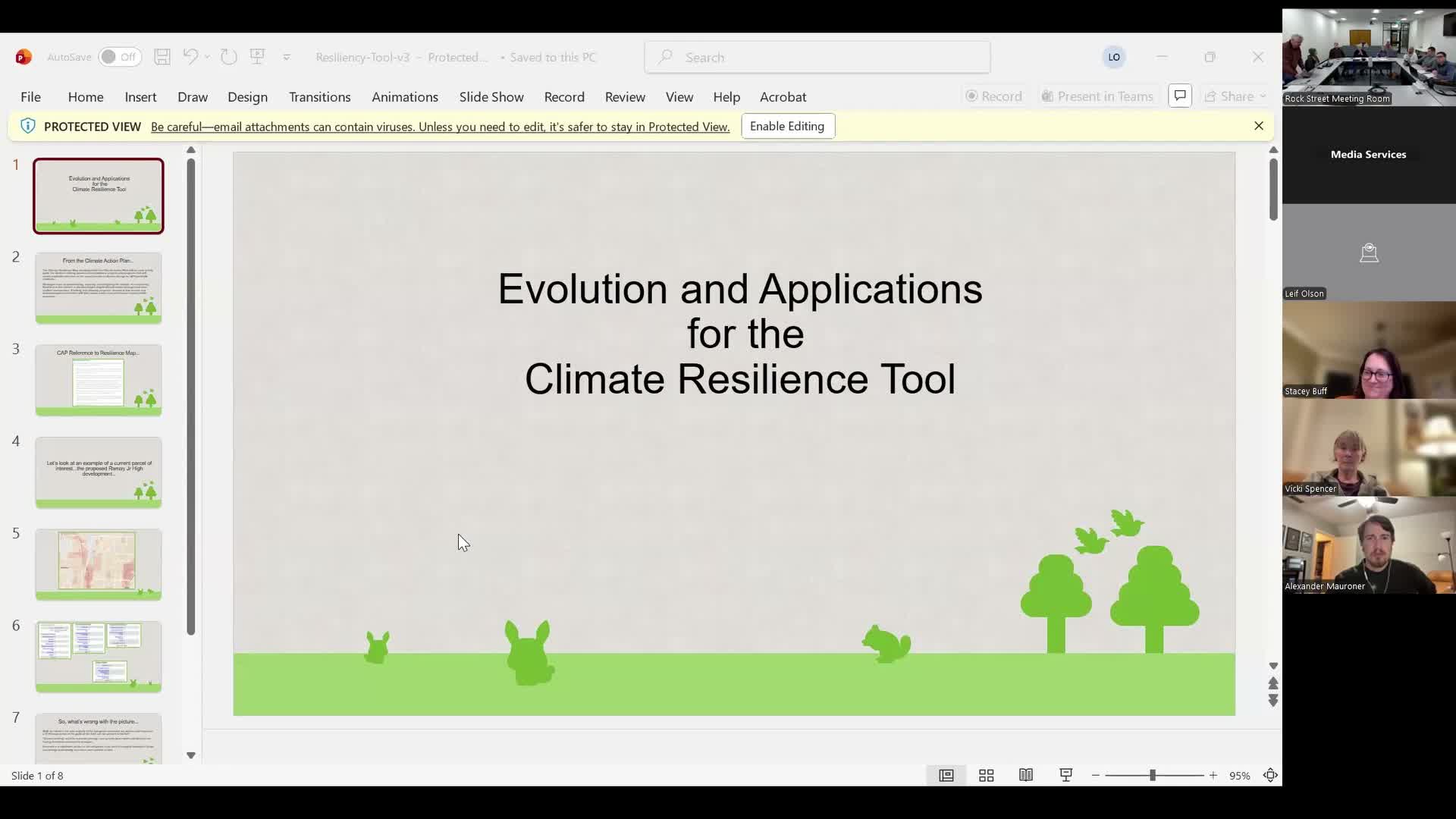
The Fayetteville Environmental Action Committee spent the second half of its December meeting reviewing the climate-resilience mapping tool developed as part of the city’s Climate Action Plan and debating how — and whether — to incorporate its output into planning and rezoning review.
Chair Jeff introduced the resilience map as “a tool that was kind of co-developed with the climate action plan,” and staff explained the index produces composite parcel scores from datasets representing ecosystem services, resilience and carbon sequestration, with a separately reported climate-equity metric. Lee Folsom and other staff emphasized multiple times that the map is intended as a desktop screening tool, not a stand-alone arbiter of zoning: “it’s really never intended to be used to determine the zoning or rezoning of the land,” Jeff said.
Committee members raised several technical and process concerns after staff demonstrated the tool using the Ramey Junior High parcel. The committee noted that the map’s desktop datasets can miss on-the-ground features — slope, recent disturbances, or stream proximity — so a parcel can score lower than members expect. Margaret Britton and others urged stronger documentation and more context in planning packets: they said a one-page explainer, percentile context, and a clear note that ground-truthing is required would reduce misinterpretation by council members, developers or the public.
Several members argued the resilience score should be provided in Planning Commission packets alongside the infill score as contextual information. Staff and some planning-aligned committee members cautioned that planning staff and some council members have expressed reservations: the resilience map was developed by environmental staff and committee contributors rather than planners, and it was not designed or validated as a rezoning decision tool. Peter Niergarten and Lee Folsom said the technical manual and data sources are available on the Climate Action Plan site and that the most defensible near-term use is as a screening or acquisition aid for land trusts or internal planning priorities.
On next steps the committee proposed practical measures rather than immediate policy change: compile a one-page FAQ that explains the tool’s datasets and limitations; include the resilience map in Planning Commission packets as contextual material (not as a binding metric); recommend ground-truthing protocols when a parcel’s desktop result appears inconsistent with field observations; and treat adjustments to weighting or score presentation as items to feed into the City Plan 2050 process.
The committee did not adopt a formal recommendation at the meeting but agreed to make the resilience tool and its documentation a 2026 EAC work priority, with members volunteering to observe planning hearings and draft explanatory materials for staff review.
Chair Jeff introduced the resilience map as “a tool that was kind of co-developed with the climate action plan,” and staff explained the index produces composite parcel scores from datasets representing ecosystem services, resilience and carbon sequestration, with a separately reported climate-equity metric. Lee Folsom and other staff emphasized multiple times that the map is intended as a desktop screening tool, not a stand-alone arbiter of zoning: “it’s really never intended to be used to determine the zoning or rezoning of the land,” Jeff said.
Committee members raised several technical and process concerns after staff demonstrated the tool using the Ramey Junior High parcel. The committee noted that the map’s desktop datasets can miss on-the-ground features — slope, recent disturbances, or stream proximity — so a parcel can score lower than members expect. Margaret Britton and others urged stronger documentation and more context in planning packets: they said a one-page explainer, percentile context, and a clear note that ground-truthing is required would reduce misinterpretation by council members, developers or the public.
Several members argued the resilience score should be provided in Planning Commission packets alongside the infill score as contextual information. Staff and some planning-aligned committee members cautioned that planning staff and some council members have expressed reservations: the resilience map was developed by environmental staff and committee contributors rather than planners, and it was not designed or validated as a rezoning decision tool. Peter Niergarten and Lee Folsom said the technical manual and data sources are available on the Climate Action Plan site and that the most defensible near-term use is as a screening or acquisition aid for land trusts or internal planning priorities.
On next steps the committee proposed practical measures rather than immediate policy change: compile a one-page FAQ that explains the tool’s datasets and limitations; include the resilience map in Planning Commission packets as contextual material (not as a binding metric); recommend ground-truthing protocols when a parcel’s desktop result appears inconsistent with field observations; and treat adjustments to weighting or score presentation as items to feed into the City Plan 2050 process.
The committee did not adopt a formal recommendation at the meeting but agreed to make the resilience tool and its documentation a 2026 EAC work priority, with members volunteering to observe planning hearings and draft explanatory materials for staff review.
View the Full Meeting & All Its Details
This article offers just a summary. Unlock complete video, transcripts, and insights as a Founder Member.
✓
Watch full, unedited meeting videos
✓
Search every word spoken in unlimited transcripts
✓
AI summaries & real-time alerts (all government levels)
✓
Permanent access to expanding government content
30-day money-back guarantee
