Absentee board reviews procedures, approves 11 absentee ballots in Buncombe County
January 29, 2026 | Buncombe County, North Carolina
This article was created by AI summarizing key points discussed. AI makes mistakes, so for full details and context, please refer to the video of the full meeting. Please report any errors so we can fix them. Report an error »
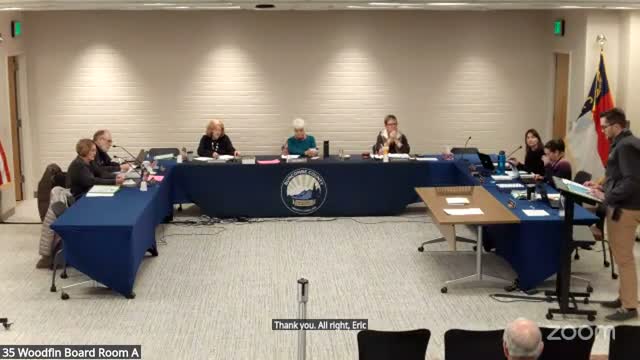
Buncombe County’s absentee board on Jan. 28 approved 11 absentee ballots and received a step‑by‑step briefing on ballot review procedures, duplication for UOCAVA packets, and scanning contingencies ahead of the March primary.
Aaron Bell, the county’s new absentee coordinator, walked the board through the review materials in the green binder, including the absentee ballot review checklist, the UOCAVA checklist, state flowcharts, and common ID guidance. "First, if you see CIV, that stands for civilian," Bell said, and he explained the MIL (military) and OVR (overseas) designations used to sort packets. Bell told the board the team had 11 ballots ready for final approval at this meeting: eight civilian and three overseas.
Bell described the review steps: confirm the voter name on the ballot envelope matches the provided list, check that the envelope is untampered, verify voter and witness or notary signatures, and confirm any photo ID or exception form in the packet. "If everything looks good and you approve it, you'll have a label up at the top here that one of the board members or both can initial," he said, describing the sign-off and reporting protocol.
For UOCAVA ballots submitted electronically, Bell said staff print the submission and use a bipartisan duplication team to create a paper ballot for review and scanning; the board reviews the affirmation, privacy waiver and ID forms and then signs the packet affirmation if approved.
On equipment, staff reported persistent problems with the ES&S 950 scanner and said the office will use DS200 machines where needed, acknowledging that DS200s require manual feeding and that scanning errors may force rescans. A board member criticized equipment reliability, saying they had paid for ES&S hardware that was not performing as expected.
Board members also asked about ID accommodations for voters 65 and older; staff confirmed a 65-and-over provision remains and said they would locate and circulate the exact memo or citation in their materials. After reviewing the packets and following the checklist, a motion to approve the 11 absentee ballots carried by voice vote.
Bell said that, to date, 667 absentee ballots had been issued this cycle (615 civilian, 51 overseas, 1 military) and compared that pace to the 2022 primary when 2,501 ballots were issued and 1,608 were returned and accepted. He noted there were no pending ballots or pending cures for this meeting and that the office would bring polybag labels for board signatures once scanning is complete.
The board scheduled its next meeting for Feb. 3 and adjourned after the procedural items were complete.
Aaron Bell, the county’s new absentee coordinator, walked the board through the review materials in the green binder, including the absentee ballot review checklist, the UOCAVA checklist, state flowcharts, and common ID guidance. "First, if you see CIV, that stands for civilian," Bell said, and he explained the MIL (military) and OVR (overseas) designations used to sort packets. Bell told the board the team had 11 ballots ready for final approval at this meeting: eight civilian and three overseas.
Bell described the review steps: confirm the voter name on the ballot envelope matches the provided list, check that the envelope is untampered, verify voter and witness or notary signatures, and confirm any photo ID or exception form in the packet. "If everything looks good and you approve it, you'll have a label up at the top here that one of the board members or both can initial," he said, describing the sign-off and reporting protocol.
For UOCAVA ballots submitted electronically, Bell said staff print the submission and use a bipartisan duplication team to create a paper ballot for review and scanning; the board reviews the affirmation, privacy waiver and ID forms and then signs the packet affirmation if approved.
On equipment, staff reported persistent problems with the ES&S 950 scanner and said the office will use DS200 machines where needed, acknowledging that DS200s require manual feeding and that scanning errors may force rescans. A board member criticized equipment reliability, saying they had paid for ES&S hardware that was not performing as expected.
Board members also asked about ID accommodations for voters 65 and older; staff confirmed a 65-and-over provision remains and said they would locate and circulate the exact memo or citation in their materials. After reviewing the packets and following the checklist, a motion to approve the 11 absentee ballots carried by voice vote.
Bell said that, to date, 667 absentee ballots had been issued this cycle (615 civilian, 51 overseas, 1 military) and compared that pace to the 2022 primary when 2,501 ballots were issued and 1,608 were returned and accepted. He noted there were no pending ballots or pending cures for this meeting and that the office would bring polybag labels for board signatures once scanning is complete.
The board scheduled its next meeting for Feb. 3 and adjourned after the procedural items were complete.
View the Full Meeting & All Its Details
This article offers just a summary. Unlock complete video, transcripts, and insights as a Founder Member.
✓
Watch full, unedited meeting videos
✓
Search every word spoken in unlimited transcripts
✓
AI summaries & real-time alerts (all government levels)
✓
Permanent access to expanding government content
30-day money-back guarantee
