Hawaii DOH explains VFC vaccine ordering, shipment-tracking and receiving rules in webinar
October 30, 2024 | Kalawao County, Hawaii
This article was created by AI summarizing key points discussed. AI makes mistakes, so for full details and context, please refer to the video of the full meeting. Please report any errors so we can fix them. Report an error »
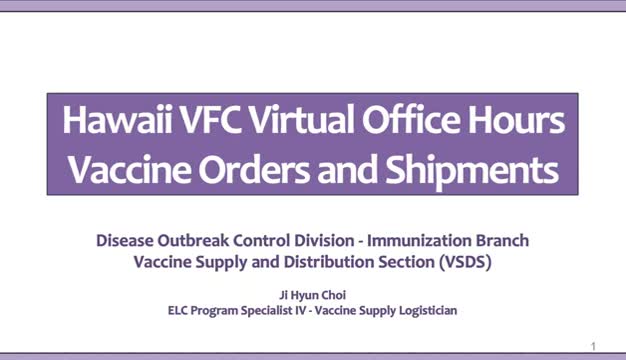
Ji Hyun Choi, vaccine supply logistician for the Immunization Branch of the Hawaii Department of Health, walked providers through the state’s process for ordering and receiving Vaccines for Children (VFC) supplies during a virtual office-hours session on Oct. 29, 2024.
Choi said the state acts as the ordering point between enrolled clinics, the Centers for Disease Control and Prevention and manufacturers. "Before we process any of your orders, we first and form foremost check that temperature logs of all storage units are showing the units are within range, so 2 to 8 degrees Celsius for fridge and, up to negative 15 degrees Celsius for freezer," she said, summarizing the Department’s verification steps before approving orders.
The presentation explained two primary ordering paths. Providers should submit routine product requests through the Hawaii Immunization Registry (HIR) after entering a required record inventory — a snapshot of doses on hand and doses administered that the CDC system uses to approve orders. For allocated or limited products (examples cited: COVID‑19 vaccines, influenza, RSV Nirmenab, birthing‑hospital Hep B), providers use vaccine order forms submitted by email or fax; these allocations are monitored more closely and may be issued on a rolling basis.
Choi outlined the order-status lifecycle in HIR: orders show as "pending" after submission, move to "in progress" while DOH staff process them, change to "sent to CDC" when forwarded to the distributor or manufacturer, become "fulfilled" once shipped/in transit, and finally switch to "accepted" after providers accept inbound transfers. She recommended waiting to accept inbound transfers until a clinic actually receives a shipment so staff can verify lot numbers and expiration dates, but noted accepting inbound transfers is required to place additional orders.
On shipment logistics, Choi named the principal distributors: McKesson (refrigerated VFC vaccines and frozen Moderna), Merck (varicella-containing products such as Varivax and ProQuad) and Pfizer (refrigerated products for older age groups and ultra-low-temperature pediatric shipments). She said temperature stability allowances are tied to transit time; for example, Varivax shipments of 40 doses or fewer are typically packed for a two‑day transit (longer if scheduled over a weekend) while larger Varivax shipments are packed for a four‑day transit; ProQuad currently ships with a one‑day transit profile. Choi added that Pfizer’s packing slip or insert lists the date tied to stability allowances.
Providers were urged to monitor automated shipment emails and tracking information so staff are present to receive deliveries and to notify the department immediately if a shipment is delayed or returned to sender. "Never refuse a vaccine shipment, open immediately upon delivery, check the temperature monitoring device or strips or the shipment transit time, and inspect the packaging and the number of doses received," Choi said, instructing providers to photograph damage, separate suspected vaccine from usable stock, label it "do not use," and retain packaging and temperature monitors until DOH and the manufacturer resolve the issue.
Choi also addressed how to distinguish VFC Pfizer shipments from commercial ones: look at the packing slip for a customer purchase order that begins with a 4 and a "Sold To" address listing "CC/FMO vaccines" with the Atlanta address.
The department will post the slide deck and a detailed VFC vaccine orders and delivery guide on the Hawaii VFC website. The session concluded with a QA period and a post‑webinar satisfaction survey link provided in chat. For follow‑up, Choi directed providers to the VFC program contact emails and phone numbers that were shared during the webinar.
The Department of Health did not present or vote on any policy changes during the session; the webinar functioned as training and guidance for providers.
Choi said the state acts as the ordering point between enrolled clinics, the Centers for Disease Control and Prevention and manufacturers. "Before we process any of your orders, we first and form foremost check that temperature logs of all storage units are showing the units are within range, so 2 to 8 degrees Celsius for fridge and, up to negative 15 degrees Celsius for freezer," she said, summarizing the Department’s verification steps before approving orders.
The presentation explained two primary ordering paths. Providers should submit routine product requests through the Hawaii Immunization Registry (HIR) after entering a required record inventory — a snapshot of doses on hand and doses administered that the CDC system uses to approve orders. For allocated or limited products (examples cited: COVID‑19 vaccines, influenza, RSV Nirmenab, birthing‑hospital Hep B), providers use vaccine order forms submitted by email or fax; these allocations are monitored more closely and may be issued on a rolling basis.
Choi outlined the order-status lifecycle in HIR: orders show as "pending" after submission, move to "in progress" while DOH staff process them, change to "sent to CDC" when forwarded to the distributor or manufacturer, become "fulfilled" once shipped/in transit, and finally switch to "accepted" after providers accept inbound transfers. She recommended waiting to accept inbound transfers until a clinic actually receives a shipment so staff can verify lot numbers and expiration dates, but noted accepting inbound transfers is required to place additional orders.
On shipment logistics, Choi named the principal distributors: McKesson (refrigerated VFC vaccines and frozen Moderna), Merck (varicella-containing products such as Varivax and ProQuad) and Pfizer (refrigerated products for older age groups and ultra-low-temperature pediatric shipments). She said temperature stability allowances are tied to transit time; for example, Varivax shipments of 40 doses or fewer are typically packed for a two‑day transit (longer if scheduled over a weekend) while larger Varivax shipments are packed for a four‑day transit; ProQuad currently ships with a one‑day transit profile. Choi added that Pfizer’s packing slip or insert lists the date tied to stability allowances.
Providers were urged to monitor automated shipment emails and tracking information so staff are present to receive deliveries and to notify the department immediately if a shipment is delayed or returned to sender. "Never refuse a vaccine shipment, open immediately upon delivery, check the temperature monitoring device or strips or the shipment transit time, and inspect the packaging and the number of doses received," Choi said, instructing providers to photograph damage, separate suspected vaccine from usable stock, label it "do not use," and retain packaging and temperature monitors until DOH and the manufacturer resolve the issue.
Choi also addressed how to distinguish VFC Pfizer shipments from commercial ones: look at the packing slip for a customer purchase order that begins with a 4 and a "Sold To" address listing "CC/FMO vaccines" with the Atlanta address.
The department will post the slide deck and a detailed VFC vaccine orders and delivery guide on the Hawaii VFC website. The session concluded with a QA period and a post‑webinar satisfaction survey link provided in chat. For follow‑up, Choi directed providers to the VFC program contact emails and phone numbers that were shared during the webinar.
The Department of Health did not present or vote on any policy changes during the session; the webinar functioned as training and guidance for providers.
View the Full Meeting & All Its Details
This article offers just a summary. Unlock complete video, transcripts, and insights as a Founder Member.
✓
Watch full, unedited meeting videos
✓
Search every word spoken in unlimited transcripts
✓
AI summaries & real-time alerts (all government levels)
✓
Permanent access to expanding government content
30-day money-back guarantee
