Maine hearing draws hundreds urging law to require judicial warrant for federal immigration enforcement at schools, hospitals and libraries
January 30, 2026 | 2026 Legislature ME, Maine
This article was created by AI summarizing key points discussed. AI makes mistakes, so for full details and context, please refer to the video of the full meeting. Please report any errors so we can fix them. Report an error »
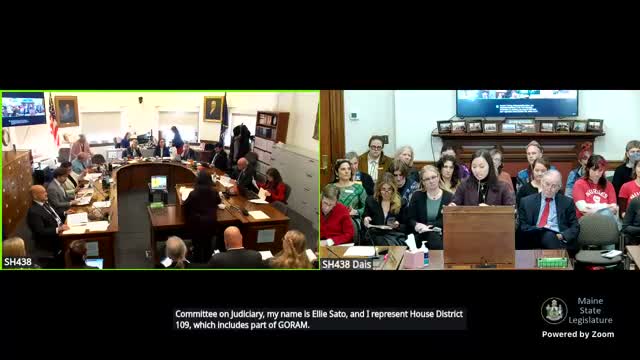
Representative Ellie Sato presented LD 2106, a bill to require a valid judicial warrant signed by a judge before immigration officers may enter nonpublic areas of specified sensitive locations — public schools, health-care facilities, child-care centers and libraries — and to prohibit voluntary consent by staff that would permit such entry. "This legislation only restricts voluntary consent for entry in the absence of a valid judicial warrant signed by a judge," Sato told the committee, framing the measure as a state-level restoration of the prior DHS "sensitive locations" guidance that lapsed in January 2025.
Why supporters want the law: Dozens of speakers — nurses, teachers, child-care providers, library directors, municipal officials and immigrant-rights organizations — told the committee that recent immigration enforcement activity in Maine has caused widespread fear. Witnesses cited school absenteeism in Portland (more than 1,000 absences reported in one district day), canceled medical appointments, and staffing shortages in health care and child care; speakers said those trends posed public-health and public-safety risks.
What supporters asked for: Many speakers urged clarifications and expansions: add courthouses and places of worship to the protected list; explicitly include community health centers, behavioral-health clinics and home- and community-based service providers; and direct the attorney general to publish model policies and training for affected institutions.
Legal and procedural questions: Committee members pressed sponsors and legal advocates on which judicial warrants would qualify (federal district court warrants were discussed), whether state courts or federal courts could issue them, how exigent-circumstance exceptions (hot pursuit, medical emergencies) would operate, and whether the bill could bind private entities or conflict with federal supremacy. Advocates urged the AG92s office and legal experts to provide samples and suggested enforcement mechanisms to include in legislated guidance.
Next steps: Sponsors and advocates agreed to bring legal samples, model policies and statutory language to a work session so the committee can refine warrant definitions, exemptions for emergencies and the scope of covered entities.
Why supporters want the law: Dozens of speakers — nurses, teachers, child-care providers, library directors, municipal officials and immigrant-rights organizations — told the committee that recent immigration enforcement activity in Maine has caused widespread fear. Witnesses cited school absenteeism in Portland (more than 1,000 absences reported in one district day), canceled medical appointments, and staffing shortages in health care and child care; speakers said those trends posed public-health and public-safety risks.
What supporters asked for: Many speakers urged clarifications and expansions: add courthouses and places of worship to the protected list; explicitly include community health centers, behavioral-health clinics and home- and community-based service providers; and direct the attorney general to publish model policies and training for affected institutions.
Legal and procedural questions: Committee members pressed sponsors and legal advocates on which judicial warrants would qualify (federal district court warrants were discussed), whether state courts or federal courts could issue them, how exigent-circumstance exceptions (hot pursuit, medical emergencies) would operate, and whether the bill could bind private entities or conflict with federal supremacy. Advocates urged the AG92s office and legal experts to provide samples and suggested enforcement mechanisms to include in legislated guidance.
Next steps: Sponsors and advocates agreed to bring legal samples, model policies and statutory language to a work session so the committee can refine warrant definitions, exemptions for emergencies and the scope of covered entities.
Don't Miss a Word: See the Full Meeting!
Go beyond summaries. Unlock every video, transcript, and key insight with a Founder Membership.
✓
Get instant access to full meeting videos
✓
Search and clip any phrase from complete transcripts
✓
Receive AI-powered summaries & custom alerts
✓
Enjoy lifetime, unrestricted access to government data
30-day money-back guarantee
