House bill proposes formula to value telecom use of rights‑of‑way; providers warn of duplication and litigation
January 29, 2026 | Science, Technology and Energy, House of Representatives, Committees , Legislative, New Hampshire
This article was created by AI summarizing key points discussed. AI makes mistakes, so for full details and context, please refer to the video of the full meeting. Please report any errors so we can fix them. Report an error »
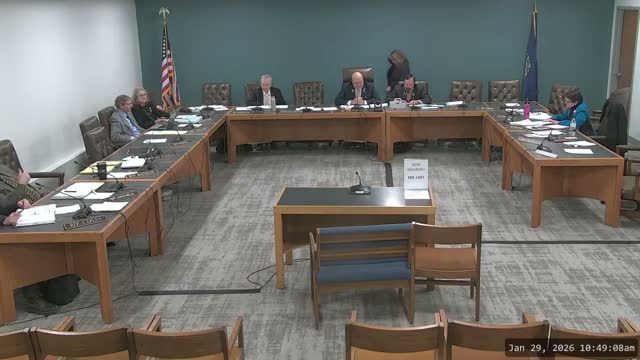
Representative Sean Durkin introduced HB 15‑67 to add a statutory formula for assessing the taxable value of telecommunication companies’ use of public rights‑of‑way. The proposal would compute a taxable area by multiplying the length of network on specified road classes by a notional 1‑foot right‑of‑way width and the locality’s average assessed land value (divided by 43,560 to convert square feet to acres).
Jim Wheeler, a civil engineer who drafted the example approach, said the formula would reduce disputes and litigation by making valuation straightforward and local: "Length is well known because it's using miles of road; width that I have implied is a 1 foot width for the right of way occupied by the telecommunications line," he testified. Municipal assessors, including Hudson’s chief assessor Jim Mishaw, supported a standardized method that they said would reduce legal costs and increase predictability for towns.
Telecom industry representatives, including Mara Weston of the New England Connectivity & Telecommunications Association, opposed the bill. They noted that many members negotiate franchise agreements and already pay franchise fees (NECTA cited roughly $12 million paid to municipalities in franchise fees last year) and warned a statutory formula using adjacent‑land value would create a location‑based tax that could be higher when lines run next to high‑value parcels. "Providers in the right of way do not have exclusive use of the right of way...using the value of adjacent land as a proxy for the value of the right of way is flawed," Weston said.
Committee members asked detailed implementation questions — which roads count, how the formula interacts with existing assessments of poles/conduits, and whether statutory language would override franchise agreements. Witnesses said many municipalities do have pole license agreements and settlements often include a clause allowing a future change in law to control outcomes; however, industry argued that embedding a formula in statute could remove local negotiation levers.
What happens next: The public hearing closed after testimony from municipal assessors, industry, and other stakeholders. Committee discussion will need to balance assessors’ desire for uniformity against industry concerns about duplication and possible litigation; the transcript shows the committee did not take a vote on this bill during the Jan. 29 session.
Jim Wheeler, a civil engineer who drafted the example approach, said the formula would reduce disputes and litigation by making valuation straightforward and local: "Length is well known because it's using miles of road; width that I have implied is a 1 foot width for the right of way occupied by the telecommunications line," he testified. Municipal assessors, including Hudson’s chief assessor Jim Mishaw, supported a standardized method that they said would reduce legal costs and increase predictability for towns.
Telecom industry representatives, including Mara Weston of the New England Connectivity & Telecommunications Association, opposed the bill. They noted that many members negotiate franchise agreements and already pay franchise fees (NECTA cited roughly $12 million paid to municipalities in franchise fees last year) and warned a statutory formula using adjacent‑land value would create a location‑based tax that could be higher when lines run next to high‑value parcels. "Providers in the right of way do not have exclusive use of the right of way...using the value of adjacent land as a proxy for the value of the right of way is flawed," Weston said.
Committee members asked detailed implementation questions — which roads count, how the formula interacts with existing assessments of poles/conduits, and whether statutory language would override franchise agreements. Witnesses said many municipalities do have pole license agreements and settlements often include a clause allowing a future change in law to control outcomes; however, industry argued that embedding a formula in statute could remove local negotiation levers.
What happens next: The public hearing closed after testimony from municipal assessors, industry, and other stakeholders. Committee discussion will need to balance assessors’ desire for uniformity against industry concerns about duplication and possible litigation; the transcript shows the committee did not take a vote on this bill during the Jan. 29 session.
View the Full Meeting & All Its Details
This article offers just a summary. Unlock complete video, transcripts, and insights as a Founder Member.
✓
Watch full, unedited meeting videos
✓
Search every word spoken in unlimited transcripts
✓
AI summaries & real-time alerts (all government levels)
✓
Permanent access to expanding government content
30-day money-back guarantee
