House panel hears heated debate over permissive leaf-blower regulation bill
January 30, 2026 | 2026 Legislature VA, Virginia
This article was created by AI summarizing key points discussed. AI makes mistakes, so for full details and context, please refer to the video of the full meeting. Please report any errors so we can fix them. Report an error »
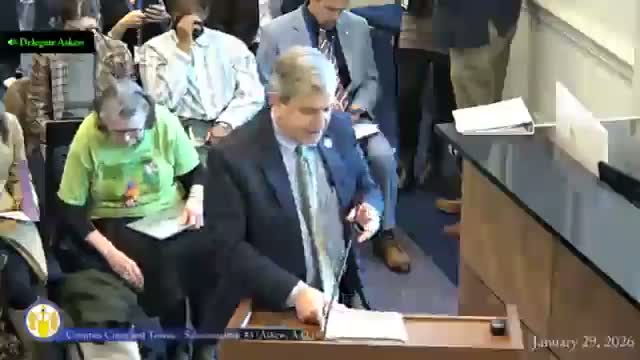
Delegate Paul Sullivan told the subcommittee HB 881 does not ban leaf blowers but gives localities with population density of at least 2,500 people per square mile a permissive tool to regulate gas-powered models, with guardrails including a minimum 12‑month delay before local regulations could take effect and opportunities to phase in changes.
"This bill simply allows localities to regulate, that's a different word than ban," Sullivan said, arguing local governments could tailor time‑of‑day limits, phased transitions or grant programs to help businesses switch to electric equipment.
Supporters described persistent noise and air impacts in dense neighborhoods. Margaret McKelvey of Quiet Clean Northern Virginia said gas blowers produce particulate pollution and disruptive sound in closely built areas and urged the committee to let communities choose local responses. "Cleaner, quieter, and powerful electric blowers are widely available, effective, and affordable," she said.
Opponents warned the bill would impose costs and operational limits on small landscaping firms, farms and golf courses. Caitlin Jordan of the Virginia Farm Bureau said some farm chores require sustained run times and that battery systems currently may need frequent swaps or generators in the field. Rob Bohannon of the Virginia Golf Course Superintendents Association said battery life and power remain insufficient for large properties.
Business groups, including the Virginia Manufacturers Association and the Apartment and Office Building Association, also cautioned that forced equipment replacement would be expensive for small businesses and housing providers and said existing local noise ordinances already provide tools for communities.
Sullivan and several witnesses pointed to improving battery technology and local examples of transition plans. Chris Lane, representing Arlington County, noted county crews are already shifting to electric equipment and said regulation can be targeted to urban areas where the problem is worst.
After extended testimony from supporters and opponents, a motion was made to carry HB 881 over to the 2027 session to continue stakeholder discussions; the voice vote carried. The committee did not take a final recorded vote on the bill at this hearing.
"This bill simply allows localities to regulate, that's a different word than ban," Sullivan said, arguing local governments could tailor time‑of‑day limits, phased transitions or grant programs to help businesses switch to electric equipment.
Supporters described persistent noise and air impacts in dense neighborhoods. Margaret McKelvey of Quiet Clean Northern Virginia said gas blowers produce particulate pollution and disruptive sound in closely built areas and urged the committee to let communities choose local responses. "Cleaner, quieter, and powerful electric blowers are widely available, effective, and affordable," she said.
Opponents warned the bill would impose costs and operational limits on small landscaping firms, farms and golf courses. Caitlin Jordan of the Virginia Farm Bureau said some farm chores require sustained run times and that battery systems currently may need frequent swaps or generators in the field. Rob Bohannon of the Virginia Golf Course Superintendents Association said battery life and power remain insufficient for large properties.
Business groups, including the Virginia Manufacturers Association and the Apartment and Office Building Association, also cautioned that forced equipment replacement would be expensive for small businesses and housing providers and said existing local noise ordinances already provide tools for communities.
Sullivan and several witnesses pointed to improving battery technology and local examples of transition plans. Chris Lane, representing Arlington County, noted county crews are already shifting to electric equipment and said regulation can be targeted to urban areas where the problem is worst.
After extended testimony from supporters and opponents, a motion was made to carry HB 881 over to the 2027 session to continue stakeholder discussions; the voice vote carried. The committee did not take a final recorded vote on the bill at this hearing.
View the Full Meeting & All Its Details
This article offers just a summary. Unlock complete video, transcripts, and insights as a Founder Member.
✓
Watch full, unedited meeting videos
✓
Search every word spoken in unlimited transcripts
✓
AI summaries & real-time alerts (all government levels)
✓
Permanent access to expanding government content
30-day money-back guarantee
